If a longtime friend suddenly becomes a foe, like Brutus to Caesar or Iago to Othello, the brain must update the person’s feelings about the betrayer without altering memories of who that companion is.
The hippocampus may sometimes store both pieces of information, but when it comes to updating feelings, it keeps identity and emotional valence separate, according to a mouse study published today in Science.
“We found the neural mechanisms that underlie emotion toward others,” says study investigator Teruhiro Okuyama, professor at the Institute of Quantitative Biosciences at the University of Tokyo: Memory-storing neurons in the hippocampus remain relatively stable, but the strength of their connections to the basolateral amygdala neurons shift, the study shows.
Okuyama and his colleagues used chemogenetics to induce aggression in previously docile mice and optogenetics to trace how hippocampal circuits change in the animal’s cagemate. They found that they could both “write and erase social memories” by targeting specific neuron populations.
“It’s truly unbelievable how much they did in this paper,” says Robert Malenka, professor of psychiatry and behavioral sciences at Stanford University, who was not involved in the work. “They did a beautiful job of taking three brain areas and defining the connectivity and the cell-type-specific connections that are responsible for the phenomenon they’re studying.”
N
eurons in the hippocampus store social memories and segregate positive and negative ones, previous work shows. But most past work has studied how negative run-ins with unfamiliar animals affect behavior.A mouse that is attacked by an unfamiliar mouse generally becomes more anxious and cautious in all future social interactions, Okuyama says, mimicking something like depressive or anxious states. But when it is attacked by a familiar mouse, it specifically avoids only that mouse, continuing to interact with others.
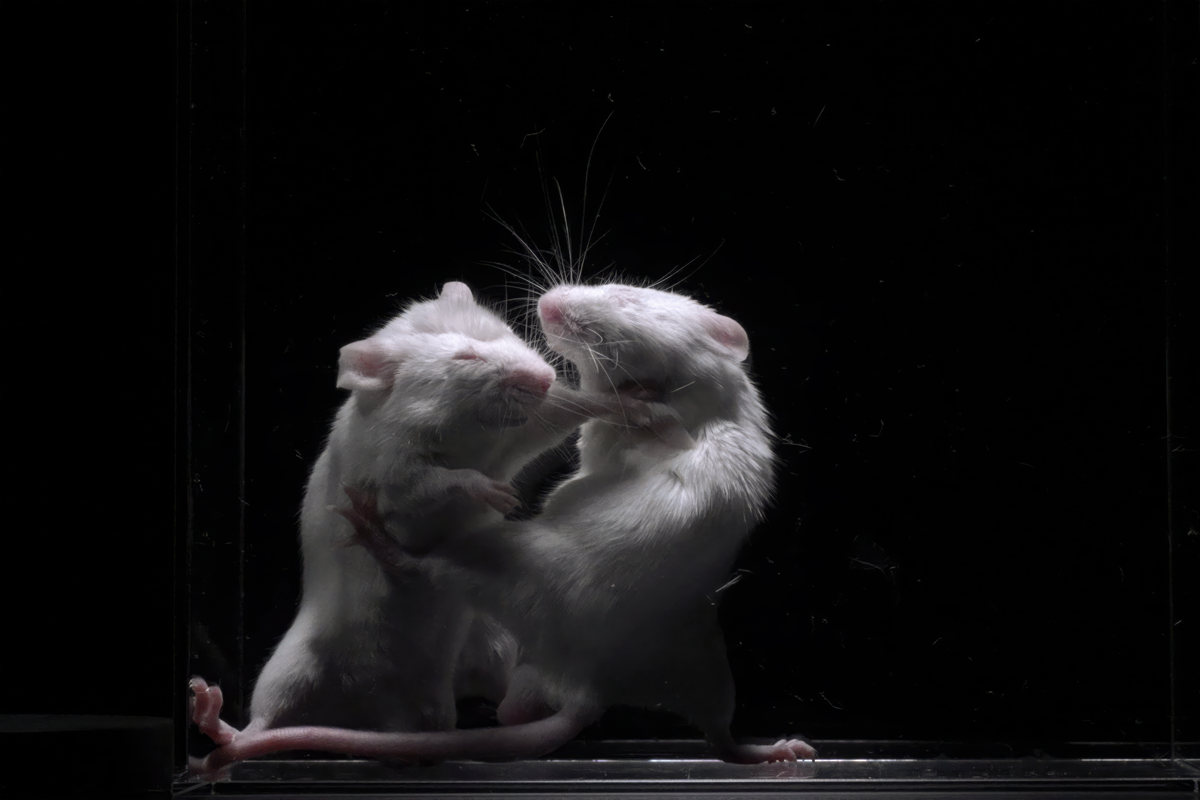
During one experiment in the new work, a mouse visited a cage in which it encountered a familiar and previously friendly mouse that had since been chemogenetically induced to attack the visitor. The latter learned to specifically avoid the newly aggressive mouse but continued to interact normally with familiar and friendly control mice, the study found.
That learning process faltered when the team optogenetically inhibited the visitor’s neuronal projections from the hippocampus to the basolateral amygdala, and from the amygdala to the nucleus accumbens. But silencing the direct hippocampus-to-accumbens pathway, which is tied to recognizing a mouse as familiar, left that avoidance learning intact.
After identifying the specific group of hippocampal neurons that stored the memory of the aggressor, the team erased it by weakening those neurons’ synaptic connections with the amygdala. The result suggests that increased synaptic connectivity between the two brain areas is necessary for mice to update how they feel about other mice. By contrast, pairing a foot shock with optogenetic activation of the memory-storing neurons in a new mouse caused it to avoid its companion, even if that animal had not previously acted aggressively.
P
opulation recordings showed a shift in how the aggressor was represented at each stage of the experiment. Amygdala neurons that respond to a threat fired more strongly to the newly aggressive mouse, but the same number of cells were involved as before. In the nucleus accumbens, by contrast, more D2 receptor-expressing neurons joined in and fired more strongly, and they fired together in tighter synchrony with each other, indicating a more distributed, population-wide coding of emotional valence.“The generalization phenomenon that they describe is consistent and robust,” says Dayu Lin, professor of neuroscience and psychiatry at New York University, who studies social defeat in another circuit and was not involved in the study. But there is another possible explanation for the mice avoiding the aggressor specifically: They also learn that the non-aggressor is safe. “They know this is a safe animal. So it might be the non-aggressor that is important for the specific avoidance to occur.”
The study also gives the field a tractable behavioral paradigm with which to study social memory malleability, says Michael Platt, professor of neuroscience and psychology at the University of Pennsylvania, who was not involved in the work. “It’s amazing that they could just change a mouse’s personality and record how another mouse updates its representation of that individual.” These sorts of manipulations aren’t possible for primate and human studies, he notes.
Still, the investigations are only “the tip of the iceberg in terms of our understanding” of social behavioral circuits, Malenka says. Understanding the downstream projections of the hippocampus-basolateral-amygdala circuit are also critical, he adds. “The change in the valence of the memory doesn’t do the animal any good unless it behaves. What is the circuitry that allows the mouse to take the memory and go toward the friendly mouse?”