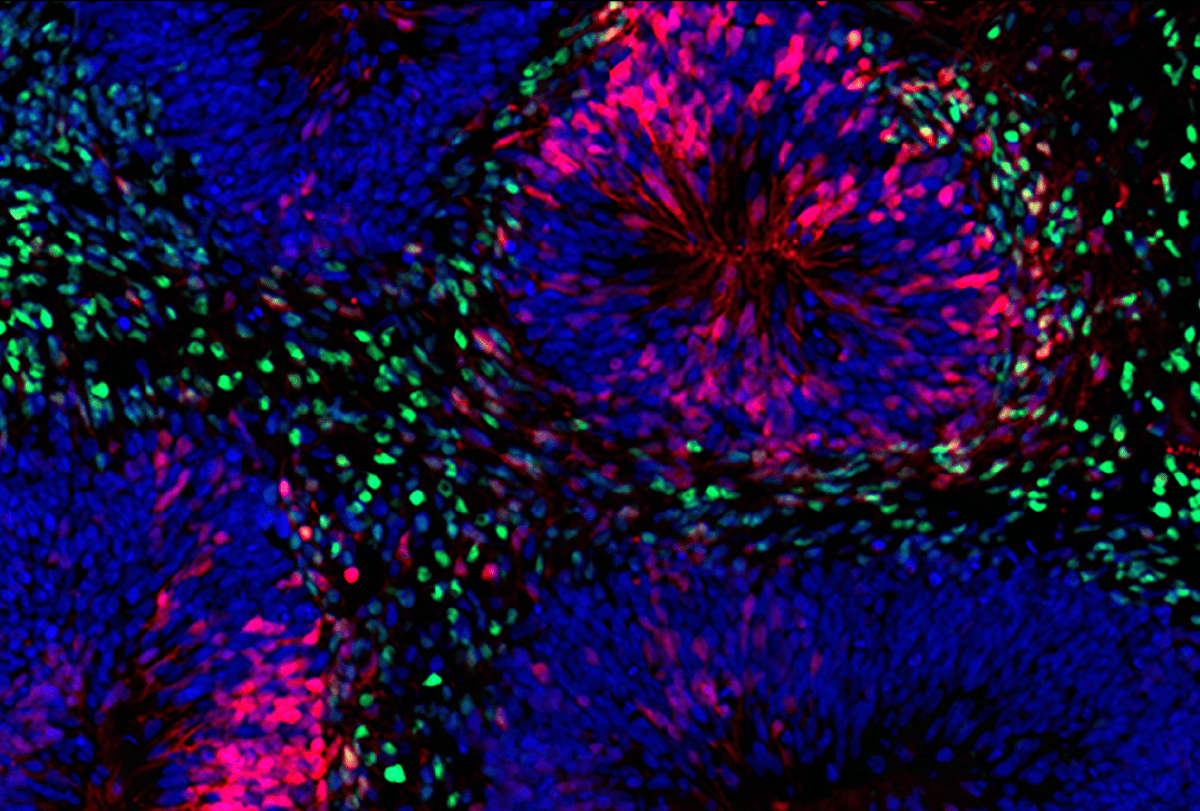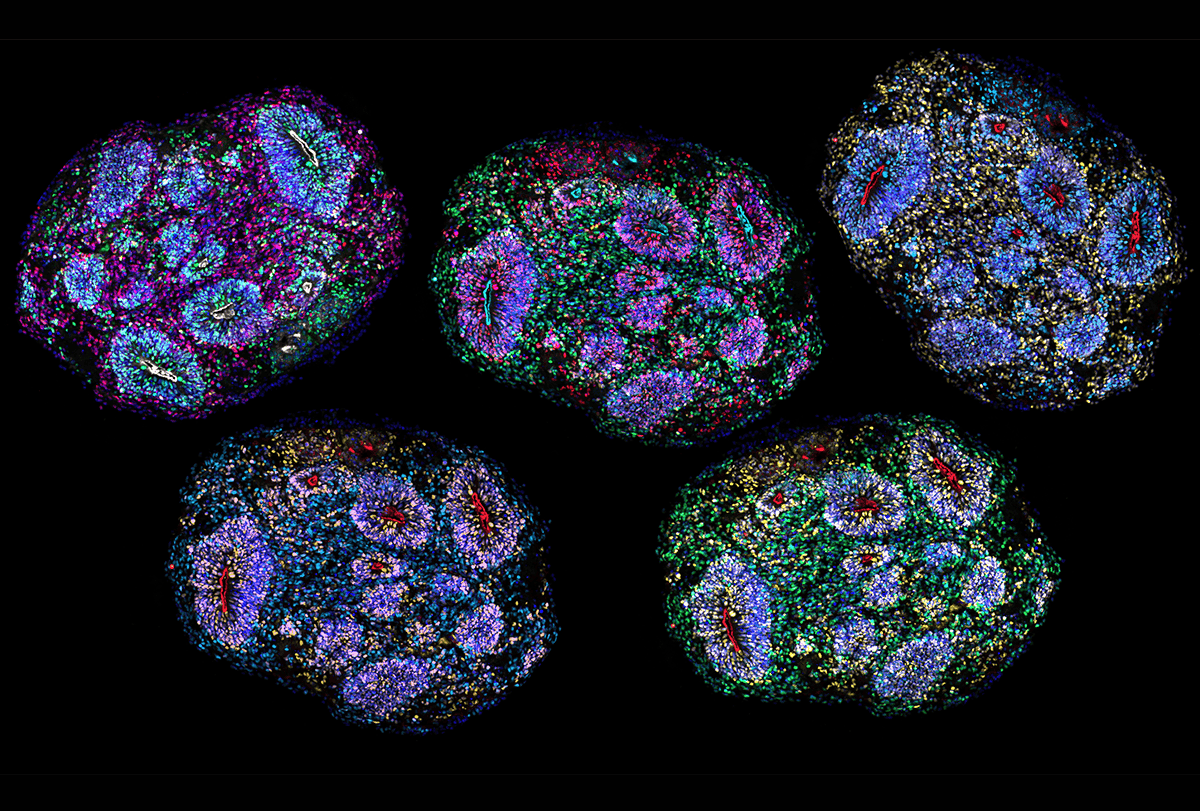
For five years, several small batches of cortical organoids grew in an isolated incubator, away from possible contamination and doted upon by a Harvard University research team. The organoids didn’t merely survive, though—they generated diverse neurons and glia and acquired transcriptional and epigenetic features of postnatal brains, all on a human-like schedule, according to a new study published today in Nature.
Organoids typically model only pre- and perinatal brains and notoriously lack robust electrical activity, says In-Hyun Park, associate professor of neuroscience and genetics at Yale University, who was not involved with the study. The new work provides an avenue to study postnatal stages of development, he says.
However, the long-lived organoids started losing neuronal signals around the one-year mark, which continued as they aged, the team found. “Yes, the organoid was maturing, everything was great, but the neurons were suffering,” says study investigator Paola Arlotta, professor of stem cells and regenerative biology at Harvard.
Modifying the culture medium enabled the team to grow a new set of organoids that had more mature excitatory neurons, greater neuronal complexity and enhanced electrical activity.
“If you want to move forward with more network activity, mature human neurons, you need to adapt your tissue culture,” says Alysson Muotri, professor of pediatrics and cellular and molecular medicine at the University of California, San Diego, who was not involved with the study. “I think it’s an important message.”
Although the study proves that organoids can indeed be cultured for a long time, waiting five years to mature organoids is impractical, Muotri says. “Nobody’s excited to keep [organoids] that long.”
T
he human brain develops more slowly than those of most other species, a feature that also holds true for brain organoids. This slow development, along with the fact that organoid quality falls off after three or four months of growth—equivalent to a second-trimester fetal brain—limits their use, Arlotta says.“We don’t know very much, in terms of understanding experimentally, how the brain develops early postnatally,” Arlotta says. As she and other researchers began to grow organoids for longer, the question eventually became whether these organoids could survive in culture for longer and track the passage of time appropriately to mimic these later stages of development, she adds. “Is it even possible to reach those stages [in an organoid]?”
Five years later, Arlotta had an answer: Cortical organoids in culture could survive for a long time. And they aged on a human-like schedule, acquiring DNA methylation and transcriptional profiles similar to those of postnatal brains, the study shows. In fact, epigenetic clocks based on tissue samples from developing human cortices reliably predict an organoid’s age, showing that these cells can keep time in a fashion much like cells in vivo.
“You can reach certain milestones of development and maturation that we didn’t know we could reach in a culture system,” Arlotta says.
The findings were a “relief” to Muotri, who had previously found that 10-month-old organoids could acquire features of complex, oscillatory activity as they grew in vitro. “They’re basically seeing the same thing that we show.”
However, RNA does not always reflect protein expression, Muotri says. (Muotri is co-founder of and has an equity interest in Tismoo, a company that uses human brain organoids to study autism and other neurological conditions.) “I think that’s what’s missing here: moving away from transcription and actually getting to exactly what the number of proteins [is], and how many proteins in its cell type, and using that as a ruler for aging.”
In a separate set of experiments, the researchers transferred 70-day-old organoids from their typical culture medium to a modified version of the commercially available BrainPhys medium called activity-permissive medium—a cocktail that contains less glucose and ion concentrations closer to physiological levels—and added a molecule that improves glutamine stability. This medium enables neuronal synchronization and more robust neural activity, Arlotta says. By one year of age in the new medium, organoids had more neurons, arborization and mature synapses and stronger electrical network activity than those grown in regular medium, the study shows. Even after two years, organoids grown in this modified medium still showed active bursting.