Artificial neural networks (ANNs) have emerged as powerful tools for investigating cognitive and neural phenomena in vision, language and other domains. They build on decades of computational modeling that compares artificial simulations with the brain. But recently, a conceptual shift has taken place. As ANNs have become increasingly sophisticated, they have been gradually repositioned from being “just” computational models to something far more ambitious: model organisms.
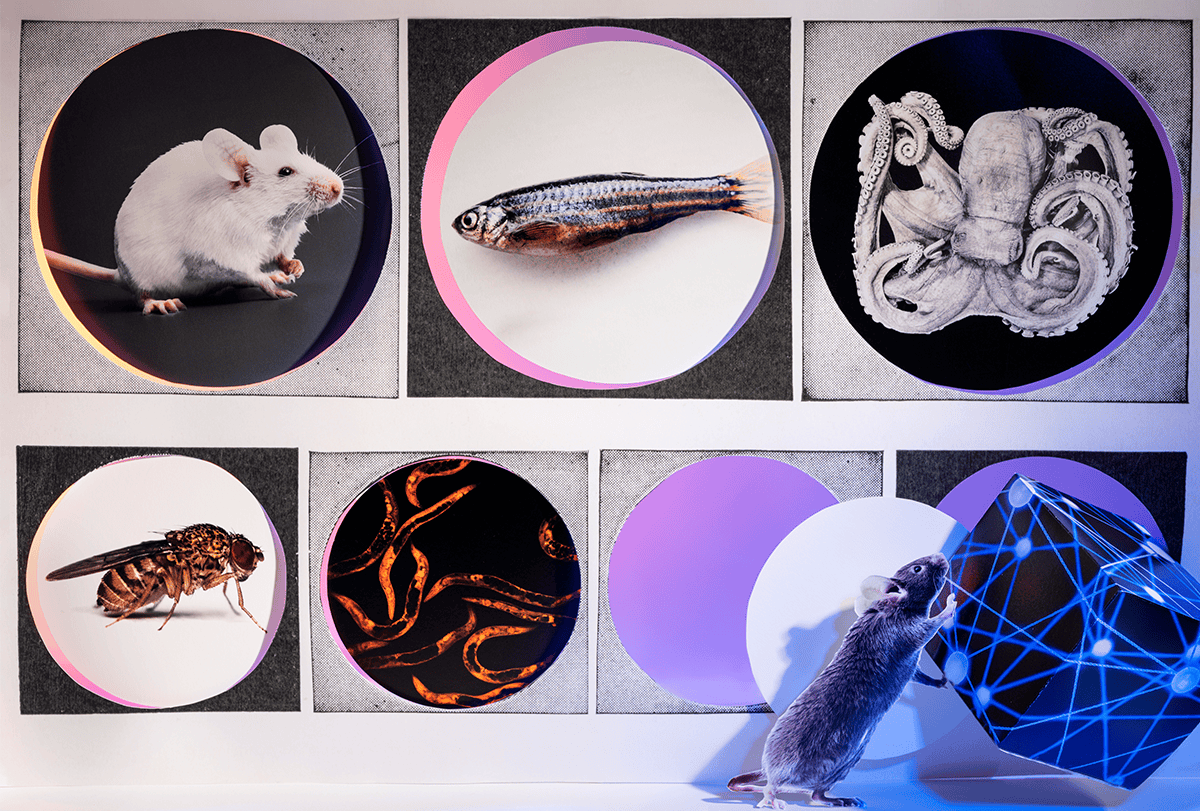
For instance, in a 2024 Nature Communications paper, one group proposed that deep neural networks are “different model organisms—unique artificial visual systems—with performant, human-relevant visual capabilities.” This framing elevates ANNs from the traditional role that computational tools have played for many decades and places them alongside such established biological models as mice, fruit flies and nonhuman primates.
I find this terminology creep problematic for two reasons. The first is that it distorts funding priorities by equating the explanatory power of animal models and ANNs—with profound implications beyond academic discourse.
Scientists using biological and computational models are familiar with their differences. This is not always true for policymakers and funders who, in the face of references to new “model organisms,” could be forgiven for mistakenly thinking that biological model organisms can now be replaced.
And this potential confusion comes at a critical juncture for the use of animal models in research in the United States. Various U.S. agencies, including the National Institutes of Health and the Food and Drug Administration, have announced intentions to reduce dependence on biological organisms, motivated in part by the assumption that artificial alternatives can serve equivalent scientific functions. In 2025, the National Institutes of Health announced that it “will no longer seek proposals exclusively for animal models” and listed computational and artificial-intelligence-based approaches as viable alternatives.
The language we use to categorize scientific tools shapes research priorities, funding decisions and regulatory policies. If we continue to blur the lines between computational and established animal models, we run the risk of treating them as scientifically equivalent. Evolution tells us that they are not.
The second issue with defining computational models as model organisms is that it ignores the enormous explanatory power that biological organisms have thanks to their shared evolutionary history.
ANNs lack the 4 billion years of cumulative selection pressures, random genetic variants, genetic drift and environmental contingencies that biological models share with people. Evolutionary biologist Stephen Jay Gould famously argued that if we could “replay the tape of life,” evolution would likely produce radically different outcomes because of the role of historical contingency.
This is why biological model organisms work as scientific tools. Findings transfer from mice to humans not because evolution consistently finds the same optimal solutions to biological problems but because mice and humans inherited their solutions from common ancestors. By contrast, convergent evolution—in which unrelated lineages independently evolve the same solutions—fails to provide the same predictive power. For instance, octopus eyes, though similar to vertebrate eyes in terms of optical properties, are not reliable models of human vision because they evolved independently and lack a shared evolutionary history. The octopus retina is more “correctly” wired than the vertebrate retina, with photoreceptors facing the light, and therefore avoids the blind spot that characterizes vertebrate eyes.
S
o why are ANNs being called model organisms? A key reason is their ability to produce outcomes that resemble human performance or neuronal activity. But the scientific value of model organisms goes beyond that: Our shared evolutionary heritage produces common mechanistic links, enabling discoveries to transfer across species even when the underlying mechanisms are not fully understood.Findings that described the organization of the visual cortex exemplify this sort of transfer. David Hubel and Torsten Wiesel’s pioneering studies in cats revealed fundamental principles of cortical organization, including receptive fields, ocular dominance columns, orientation selectivity and critical periods for visual development. These discoveries, later confirmed in macaque monkeys, established the conceptual framework that underlies our understanding of human visual processing. The conservation of mammalian visual system architecture ensured these findings would translate despite significant differences in visual ecology between cats, monkeys and humans. The squid giant axon—which revealed the ionic basis of action potentials across the animal kingdom—and circadian clocks in Drosophila are further examples of conserved mechanisms through evolution.
This is not to say that animal models always translate to humans; failures in translating findings also occur. But the previous examples demonstrate the value of a shared evolutionary history, which is something ANNs cannot fully replicate.
It is also notable that phenotypic similarity with humans—a motivation for considering ANNs as model organisms—is not required to benefit from underlying mechanistic continuity across species. For instance, Duchenne muscular dystrophy is caused by a variant in the DMD gene in humans. A similar mutation in mice causes significantly milder symptoms, yet because of our shared ancestry with mice, the severe muscle wasting observed in people is only one additional genetic modification (mdx/MYOD1−/−) away.
By contrast, ANNs can show similar outputs despite having completely different causal structures. For instance, large convolutional neural networks can be biased toward classifying images using texture rather than human-employed shape. These ANNs and humans are both classifying images, but in different ways. The ANN mechanism here is not just inapplicable to humans, but in a domain that is less well understood than object vision, it may be misleading.
Interestingly, our shared evolutionary history with model organisms preserves not only solutions but historical accidents and suboptimal features, which themselves carry explanatory power. These evolutionary quirks illuminate both normal function and pathological vulnerabilities across species. The vertebrate retina demonstrates one such quirk: It is inverted, so light must pass through layers of neurons and fibers before reaching the light-detecting photoreceptor outer segments. This arrangement (present across vertebrate lineages) explains the blind spot and contributes to retinal detachments that can occur between photoreceptor outer segments and the retinal pigment epithelium.
ANNs result from a fundamentally distinct optimization process, yielding quirks that are not shared with humans (or other biological organisms). For instance, deep neural networks are vulnerable to being “fooled” by minor pixel modifications (often imperceptible to humans) that cause them to incorrectly classify images. Such quirks provide no insight into biological vision because they stem from optimization dynamics and dataset statistics rather than shared evolutionary constraints.
Is it too late to take back our characterization of ANNs as model organisms? Many neuroscientists have enthusiastically embraced referring to ANNs and other computational models as model organisms. Should we throw in the towel and ignore our evolutionary heritage? I would argue that it’s not too late. Science is nothing if not self-correcting, and scientists are used to holding one another accountable for the precision of our language.
Neuroscientists have used computational models for decades without considering them model organisms. Exploring how ANNs achieve visual and other types of processing will continue as an interesting avenue of research. We can do this without co-opting the term “model organism.”