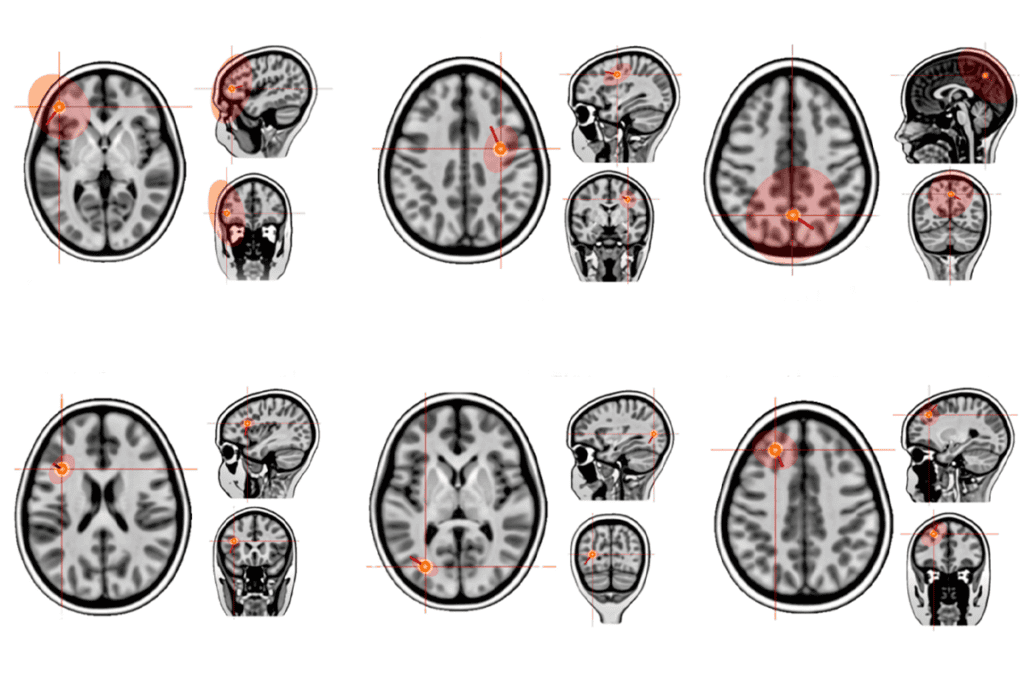
Several well-funded teams are betting tens of millions of dollars that the approach that spawned large language models will work for the brain: Train artificial neural networks on vast amounts of brain data, and the models will keep improving. This year alone, Meta, Stanford University, Neuralink and others have released or begun building this kind of foundation model of human or mouse brains.
Whether this bet will pay off is far from settled—and that is at the heart of a Dual Perspectives article published today in The Journal of Neuroscience. In the article, Bing Wen Brunton and Patrick Mineault debate whether artificial-intelligence (AI) models that successfully predict brain activity will also help explain how the brain works, and whether that understanding requires modeling the body. Brunton and Mineault plan to revisit the topic during a live session at the annual meeting of the Society for Neuroscience in Washington, D.C., this Sunday, 15 November.
Models that accurately predict brain responses could one day stand in for animals or people in tests of novel stimuli and treatments, says Daniel Yamins, associate professor of psychology and computer science at Stanford University, who is involved in the Stanford Digital Brain Project, an effort to build a functional MRI (fMRI) and MEG-based foundation model of the human brain.
These models can also be a tool to help explain how the brain works, according to Mineault and others. A model that reproduces brain activity can be studied in ways a living brain can’t, and can make predictions that can later be verified in real brains, says Mineault, NeuroAI research lead at the Amaranth Foundation, a philanthropic funder of NeuroAI and AI safety research.
Although Brunton and Mineault agree on some points, Brunton and other researchers are more skeptical. Many different models can fit the same neuronal recordings, but nothing guarantees that a highly predictive model will work like a brain does, says Brunton, professor of biology at the University of Washington.
And even if a model does work like a brain, it wouldn’t necessarily help us understand it, says John Krakauer, professor of neurology and neuroscience at Johns Hopkins University. Such a model would be “a second brain you have to neurally understand.”
E
xisting foundation models have already made important strides. For example, they can accurately predict neuronal responses to stimuli they were never trained on. A foundation model of the mouse visual cortex, trained on calcium imaging recordings of mice watching natural videos, predicted how neurons respond to coherent motion and noise, according to a study published in Nature last year. The model also predicted neurons’ anatomical cell types, dendritic features and connections, as well as the neuronal activity of new mice after seeing less than half an hour of their brain data.Accurate predictions are only the first step, says Andreas Tolias, professor of ophthalmology at Stanford University, who worked on the Nature study and co-leads the Enigma Project, which is funded by the Amaranth Foundation. The real test of a model’s usefulness is whether it reveals something new about the brain. An earlier model from his lab, for example, predicted that when a mouse’s pupils dilate, its visual neurons become more sensitive to ultraviolet light, which the team confirmed via in-vivo experiments.
Other foundation models have had similar successes. Meta’s TRIBE v2—which draws on more than 1,000 hours of brain scans from people watching videos, listening to audio and reading text—predicts fMRI responses to new stimuli and tasks in people it was never trained on, according to a preprint posted on arXiv in May. In April, the company launched a $15 million effort to create a model from 15,000 hours of precision-scanning fMRI data. Jean-Rémi King, associate researcher at the École Normale Supérieure and leader of the Brain & AI team at Meta, passed The Transmitter’s request for comment to Athyu Eleti, AI communications manager at Meta, who said Meta would not be able to comment.
The fact that these models continue to improve with more data suggests that models of the brain are limited by the amount of available data, says Grace Lindsay, assistant professor of psychology and neural science, and of data science, at New York University, who is not involved in TRIBE or the mouse visual cortex model. “Any performance we see is not the peak performance a model could get. More data should help,” she says.
Brunton agrees but notes that whether more data will ever be enough to model a real brain is unclear. The relationship between the amount of any type of neuronal data fed into a model and its performance is unknown, and it likely differs from how large language models improve with more data, she says.
The answer may depend on the data, early studies suggest. The predictive ability of OmniMouse, a model trained on recordings of more than 2.3 million neurons from 73 mice, improved with more data, for instance. But making the model bigger—adding more parameters, the adjustable values a model tunes as it learns—helped only up to a certain point. Models that decode what a person is seeing from their brain activity improved with more recording hours per person, but adding more people barely helped, according to a 2025 study. Three foundation models, including BrainLM, which was trained on 6,700 hours of fMRI recordings, were worse at predicting people’s cognitive scores than a simple linear model of brain connectivity—and a larger version did worse than a smaller one, according to a preprint posted on arXiv in May.
“I’m skeptical that foundation models will be just as successful for every type of data,” Brunton says. “We need to understand scaling laws of models, for each type of data, to understand how much data is enough.”
A
nother open question is whether data-driven foundation models will lead to any mechanistic understanding of the brain. They learn to predict neuronal activity by training directly on recordings of neuronal activity. By contrast, task-trained models—another way that neuroscientists try to describe brain function—learn to do something a person or animal can do, such as recognize the objects in an image, and are compared with the brain afterward.Data-driven models are the more promising path, Mineault says. The best task-trained vision models explain only about half of the variance in neuronal recordings from the inferotemporal cortex, according to a Brain-Score benchmark, he says. And image classifiers have actually become less accurate at predicting neuronal activity as they have gotten better at classifying images, according to previous work.
Brains and data-driven models won’t converge automatically, Mineault says. Training models directly on brain recordings can help explain the rest of the variance, he says, particularly recordings from intermediate stages of visual processing, such as V1, V2 and V4, which transform what comes into the retina and feed that into regions that recognize objects. Those recordings could constrain what happens inside a model, ensuring that it ends up more brain-like, he says.
Predicting the brain’s activity may be on the path to understanding it, he says. In 2012, artificial neural networks became far better than other methods at classifying images, for example, “but it took a really long time for us to actually understand what was going on inside of these models.”
That’s why, to be trusted, a model’s predictions need to be tested in a real brain, Tolias says. “These models can also hallucinate,” but a model is good enough, in his view, when it can “make a novel discovery that is verifiable in the brain.”
Even if, thanks to more data, a model gets better at predicting brain activity, that is not the same as making it more like the brain, Yamins says. “There’s no reason for a model of that format to have internal layers that look anything like the brain. They’ll just look like a prediction machine.”
As models trained to recognize objects have improved, for example, they have also gotten better at accurately predicting neuronal responses in the monkey inferotemporal cortex, an area involved in recognizing objects, previous work shows. “The internals of [task-trained] models have a chance of matching internal representations of the brain,” Yamins says.
Combining task-trained and data-driven models is the ideal way to potentially converge at brain-like solutions to problems, Yamins says, but how to do this in practice “hasn’t been figured out.”
But even such combination approaches face the same potential pitfalls, Brunton says. Even when foundation models make accurate predictions, for instance, they don’t contain the molecules and cells that produce neuronal activity, which limits how well they can predict responses to therapies. When a drug targets “receptors, ion channels, second messengers or gene expression, it seems unlikely a foundation model that lacks these scales of description would make valuable predictions,” she says.
Krakauer says he is “increasingly skeptical” as claims escalate from predicting neural data to predicting responses to drugs or lesions. Accurate predictions “are all very cool,” he says. “But that is very different from saying that the neural data are going to give us” distilled psychological insights into how people think.
B
runton’s side of the debate starts from a different premise—that intelligence is a property of the whole organism. She makes the case with a thought experiment: Isaac Newton films thousands of falling apples with an iPhone and trains a transformer model on the footage. The model would predict the next apple’s fall “better than F=ma even could,” she writes in the Dual Perspectives article, but “you could not use this transformer model to design a rocket and put it on the Moon. Getting to that kind of understanding, she writes, “took ignoring data.”And even models that behave realistically can deceive, she says. Wiring the worm connectome to a fly body produced “perfectly serviceable walking”—but a random network walked just as well.
The details of the body can sometimes be set aside, Mineault says. “I think that if we’re talking about perception or cognition, maybe those factors are not quite as important.”
The differences between Brunton’s and Mineault’s arguments in the Dual Perspectives article come down mainly to which level of the brain to study and what to build first. They settled on similar next steps: Measure as much as possible, and then distill those measurements into principles of how the brain works. Mineault says the right way forward is to start with large-scale recordings and detailed connectomes. Brunton says she welcomes digital twins, as long as they are embodied and include feedback.
As researchers test whether scale pays off, they should be ready to swallow a bitter pill. “We have to admit the possibility that the answer could be, ‘Oh yeah, this is not going to work,’” Brunton says.