Consciousness conundrum: In contemporary neuroscience, we have an apparently uncontroversial assumption (about the stream of consciousness and its contents), but no clear way to interpret the data.
Life happens in real time, but experience may be composed in ragtime—like the music genre, full of offbeat notes and uneven rhythms. The assumption that waking life consists of a “stream” of conscious representations has inadvertently led consciousness science to its current impasse.
Despite interdisciplinary enthusiasm, improved scientific techniques and accumulating data, consciousness science appears to have hit a snag. Even top scientists admit it: Empirical progress has failed to realize optimistic predictions for identifying the neural basis of consciousness. Some argue that the main hindrance has been conceptual, such as shifting definitions of consciousness. Others blame practical limitations, including imprecise neural measures, especially in humans. Still others point toward deeper epistemic sources—that science is an objective, third-person endeavor, and consciousness is subjective and accessible only from a first-person perspective. We believe, however, that the solution may lie in revising one of our common sense intuitions about consciousness.
Popular belief holds that conscious experience is continuous, that waking life consists of a “stream” of consciousness. That stream includes or excludes thoughts—perceptions, memories, deliberations—at any given moment. Accordingly, scientists design experiments with the aim of determining what neural activity takes place at the moment a stimulus, a memory or an idea “enters consciousness.”
The current paradigm in the neuroscience of consciousness orients experimentation around the search for the “neural correlates of consciousness” (NCC), typically defined as “the minimal set of neuronal mechanisms jointly sufficient for any one specific conscious experience.” Since its introduction by Christof Koch and Francis Crick in 1990, the standard interpretation of the NCC has included the assumption that consciousness is a stream of representations, implying that at any one time, there will be a set of neural events correlating to the content of that stream.
The goal of the NCC approach is admirable: to pursue empirical data in a theory-neutral way. But we submit that because its implementation has smuggled in the assumption of a stream of consciousness, in effect, the NCC approach violates theory-neutrality and has inadvertently led consciousness science to its current impasse.
C
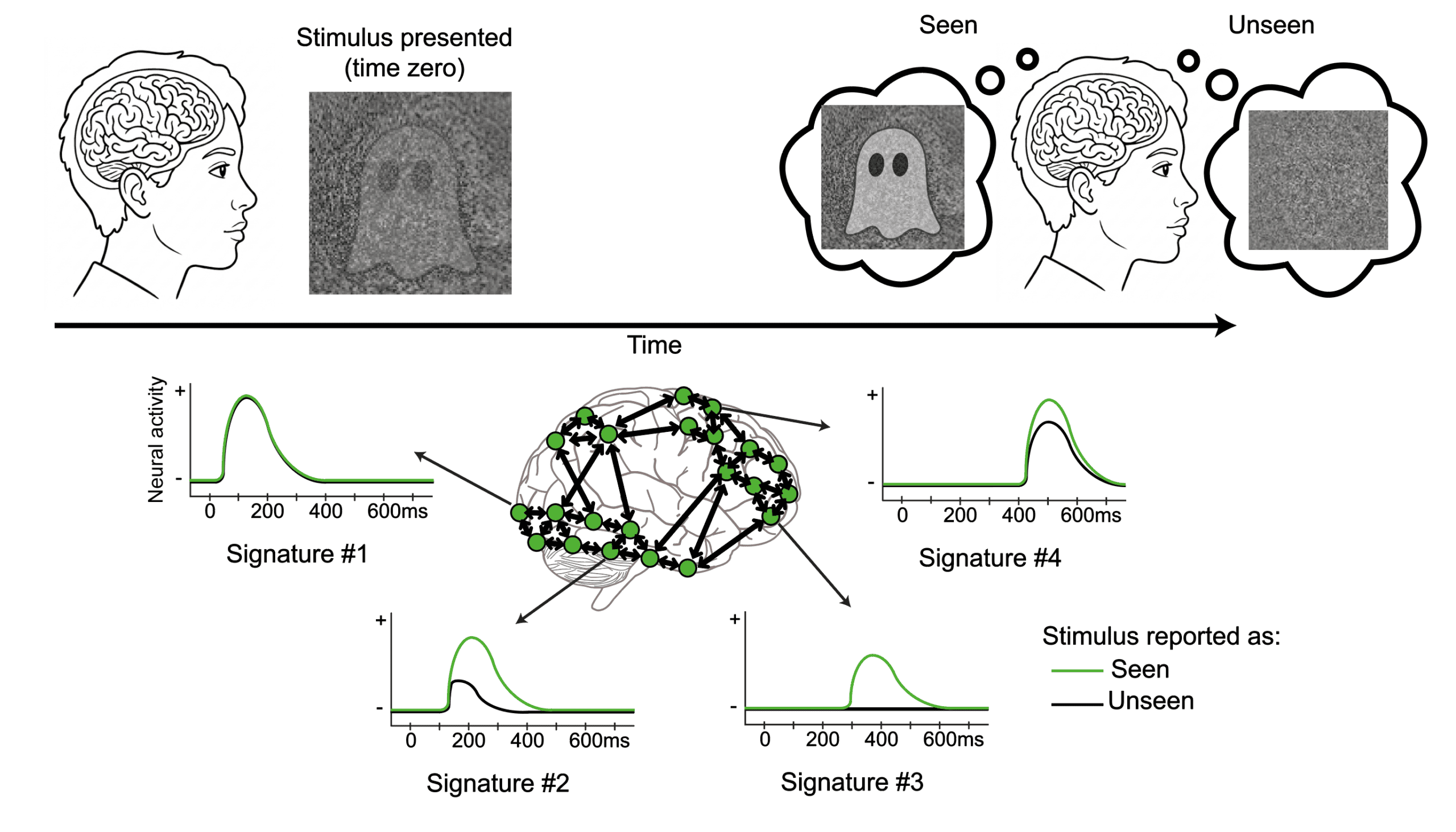
onsider a hypothetical experiment, as illustrated in Figure 1. A participant is shown a noisy image for a few seconds. Midway through, a semi-hidden figure of a ghost appears. Afterward, an experimenter asks the participant to report if they saw anything interesting. The experimenter then administers some apparently unrelated forced-choice tasks—to choose between paired words like “haunt” and “dive,” or “spirit” and “liquor,” for example. Finally, the experimenter directly asks the participant if they saw a ghost.
Hidden ghost: In this hypothetical experiment, a participant is shown a stimulus embedded in noise. Brain activity is compared between cases in which they report seeing or not seeing the stimulus.
Francis Fallon, Max Opitz, Michael Pitts
Imagine further that EEG recordings collected as the hypothetical participant saw the ghost indicate four interesting neural activity patterns, or signatures, each a few hundred milliseconds apart. Which one should be interpreted as indicating the time at which the participant became conscious of the ghost? The first signature occurs in every case, regardless of what the person reports seeing, and might simply be evidence of basic (unconscious) sensory processing. The last signature (number 4) occurs only when people spontaneously report seeing the ghost.
But this neural activity might be tied to the preparation of the verbal report, rather than to the conscious experience itself. Signature 2 happens in the cases where people chose the spookier option within each forced-choice pair, indicating a “priming effect” on their behavior, even if they later deny seeing the ghost. Signature 3 happens only in the cases in which people, when asked if they saw a ghost, respond in the affirmative, leading some to interpret this as the key NCC. However, does the third signature reflect a now-conscious retrieval of an initially subconscious percept?
This hypothetical conundrum has clear parallels in actual consciousness science. The interpretation of Signature 2 as the genuine NCC corresponds most closely to Recurrent Processing and Integrated Information theories. These theories propose that early stages of sensory integration and differentiation are sufficient for conscious perception. The interpretation that Signature 3 reflects the real NCC is consistent with Higher-Order theories (including Attention Schema Theory) as well as, perhaps, some versions of Global Workspace and Predictive Processing theories. Higher-order theories collectively propose that first-order perceptions and thoughts, however well integrated or differentiated, remain unconscious until some additional mechanism interacts with them. Global workspace theory posits that first-order perceptions and thoughts are consciously experienced only when they are made broadly accessible to the rest of the brain via selection and broadcasting mechanisms, which in turn enable flexible, voluntary behavior. The interpretation that favors Signature 4 has been treated by various thinkers under the label “the refrigerator light illusion,” i.e., whenever we open the door to introspect our experiences, the light of consciousness always seems to be on. (See also Naccache on “temporal islets” of consciousness.)
So, just as in the hypothetical case, in contemporary consciousness science we have an apparently uncontroversial assumption (about the stream of consciousness and its contents), but no clear way to interpret the data. Despite having an ostensibly theory-neutral frame—the NCC—and several rival theories, we have no clear way to determine the victor. What has gone wrong?
The problem may very well lie in the persistent neglect of the possibility that consciousness consists of multiple mental events, correlating to multiple, heterogeneous neural events that play out over time. Perhaps all four signatures are important. Each might well reflect a necessary stage of processing with no single stage being sufficient on its own. Some or all of the approaches mentioned above may capture different aspects or mechanisms of consciousness, without there having to be a single fact of the matter about whether a participant is conscious of a stimulus at a particular point in time.
W
e realize that this may seem counterintuitive at first. But what seems intuitive now may have surprisingly recent historical roots. In the late 19th century, William James introduced the phrase “stream of consciousness.” (The idea soon found a home in the literature of Joyce and Proust.) By then, the notion of mental “elements” had become popular among physiologists, neurologists and the first psychologists. Many of them adopted doctrines of “psychophysical parallelism,” asserting that mental elements should have physiologic correlates. These (and other) approaches suggested two parallel timelines—one of physiologic events and the other of mental elements.
By the time the modern paradigm for studying consciousness was established, a century of cultural currency and scientific practice had hardened this suggestion into unquestioned dogma. Talk of mental elements and “atoms of thought” had given way to talk of representations, but these could still constitute the objects of consciousness, the water in the stream.
Philosophical debates about consciousness became especially entrenched in the 20th century. Crick and Koch’s NCC proposal sought to bracket these controversies and create a theory-neutral space for empirical investigation. But the standard interpretation of the NCC is a continuation of the same notion of consciousness that gained popularity a century before: They are physiologic events correlating to a stream of conscious representations.
The intent of the NCC approach is laudable, and its goal may be feasible. But the practice of searching for the NCC at a single point in time precludes certain interpretations of data, artificially limiting our explanatory options. Life happens in real time, but experience may be composed in ragtime—like the music genre, full of offbeat notes and uneven rhythms. Let the quest for the NCC accommodate this: Experimentalists in consciousness science should no longer tacitly assume a single stream of conscious representations correlating to a sequence of neural states. Challenging this core assumption will open up new opportunities for experimental design and interpretation that allow for the possibility that consciousness’s timing is more complex. Call it the NCC-Rag.