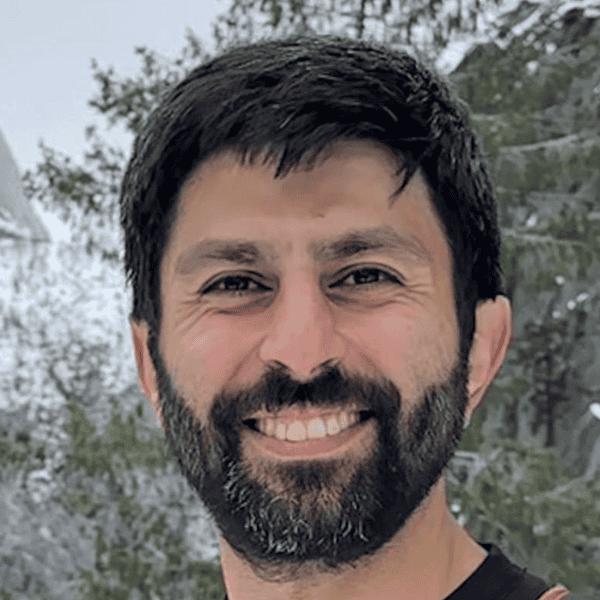
Arash Fassihi.

Arash Fassihi

Assistant project scientist
University of California, San Diego

Arash Fassihi is an assistant project scientist in David Kleinfeld’s laboratory at the University of California, San Diego. He studies how neural circuits transform sensory information into perception and coordinated action. His research combines quantitative behavioral analysis, electrophysiology and circuit manipulation to investigate tactile decision-making, memory, and motor coordination in active sensing. His current work examines how the superior colliculus and brainstem coordinate movements of the head, vibrissae, eyes and tongue during goal-directed behavior.

Fassihi earned his Ph.D. at the International School for Advanced Studies (SISSA) in Trieste, Italy, where he worked with Mathew Diamond on tactile and time perception, working memory and decision-making in rodents and humans. At UC San Diego, he investigates distributed sensorimotor circuits that organize natural behavior.

He is also involved in scientific community-building, including organizing the Middle Eastern Systems Neuroscience Symposium and serving as a teaching assistant at the NeuroBridge Summer School.

Explore more from The Transmitter

Mice playing, engaged in learning and memory: some of their brains are yellow, and some are red, matching a red and yellow legend that runs through the image to underscore both memory and learning.

This paper changed my life: A technical breakthrough for memory studies

In a 2007 Science paper, Mark Mayford and his colleagues found that some neurons activated during learning are also recruited during memory retrieval. Noelia Weisstaub shares how this study and others drove an era of great progress in tool development.

By Noelia Weisstaub
14 August 2026 | 5 min read

Early experience reshapes zebrafish retinal cells, alters behavior

The cells undergo a classic form of plasticity previously thought to occur only in downstream visual circuits.

By Siddhant Pusdekar
13 August 2026 | 0 min watch
Research image of expression of MEIS2 in PV interneurons.

Loss of interneuron plasticity may be shared hallmark of neurodevelopmental conditions

Restoring an experience-dependent interneuron plasticity gene in adulthood improves memory and cuts seizures in CNTNAP2 knockout mice, a new study shows.

By Claudia López Lloreda
12 August 2026 | 5 min read