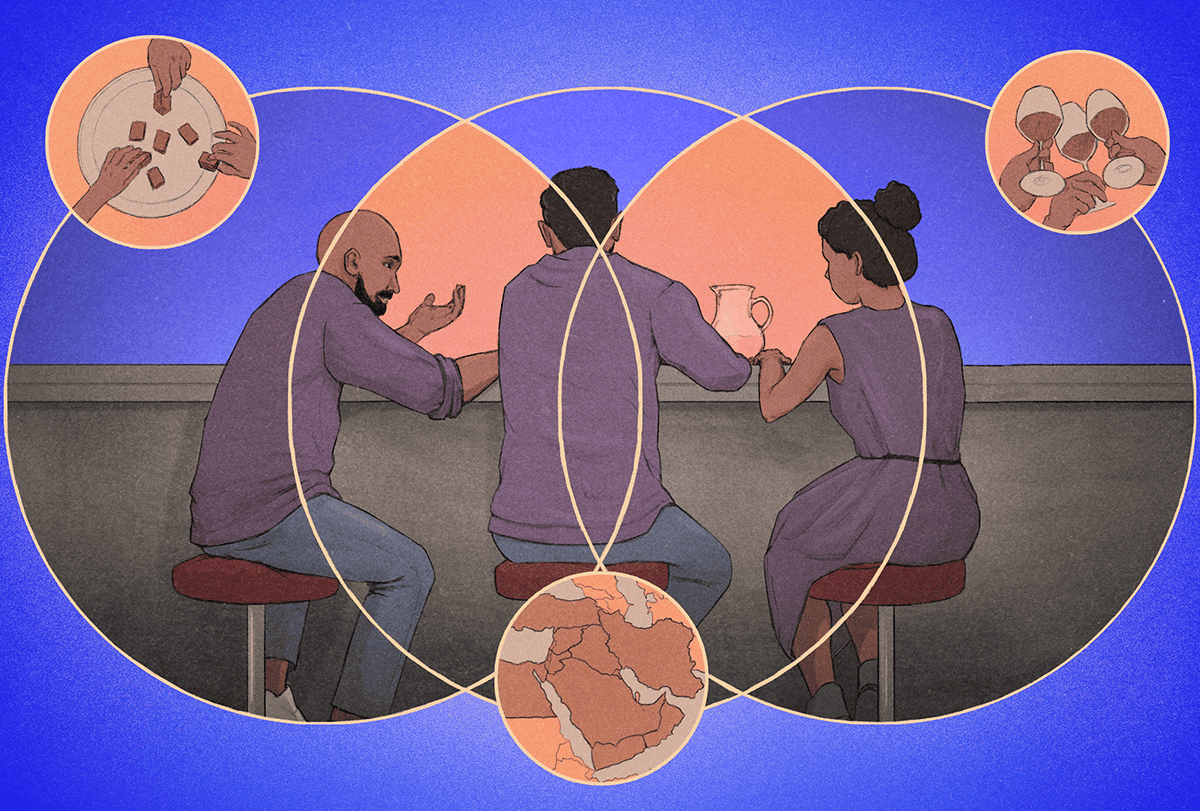
Last November, just as tens of thousands of neuroscientists flocked to the Society for Neuroscience conference at San Diego’s large convention center, a much smaller meeting convened nearby. There, at the first ever Middle Eastern Systems Neuroscience Symposium, attendees snacked on plates of baklava during coffee breaks, heard music from the Egyptian singer Umm Kulthum marking the end of presentations, and shared research highlights from Middle Eastern countries and scientists.
We were all in attendance. We are four U.S.-based postdoctoral fellows who grew up in different parts of the Middle East. Arash grew up in Tehran, Iran; Abdulraheem is a Palestinian citizen of Israel who grew up in a Muslim community; and Gily and Noga grew up in predominantly Jewish communities in Israel. And we had all met a year earlier at the Middle Eastern Social at SfN in 2024—which was a dialogue-promoting event organized by Yavin Shaham and other prominent middle eastern neuroscientists, including Khaled Moussawi, Natalie Zahr and Nelly Alia-Klein.
That social took place on the eve of the first anniversary of the 7 October massacre, a turning point for the Middle East that led to intensified conflict and bloodshed. As we talked at the event, however, it became clear that we shared many formative experiences, both good and painful, and the empathy we felt for one another was like a breath of fresh air. The connection felt both natural and complicated—and necessary for maintaining hope and humanity.
We left the conversation wanting to build a community that could embrace our genuine differences while also drawing on the shared cultural threads we recognized. And so we decided to expand the social in 2025 to a full-day symposium, and soon gained support for such an event from the Simons Foundation; the University of California San Diego; ScienceAbroad; private donors through GoFundMe; and Shaham. (The Simons Foundation is The Transmitter’s parent organization.) We recruited top-tier neuroscientists from across the region to give talks, including keynote speakers Reza Shadmehr, Nachum Ulanovsky and Athena Akrami. We also invited presentations from outstanding trainees to represent the next generation of Middle Eastern neuroscientists.
When it all came together, the science was excellent and the atmosphere was open, warm and familiar. The Q&A sessions highlighted the cultural similarities among participants—for example, the questions were sharp, direct and blunt. The speakers—direct themselves—recognized that the best compliment to their talk is a question that challenges its core ideas.
The enthusiasm we witnessed at this first gathering demonstrated the need for this community of neuroscientists to come together. Many attendees told us that they felt more at ease and better understood than they had in a long time. The symposium ended with Iranians, Israelis, Palestinians and people from other regions of the Middle East sharing Mexican food on a rooftop bar, talking about neuroscience and our hopes for the future.
The second edition of the symposium is set to occur in Washington, D.C. in November, right before SfN. But rather than just having one annual meeting, we envision building a community that remains active year-round. We are launching an online platform to help members connect, seek advice, share methods and support one another whenever they want. We are increasing our social media and aim to launch a Slack channel for our group. And we are in the process of opening a new section on our website to share news about our community members, celebrate their successes and post job opportunities.
W
e are not the first to use neuroscience as a bridge for the Middle Eastern community. NeuroBridges, a summer school held annually in Cluny, France, brings together trainees from across the region for 10 intensive days of learning and collaboration in computational neuroscience. It may be one of the few places on earth where you can see a neuroscientist from Jerusalem fitting a model to neural data alongside a neuroscientist from Tehran. NeuroBridges is an inspiring initiative, and we are proud to follow in its footsteps.Highlighting shared goals can be the key to transcending political barriers. Today, people across the Middle East rarely meet across national and ethnic lines. As a result, we grow up with little direct familiarity with one another or with each other’s narratives. What we have are fragments and stereotypes, rather than actual human connection. This creates fertile ground for mistrust and dehumanization. For many attendees, our symposium provided the first meaningful interaction with someone from the “other side.”
When this first interaction focuses on shared goals, it humanizes the person in front of you. Such experiences have ripple effects that extend beyond the participants when they return to their communities.
Our commitment to fostering this community stems from our experiences that have shaped how we think about science’s role in society. Noga recalls an Iranian scientist telling her that they were surprised to meet an Israeli who treated them kindly. As a member of the Arab minority in Israel, Abdulraheem remembers having only a few meaningful relationships with Jews growing up, but joining Israeli academia created an opportunity for him to form friendships with people whose backgrounds and perspectives often differed greatly from his own. Arash recalls that during the recent massacre of anti-Islamic regime protesters in Iran, and even during the U.S.-Israel-Iran war, some of the people who were most empathetic toward him, and consistently asked about his family in Iran, were Israeli and Palestinian-Israeli colleagues.
For all the positive that can bloom from a symposium like ours, it also presents distinct challenges. We were mindful, for example, of the risk of disruption by people who might seek confrontation or even violence rather than dialogue. To this end, we hired a security guard to ensure our participants’ safety—although we were aware that those who grew up in totalitarian regimes or as ethnic minorities might find an armed guard threatening.
We also realized that we needed to ensure our participants and their relatives would not suffer any negative consequences as a result of attending the symposium. A single post or social media mention that identified a participant could have dire consequences in some countries. In the upcoming meeting, one of our speakers, a notable professor, requested not to be identified by name in the program so they can visit their family in the region safely. In light of this, we asked participants to be aware of these risks and to avoid taking photographs during the conference. The fact that people from these countries still choose to attend speaks to their tremendous courage and gives us hope.
Through our efforts, we aim to create recognition and trust among Middle Eastern neuroscientists that grows into a deeper understanding of our shared experiences. An attendee to last year’s symposium summarized our hope for the community perfectly: “A community like this, which is dedicated to transcending political conflicts in favor of advancing science, is a rare gem that should be treasured. In the end, it is through personal relationships that we collaborate, and anything that promotes the formation of new relationships across our troubled region is a force for good.”