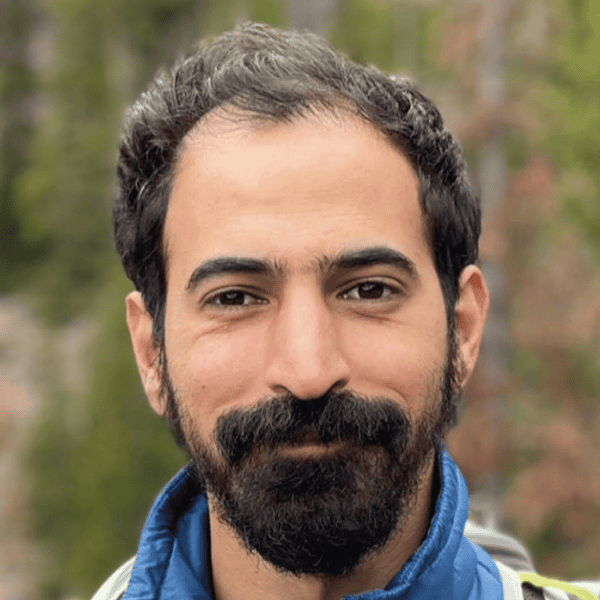
Abdulraheem Nashef.

Abdulraheem Nashef

Postdoctoral fellow
University of Colorado Anschutz Medical Campus

Abdulraheem (Abed) Nashef is a postdoctoral fellow at the University of Colorado Anschutz Medical Campus. He is currently investigating the role of neuronal population activity in controlling motor behavior and learning in mice performing reaching tasks, training with Dr. Abigail Person. His work uses computational modeling, optogenetics, and electrophysiological methods to understand the basic principles of cerebellar computation.

Abed received his bachelor’s degree and Ph.D. from the Hebrew University of Jerusalem. As a Ph.D. student, he worked with Dr. Yifat Prut, investigating the role of the cerebellar-thalamocortical system in motor control in behaving monkeys. His work and research have received numerous awards and fellowships, including the Hans Wiener Prize for Outstanding Dissertations from the Hebrew University of Jerusalem and postdoctoral fellowship from the Life Sciences Research Foundation and Amgen.
Explore more from The Transmitter

Illustration of an open journal featuring lines of text and small illustrations of eyes and mouths.

Links between tuberous sclerosis complex and autism, and more

Here is a roundup of autism-related news and research spotted around the web for the week of 17 August.

By Jill Adams
18 August 2026 | 1 min read
Taylor Bolt photo illustration.

The fun and flexibility of data science

Taylor Bolt spent his Ph.D. and postdoc digging through brain imaging data for clues to cognition. In industry, the datasets are different but the joy of answering questions with data remains.

By Katie Moisse
18 August 2026 | 7 min read
Two trajectories cross over each other showing areas of alignment and misalignment.

Mind over metrics: How can we tell if two brains (or AI models) are alike?

The ability to record from large populations of neurons has triggered the development of myriad methods for comparing them. But we’re still grappling with how to convert measures of likeness into a better mechanistic understanding.

By Alex Williams
17 August 2026 | 7 min read