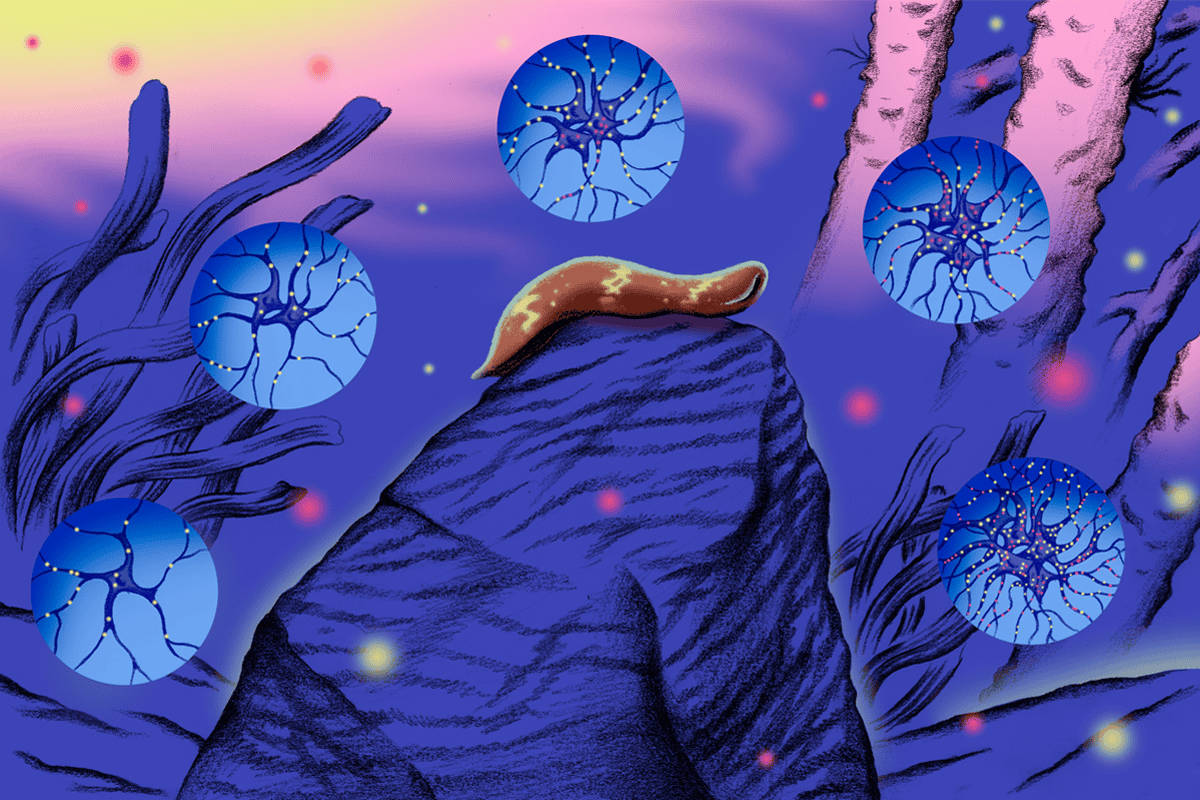
Sometime in the nervous system’s deep evolutionary past, simple nerve nets, in which signals flow in all directions, gave way to complex brains parceled into regions that carry out specific functions. The unique structure of the three-banded panther worm (Hofstenia miamia) brain, however, upends any assumptions about how this transition occurred.
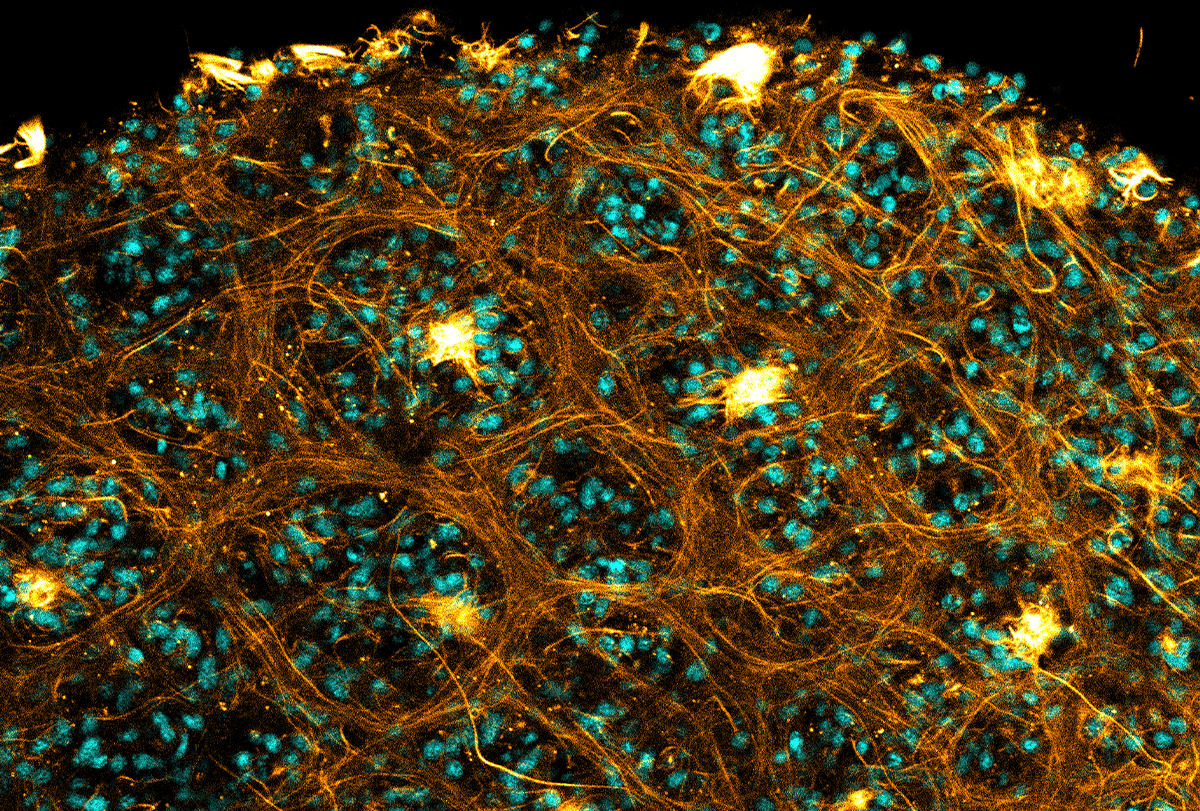
The grain-of-rice-sized marine worm has three light stripes across its back and is a voracious predator of tiny invertebrates—hence its common name. Its nervous system is more condensed than a nerve net, with a closely packed concentration of nerve cells in the head. But unlike the brains of other bilaterally symmetrical organisms, such as roundworms, insects, mice and humans, it lacks specialized regions. Hofstenia’s lineage diverged from that of these other groups about 550 million years ago, near the very base of the bilaterian family tree.
The animal is also capable of regenerating its entire body from a fragment of itself, a phenomenon that Mansi Srivastava, professor of organismic and evolutionary biology at Harvard University, has studied for more than a decade. Now, Vikram Chandra, a postdoctoral researcher in Srivastava’s lab, has adapted the slice-and-dice methodology typical of those studies to investigate the worm’s nervous system. The researchers shared some of their first results from this project in a preprint posted on bioRxiv earlier this year.
Srivastava and Chandra spoke with The Transmitter about why three-banded panther worms are “great lab rats,” what the animals manage to do with half their brain missing, and what the researchers plan to do next.
This interview has been edited for length and clarity.
The Transmitter: How did you begin working with Hofstenia?
Mansi Srivastava: When I started my postdoc research years ago, I was really driven to study the evolution of regeneration. Planarian worms had become the established, go-to system for this research. But to me, insights that are about one organism are nowhere near as satisfying as evolutionary insights. So I tried working on lots of different species that gave me evolutionary distance from planarians; and acoels, a class of flatworm-like invertebrates, were always really interesting. But at that time, there was not a perfect acoel model system established in the lab. And so I actually went out and collected the species from the field.
There’s this guy, Ulf Jondelius at the Swedish Museum of Natural History, who’s an expert on acoels. And we asked him, if you were to pick any acoel and try to grow it in the lab, which one would it be? And he pointed us to this one. So we went to Bermuda, based on a paper they had published years ago, which listed exactly the latitude and longitude where [three-banded panther worms] were last collected, and we were able to collect them. And then after that, I got super lucky. There are so many points at which new model systems will fail. But we were able to figure out ways of culturing them and got lots of tools and techniques working in them.