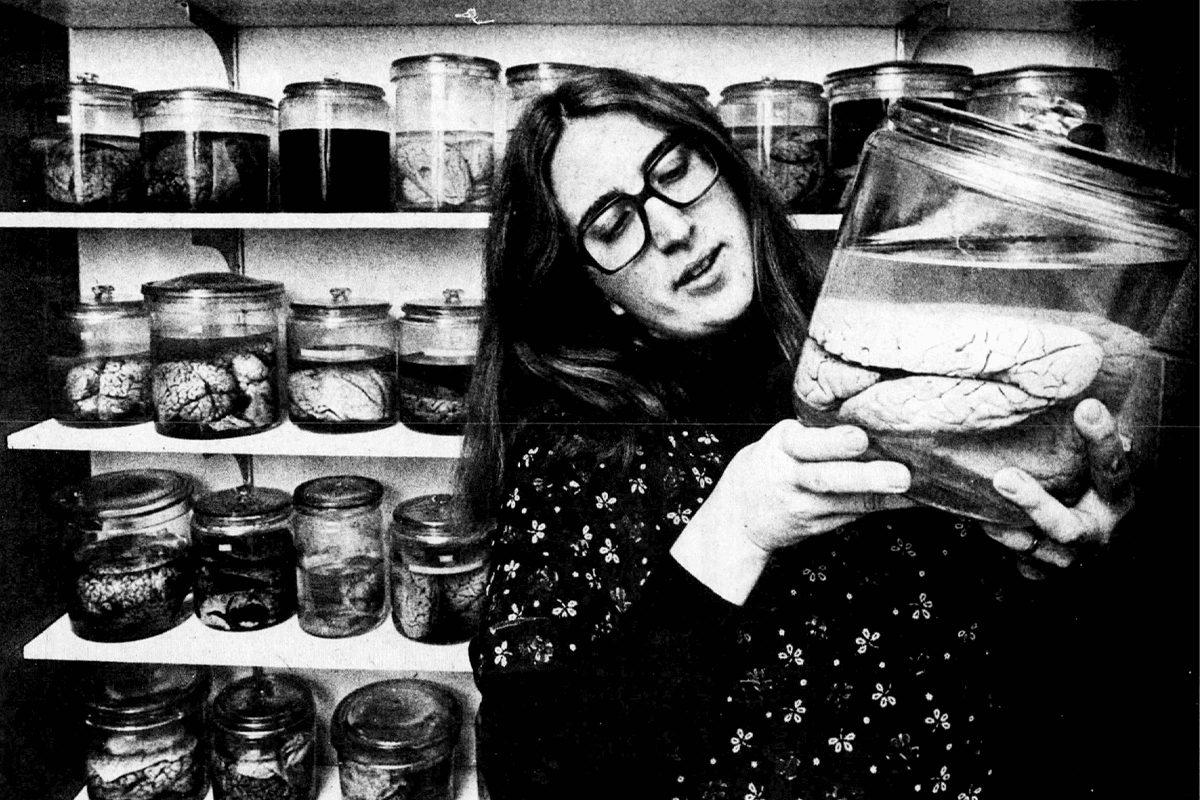
Barbara Finlay looking at a glass jar with a brain.
Brain beholder: Barbara Finlay, pictured here in the Wilder Brain Collection that she curated at Cornell University, spent her 40-year career studying how the brain develops and evolved.
The Ithaca Journal / Richard Marshall
Add us as a Preferred Source on Google

Remembering Barbara Finlay, ‘maverick’ of evolutionary neuroscience

Finlay, who died on 12 September, championed the idea that developmental constraints dictate how evolution sculpts brains, a concept she used to model the timing of hundreds of events and align them across mammalian species.

By Calli McMurray
23 October 2026 | 8 min read

In 1995, Barbara Finlay proposed a rule to explain the structure of every mammalian brain: The size of each region scales with overall brain size, and when a region begins to develop dictates how large it will grow.

At the time, the prevailing idea was that brain structure mirrored a species’ functional adaptations. So a species with a large visual cortex must have sharp vision, for instance, whereas one with a small auditory cortex would have poor hearing. 

Finlay reasoned that evolution could not shape brains in such a freewheeling way but instead had to contend with the rigid rules of development. For her proposal, she drew on her knowledge of those constraints and gathered published data from 131 species. The resulting Science paper she published with her colleague Richard Darlington revealed that brain structures scale together, with different growth curves dictating their ultimate size. Structures born later in development grow larger than those born earlier because there is a larger pool of progenitor cells available to build them. The pair used this rule to predict when neurogenesis begins for different brain regions in many species of mammals. 

This expansive approach was typical of Finlay, who died on 12 September at the age of 75. “She was someone who brought together vast amounts of knowledge and literature into new concepts,” with great originality and creativity, says Gaby Maimon, professor and head of the Laboratory of Integrative Brain Function at Rockefeller University and a former undergraduate researcher in Finlay’s lab. 

“Barb was a maverick,” says Alexander Ophir, professor and chair of the psychology department at Cornell University. “If you paid attention to her work, it pushed you to think differently about everything that you were studying,” 

F

inlay was born on 25 October 1950 in Pittsburgh, Pennsylvania. Her younger siblings—a set of fraternal twins, Kathy and Bill—were born less than two years later. 

As a child, science was not on her radar—she was more interested in history and politics, she said in an interview in 2025. Yet she jumped at the chance to spend a summer out of town, away from her parents at a high school science training program at Indiana University in 1967.

The program included a six-week stint working in a laboratory. Finlay ended up assisting an optometry master’s student with their thesis, measuring how easily people could discriminate triangles from circles and circles from octagons. The project didn’t excite her, but she read up on the field anyway in a library copy of “The Perception of the Visual World,” by James J. Gibson, she said in the 2025 interview. “It knocked my socks off.”
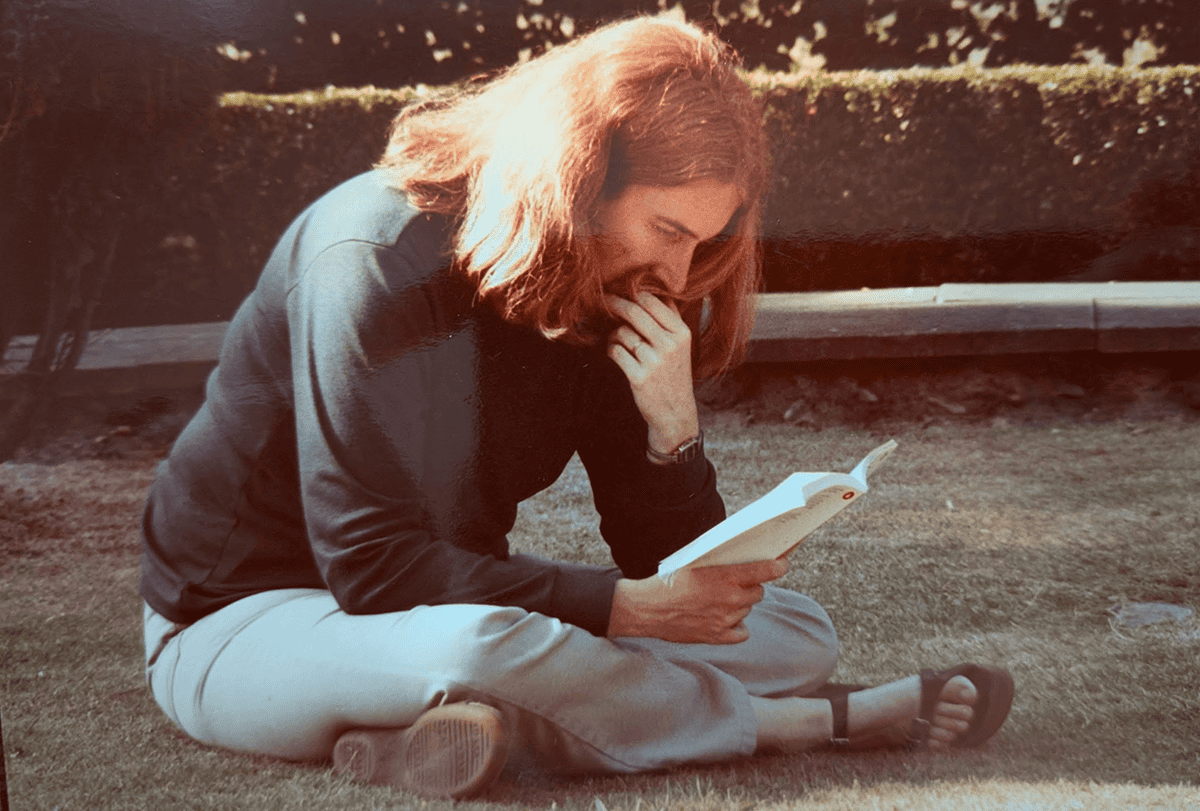
Barbara Finlay sitting on grass reading a book.
Ravenous reader: Barbara Finlay read quickly and widely. Any book was fair game, except for military histories, her son says.
Courtesy of Laura Vineyard

Once she returned home, she watched a TV program about David Hubel and Torsten Wiesel’s experiments recording from neurons in the cat. Her future crystallized: “This is it; this is what I’m going to do,” she recalled thinking. She was going to be a neuroscientist. 

She earned a B.A. in psychobiology at Oberlin College in 1972, and a Ph.D. in brain and cognitive sciences at the Massachusetts Institute of Technology in 1976. She joined the psychology department at Cornell University as assistant professor that same year. 

The early days of her research focused on the development of the visual system, including the role of cell death and how thalamic projections find their targets. The 1995 Science paper—which is her most cited, with more than 1,100 citations, and perhaps her most influential—marked a turning point in her work. “Tying those developmental parameters with the adult structure was really innovative,” says Christine Charvet, assistant professor of neurosciences at Auburn University and a former postdoctoral researcher in Finlay’s lab. Finlay spent the next 20 years refining that model.

In initial follow-up studies, Finlay expanded her predictions to capture more events in development in a larger number of species. In 2001, she also created a table so researchers could “translate time” and find equivalent developmental ages across those species. By 2013, the model included 271 events in 18 species of mammals and covered the first three years of human development. Charvet took over the project when she began her own lab in 2018;  it now contains 1,000 events, and Charvet is working to include the entire human lifespan.

F

inlay possessed a hungry mind. She read widely, constantly and quickly. “When I went over to her house, she would have stacks of books by her bedside that she would read and finish in an evening,” says Jeri Janowsky, a former graduate student in Finlay’s lab. Books on any topic were fair game, except perhaps military history, her son, Will Vineyard, says. 

She had a remarkable ability to retain and synthesize everything she had read, says Malcolm MacIver, professor of biomedical and mechanical engineering at Northwestern University and a collaborator and close friend. A conversation with her could start on the topic of brain evolution before quickly moving on to metabolism, and then robotics, and then how eyes evolved, he says.

As a result, she had unique and often profound insights on an enormous array of topics. “To say that she was a brilliant person underserves her. She is of a different kind of mind,” MacIver says. Yet she could be difficult to understand in conversations: She spoke elliptically, sometimes mumbled, and jumped from idea to idea, he adds.

“Barb would say stuff, and I think two or three years later I’d understand it,” Maimon says. 

Despite her intellect, she was not stuffy or pretentious; she had a dry, sarcastic sense of humor, Vineyard says, and she liked to slip ridiculous things into conversation. When her daughter, Laura Vineyard, was young, Finlay told her that our bodies turn off when we dream, but the same isn’t true for deer, Laura says. “So deer are always walking around, getting into trouble when they’re asleep, because of their dreams.” Laura says she believed this until she was 25. When she later asked Finlay about it, her mother didn’t remember but “laughed and laughed” at the prank.

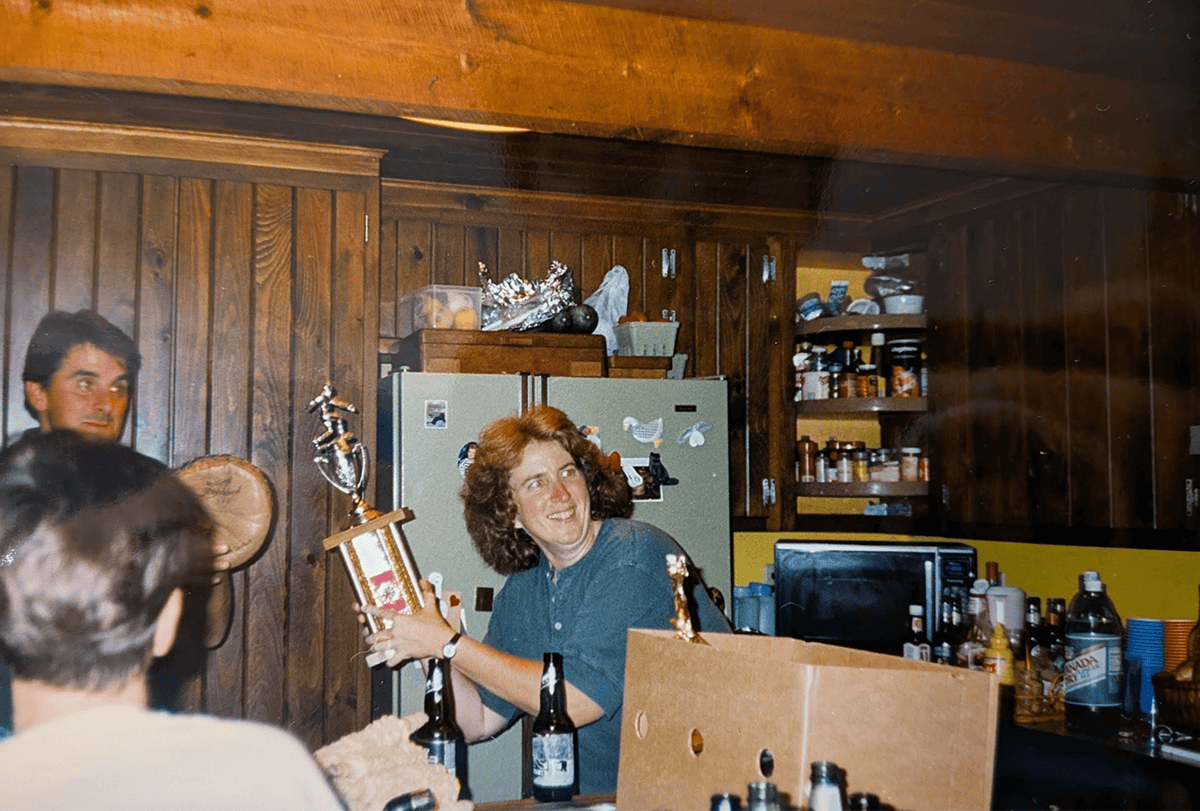
Barbara Finlay at a party.
Brainy bash: Finlay was a fixture of the Cornell community and threw great parties for the psychology department, says former colleague Alexander Ophir.
Courtesy of Laura Vineyard

Finlay fostered an intellectually stimulating and warm environment at Cornell, Ophir says. “If you ever had a problem, you could go to her. And you know you’d walk out head spinning, but with a ton of ideas just floating around.” She served as department chair for five years. Many members of the faculty take a turn in that role, but only Finlay’s tenure is repeatedly brought up as a standard to emulate, Ophir says. She also threw rambunctious parties for the psychology department.  

Maimon’s time in Finlay’s lab was, scientifically, “a big failure,” he says. “My thesis work in her lab produced absolutely nothing. My experiments never worked.” Yet he considers Finlay to be the most influential person in his career. He added Finlay as one of his mentors on NeuroTree, a genealogy of neuroscientists that typically lists only graduate school and postdoctoral mentors. “I wanted to be associated with her.” 

In addition to doing research, Finlay served as co-editor of the journal Behavioral and Brain Sciences for more than 20 years. She took the job seriously and also delighted in it, says co-editor Paul Bloom, professor emeritus of psychology at Yale University. She took great care to provide detailed feedback to young researchers when she had to reject their submissions, “as if she viewed herself as a mentor to the field through her capacity as editor,” Bloom says. “There is no way to quantify how many people in the field she has given advice to and encouraged.”

F

inlay retired from Cornell in 2016, but she remained a fixture in the campus community, Ophir says. She also kept researching the brain and published papers on the water-to-land transition, the case against human exceptionalism, and how the societal role of grandmothers affected brain evolution.

“She had a huge conceptual map of the space of what a brain was and how it evolved and how it developed, and she could just walk around this map and see things that other people couldn’t see,” says Lucia Jacobs, professor emerita of psychology at the University of California, Berkeley and a former technician in Finlay’s lab. 

She slowed down after she was diagnosed with endometrial cancer in 2021. She entered hospice care in June this year following complications from the cancer, but her mind stayed sharp, her children say. 

Maimon visited Finlay for the last time in August. She told him about an infamous April Fools’ prank she instigated in the 1990s. Finlay, at the behest of a few students, put on a research seminar from a bogus visiting professor. They hired an actor from a local acting school to play the professor, who memorized an hour-long script that contained a “crescendo of nonsense,” Maimon says. The actor described his research on fear responses, which involved throwing angry animals at study participants. When the seminar concluded, Finlay and her co-conspirators stood up and took a bow. 

At the end of the story, Maimon asked why on earth she pulled this prank. Finlay told him, “Because it was fun.”

Sign up for our weekly newsletter.

Catch up on what you missed from our recent coverage, and get breaking news alerts.