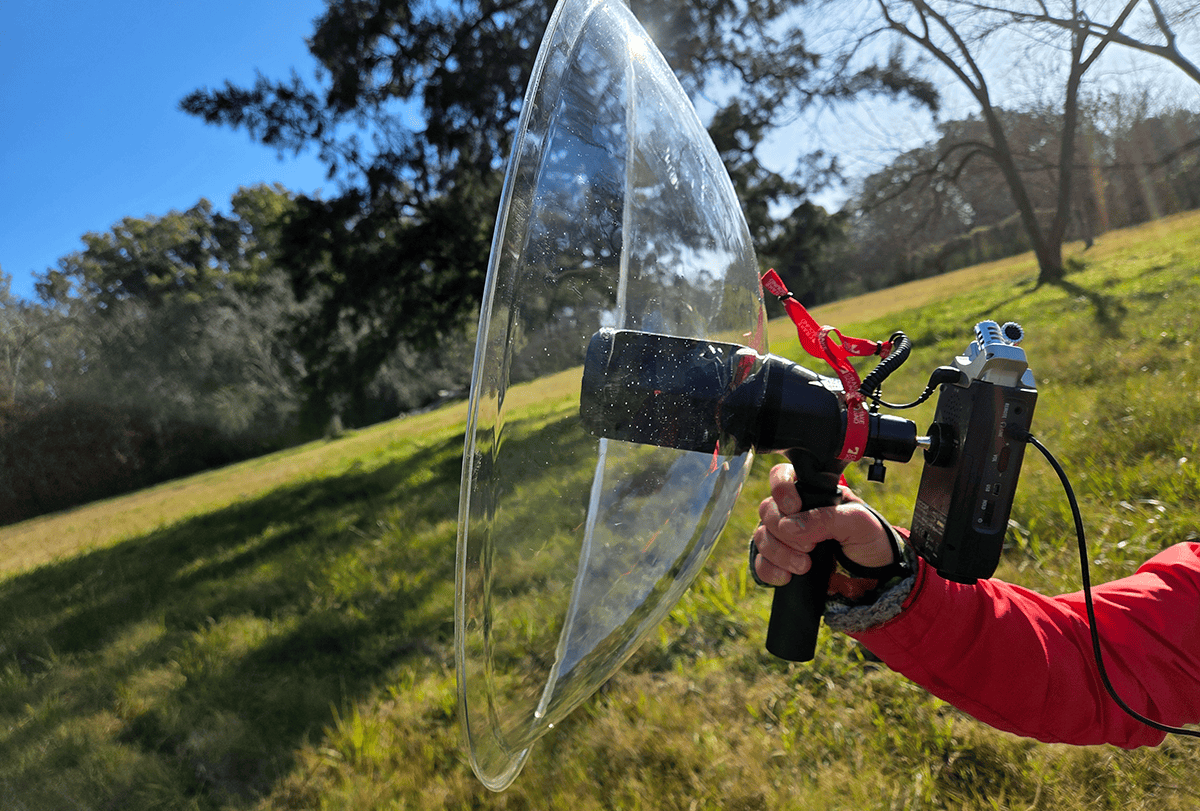
Listen to a male and female Rufous horneros tightly synchronize their songs when singing together:
0:00
/

Oscines and suboscines, two evolutionarily close lineages of birds, do and don’t learn to sing, respectively, helping scientists uncover the neuronal correlates of song learning and variability.
Leia este artigo em português.
Male and female rufous horneros (Furnarius rufus) sing duets, combining their songs in harmony. The songbirds are common throughout the Southern Cone of South America, living in mud nests that resemble their namesake, a woodfire oven.
Horneros are suboscines, a group of birds closely related to oscines. But unlike in oscines, which learn to sing by mimicking a tutor, the suboscines’ song is innate. Comparing the two groups makes it possible to ask questions about the neural origins of vocal production, says Ana Amador, professor of physics at the University of Buenos Aires. “It’s a window of opportunity: Exactly where they are evolutionarily closest, what is the difference between learning to sing and not learning to sing?”
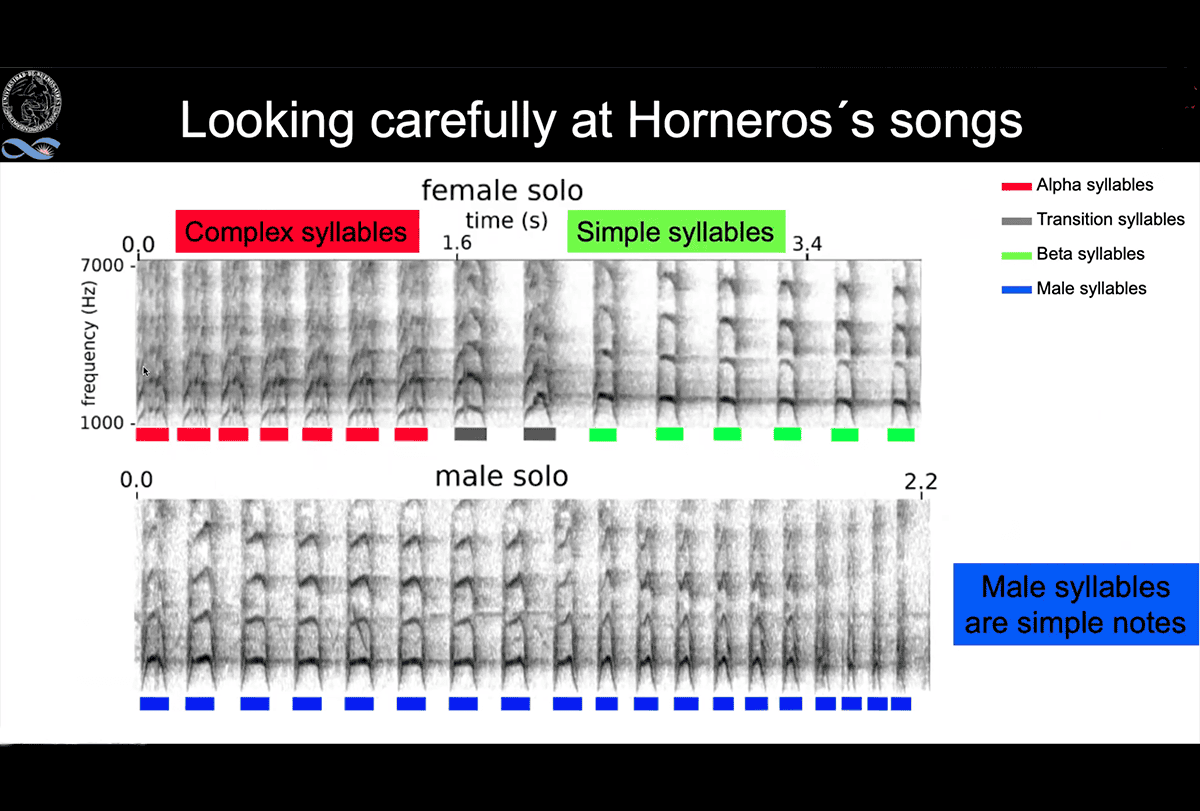
During the COVID-19 pandemic, Amador noticed something odd about the female horneros in her garden. Each one had a distinct, individually identifiable syllable structure, she says. This was unexpected because that sort of vocal signature is typically associated with species that learn to sing. Also, the birds may be one of the only known suboscine species in which the female’s syllables are structurally more complex than the male’s, opening up an opportunity to study sex-dependent differences in birdsong, she adds.
Field recordings from beyond Amador’s garden revealed that each female rufous hornero does indeed have unique vocal characteristics. Biophysical modeling of the motor inputs to the songbirds’ vocal cords recapitulated this variability, Amador found. The model can predict the motor instructions needed to produce each female’s song, but whether those individual instructions originate from the brain, or the variability arises from physical differences in the birds’ bodies, remains an open question. “What instructions is the body receiving to generate song? What instructions is it getting from the brain?” Amador asks.
Amador is continuing to build out a larger dataset of rufous hornero songs to ask how much females’ songs vary across populations. But because horneros can’t survive in captivity, Amador’s group can’t directly test whether those individual signatures reflect distinct motor instructions from the brain.
The great kiskadee (Pitangus sulphuratus), another suboscine common across Latin America, tolerates captivity, however. Implanting electrodes in the muscles controlling a sleeping kiskadee’s vocal organ showed that the muscles activate spontaneously in the same pattern as when the bird is awake and singing. The implication is that the birds are dreaming their songs, Amador says. The lab also works with canaries, which are oscines. Canaries’ rhythmic, repetitive songs make them well suited for studying how the brain encodes song structure at the level of individual neurons using electrophysiology.
Amador says she uses fieldwork to find questions and the lab to answer them. The region’s biodiversity is a “gold mine,” she adds. Most suboscine lineages are concentrated in Latin America, making the region one of the few places to study the evolutionary boundary between vocal learning and innate song.