THIS ARTICLE IS PART OF OUR STATE OF NEUROSCIENCE IN LATIN AMERICA REPORT.

A pop of color: Heliconius butterflies tend to prefer mates that match their own color patterns.
Video by Mariana Murillo
Add us as a Preferred Source on Google

Discovering how butterflies choose their mate

Heliconius butterflies offer a window into the neural circuits and genes involved in mate color preference.

Lea este artículo en español.

Leia este artigo em português.

Heliconius butterflies prefer mates that resemble themselves, and even closely related species have strikingly different patterns, ecologies and behaviors.

“We’re trying to understand how behaviors are coded in the brain, and how this contributes to the diversification of species,” says José Borrero, a graduate student in Richard Merrill’s lab at Ludwig Maximilian University in Munich, who studies Heliconius butterflies in collaboration with Carolina Pardo-Díaz, associate professor of evolutionary genetics, phylogeography and ecology at the Universidad del Rosario in Bogotá, and Camilo Salazar, professor in the same department.

Colombia has an extraordinary density of Heliconius species, with distinct populations on either side of the Andes Mountains, making it an ideal location to study how differences in habitat shape the butterflies’ brains, behavior and genetics. A single genetic locus accounts for about 30 percent of the difference in mate preference between two species, a surprisingly large effect for a behavior as complex as mate choice, says Merrill, professor of evolutionary biology at Ludwig Maximilian University in Munich. The genes underlying mate preference sit physically close in the genome to those controlling wing pattern, meaning that they tend to travel together and help populations stay distinct even when they interbreed. Both sets of genes can jump species boundaries entirely through hybridization, carrying behavioral preferences and color patterns across lineages.

Now the lab wants to understand how those genetic differences translate into differences in the brain.

Vision test: Using an optomotor test, researchers test butterflies’ visual acuity, which they then correlate with investment in the visual parts of the brain and with eye morphology.
Video by Mariana Murillo

The butterflies’ brains continue developing after they emerge from their chrysalises, the collaboration has shown, and for that reason, mature butterflies see significantly better than newly emerged ones. The optic lobes, which process visual information, keep growing throughout the animal’s life, according to a preprint. Species that live in darker, more complex forest interiors have larger optic lobes and better acuity, and rely more on vision over smell when foraging. Males don’t begin searching for mates until their brains and visual ability have had time to mature, the study found.

The fieldwork happens at a research station near Bogotá, where butterflies are kept in large outdoor cages set directly beside the cloud forest the species inhabit. The cages were close enough that the animals experienced the same light conditions, temperature and vegetation found in their natural environment. The setup is essential to the experiments: Butterflies tested under white lab light, without the ultraviolet wavelengths they use to perceive their environment, perform terribly, Borrero says. “If we want to understand how they behave,” he adds, “it’s important to test them in the environment where these behaviors actually take place.”

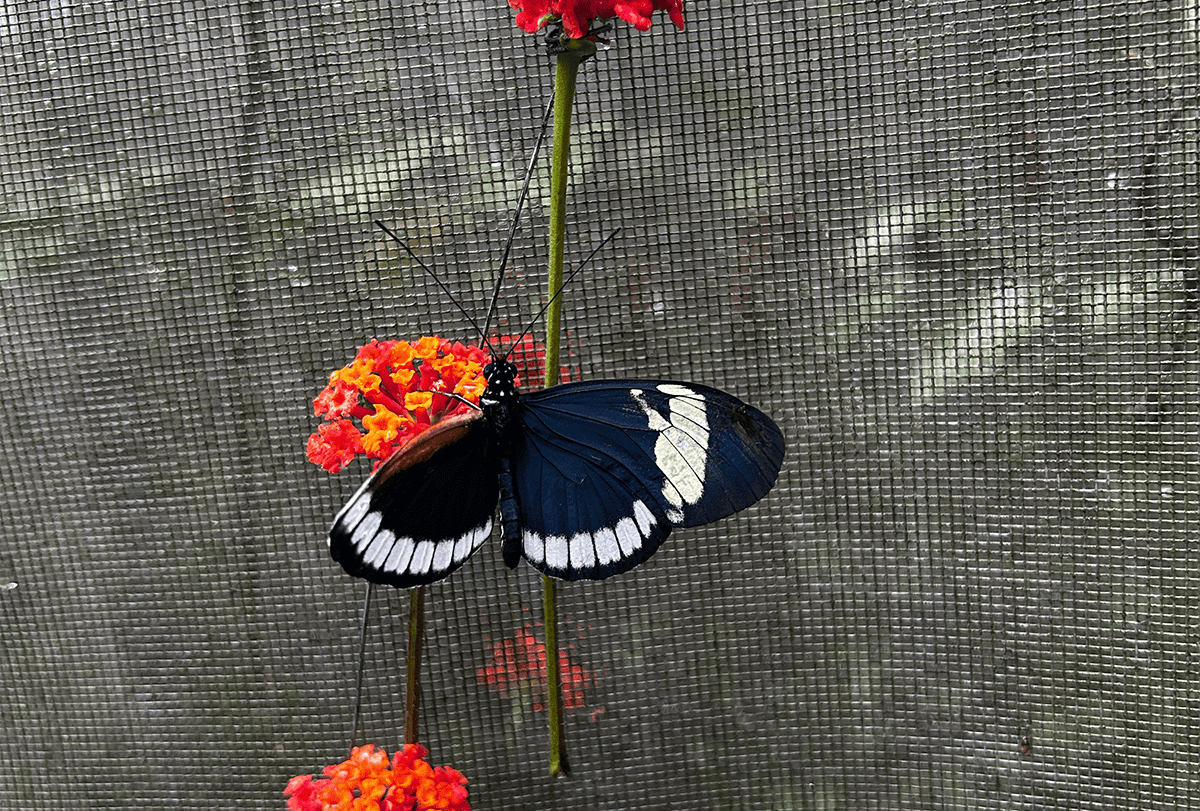
Butterfly on a flower.
Butterly garden: Butterflies were raised in large outdoor cages that closely mimic their natural habitat.
Photography by Mariana Murillo

Sign up for our weekly newsletter.

Catch up on what you missed from our recent coverage, and get breaking news alerts.