Neuromodulators
Recent articles

What should the field prioritize over the next 10 years?
Respondents pointed to a range of challenges in basic neuroscience—such as understanding naturalistic behaviors, intelligence and embodied cognition—and called for more circuit-level research, more precise brain recordings and more work in alternative models. Just as many pushed for a translational pivot.
What should the field prioritize over the next 10 years?
Respondents pointed to a range of challenges in basic neuroscience—such as understanding naturalistic behaviors, intelligence and embodied cognition—and called for more circuit-level research, more precise brain recordings and more work in alternative models. Just as many pushed for a translational pivot.
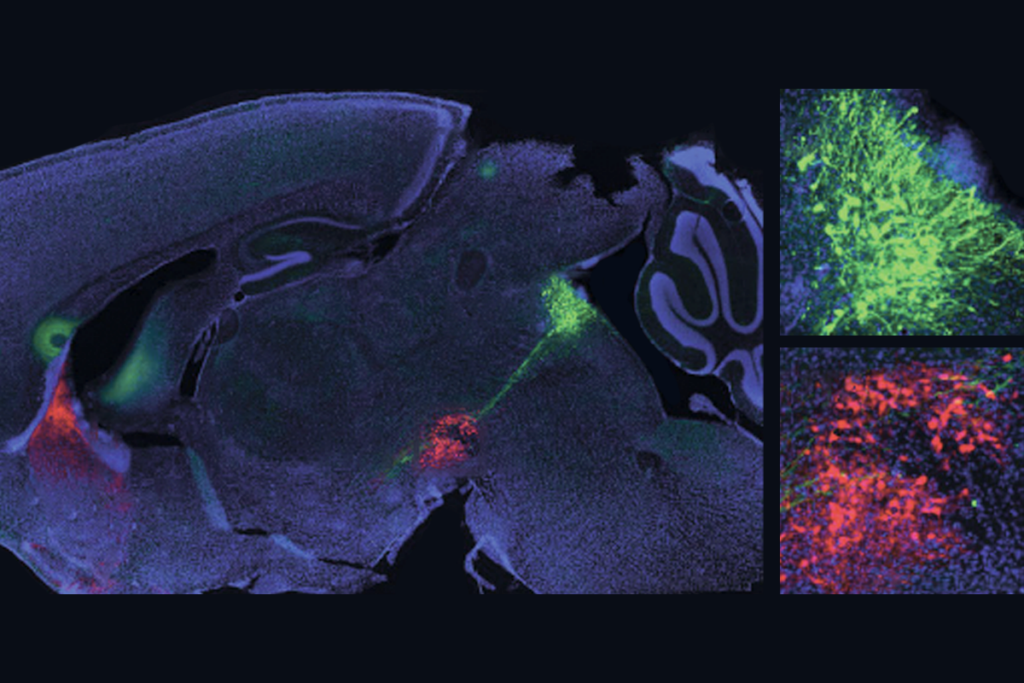
Dopamine ‘gas pedal’ and serotonin ‘brake’ team up to accelerate learning
Mice learn fastest and most reliably when they experience an increase in dopamine paired with an inhibition of serotonin in their nucleus accumbens, a new study shows, helping to resolve long-standing questions about the neuromodulators’ relationship.
Dopamine ‘gas pedal’ and serotonin ‘brake’ team up to accelerate learning
Mice learn fastest and most reliably when they experience an increase in dopamine paired with an inhibition of serotonin in their nucleus accumbens, a new study shows, helping to resolve long-standing questions about the neuromodulators’ relationship.
Explore more from The Transmitter

Creating community through grant support
Fiona Sanderson, a senior program manager at the Brain Canada Foundation, shares how she got into grant administration and how she helps connect researchers with funding and one another.
Creating community through grant support
Fiona Sanderson, a senior program manager at the Brain Canada Foundation, shares how she got into grant administration and how she helps connect researchers with funding and one another.

This paper changed my life: A first glimpse into the ‘middle’ of brain processing
Work by Jeffrey Moran and Robert Desimone showed that monkeys could focus their attention on different stimuli in their visual field without shifting their gaze. Their work marked a key milestone in the emergence of cognitive neuroscience.
This paper changed my life: A first glimpse into the ‘middle’ of brain processing
Work by Jeffrey Moran and Robert Desimone showed that monkeys could focus their attention on different stimuli in their visual field without shifting their gaze. Their work marked a key milestone in the emergence of cognitive neuroscience.
Acetaminophen effects on developing brain organoids; and more
Here is a roundup of autism-related news and research spotted around the web for the week of 12 October.
Acetaminophen effects on developing brain organoids; and more
Here is a roundup of autism-related news and research spotted around the web for the week of 12 October.