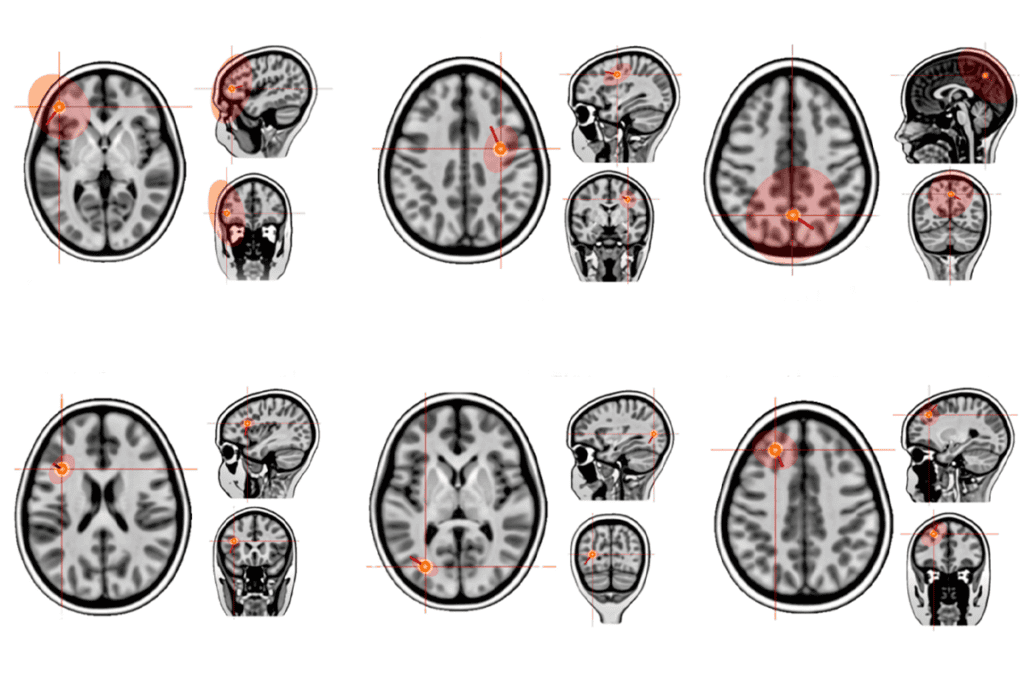
Brain flows, as Michael W. Cole defines them, are “the dynamic processes at the core of what the brain does and what generate the mind.” I couldn’t agree more.
Cole, professor of neuroscience at Rutgers University, has done as much as anyone in the brain imaging community to promote the notion that signals flow through the brain—his early work was among the first to broach the topic. In his new book, “Brain Flows: How Network Dynamics Compose the Human Mind,” Cole serves as an amiable guide through a body of work that places brain flows at the center of cognitive processing.
The book opens with a description of a visit to his daughter’s preschool classroom for “Dad Day.” Each father-child pair is given a collection of simple wooden parts, along with some glue and nails, and left to build something for the child. Eschewing simple constructions, his daughter asks for a unicorn. Cole endearingly describes his attempts and the creativity he and his daughter drew on to make the project a success, at least in his daughter’s eyes.
Cole’s point is that we are dynamic creatures. We need to adapt in real time to the challenges the world constantly throws at us. We must draw on and integrate many different brain systems. Throughout the book, these ideas come through vividly.
Where he is less successful is in describing how brains actually manage this flow of information—for the simple reason that we don’t know. Accurately following brain signals as they traverse the brain remains difficult. But if his evidence is impressionistic, it is no less convincing for being so. He is asking all the right questions.
Part of the reason we remain mostly ignorant of brain flows is that researchers don’t usually think about things this way. As Cole put it in a blog post supporting the book, “Looking across the neuroscience literature, spikes (and their correlates, say with fMRI or EEG activity) are measured from localized neural populations. All manner of sophisticated analyses are used to understand these activity patterns. What about where those activity patterns originate? Where they go? Do we know what they do once they get where they’re going?”
Amen. The brain is a sophisticated system for routing information; it must physically move signals around and adapt dynamically. It is not—or not only—a device for doing point computations as is so often assumed.
Cole demonstrates again and again, through examples of function and phenomenology, how neuroscience focuses almost exclusively on the computations being performed by populations rather than the dynamic flow of signals across networked communities of neurons, regions and systems. He makes a wide-ranging and convincing case that flow is the basis of just about everything else the brain does.
He is at his most detailed and thorough in Chapter 3, when he discusses how “flexible hub” regions in the frontoparietal cortex play a role in goal-setting. “Like thermostats,” Cole writes, “flexible hubs within control networks achieve goals using negative feedback loops,” while mismatches between expected and actual reward serve as gating mechanisms that select flows targeting new goals.
T
hroughout the book, Cole dissects the idea of “functional connectivity,” or inferring brain flows from sequences of activations in different areas. He argues that this work makes strong assumptions, often unspoken, about how putative signals flow and interact. His proposed solution is to bring machine learning into the mix. This may be fruitful, but neural network models also make assumptions and suffer from interpretability problems. Even assuming the biological data are meaningful, he leaves out other sophisticated flow models that have been applied to functional imaging.Although neuroscience lacks a way to reliably track flows across the brain, a few studies give us a glimpse of what it might look like at the single-cell level. György Buzsáki and his colleagues performed an exhaustive search of recordings in the rat hippocampus to see if specific spiking patterns popped up at different neurons over time more often than could be explained by chance. They discovered that spike flows reliably follow trajectories linking single neurons along many different routes. Artur Luczak’s lab has done similar work in the rat auditory system.
More can potentially be done with techniques like these to understand brain flows, provided we assume, as Cole does, that there are flows to be found. Cole doesn’t mention the single-cell work, though it helps motivate his conceptualization of the brain as flow.
There’s also a body of work by a community of researchers studying brain flows from the theoretical side. Rather than trying to explain behavioral data directly from putative brain flows, the goal of this approach is to see how simple, interpretable assumptions about routing affect simulated brain flows on a given connectome. Studies in this area often use nonhuman tracer-based connectomes, which provide a much more detailed and accurate picture of connectivity than is possible with human imaging. Bratislav Misic and his colleagues pioneered early work in this area.
Misic’s model is explicitly based on the idea of brain regions as internet routers, complete with queues to store messages for future forwarding. The model is interesting because it predicts disproportionate flow through areas such as the hippocampus compared with what you would expect based on connection strength alone. This work goes uncited in Cole’s book, along with more recent theoretical models developed by Andrea Avena-Koenigsberger, Danielle Bassett, Richard Betzel, Caio Seguin, Kayson Fakhar and others.
If I am being overly critical, it’s because I want very much to unite the disparate efforts of those who think like Cole but may not realize it, and to show him and the rest of us that we are not alone. Although I think more existing research could have been brought to bear in some sections of the book, my take may be merely due to my own hindsight bias. I am already a devotee of the idea; he was not writing the book for me. The audience, I think, is the ever-expanding community of neuroscientists and those in cognate disciplines of psychology, cognitive science, computer science and beyond, perhaps along with lay enthusiasts of the brain. On this score, he succeeds mightily.
Cole’s book makes a compelling case for why brain flows matter. I hope and expect it will help shape the future course of research across the vastness of neuroscience. I also hope this book will inform the public consciousness and help shift our notion of the brain as a computer to the brain as flow.