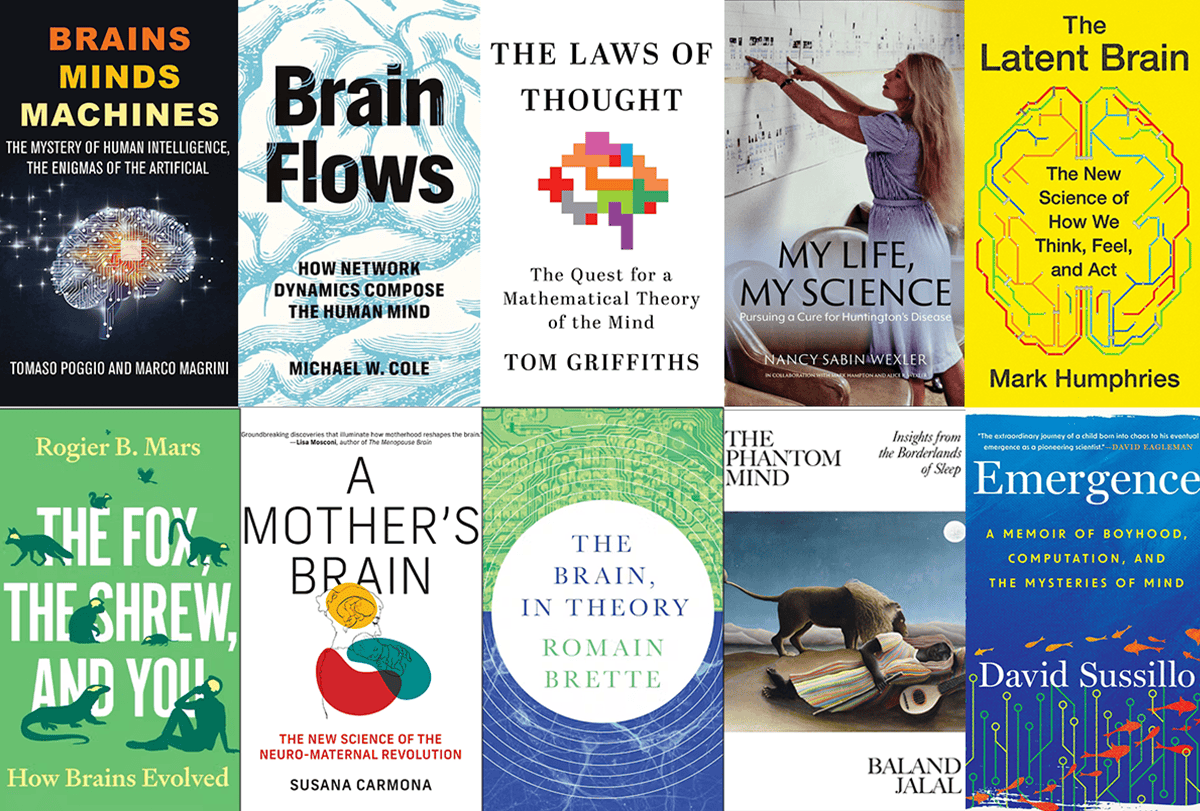
Summer reading: The Transmitter’s book list features titles by prominent neuroscientists such as Romain Brette, Susana Carmona, Mark Humphries and David Sussillo.
Add us as a Preferred Source on Google
Set us as a Preferred Source to see The Transmitter more prominently in your Google Search results.
Five new neuroscience books, and other notable titles from 2026
The Transmitter’s summer reading list includes an autopsy of the Human Brain Project, an overview of the neuroscience of motherhood and a memoir from a pioneer in Huntington’s disease research.
“A Mother’s Brain: The New Science of the Neuro-Maternal Revolution” by Susana Carmona (MIT Press)
In a 2024 Nature Neuroscience paper, Susana Carmona analyzed brain imaging data from more than 100 pregnant women in Spain, making it one of the most detailed studies of what happens in the human brain during gestation. In her new book “A Mother’s Brain,” she provides a comprehensive, research-based view of the dynamic brain transformation that occurs during those nine months while sharing her own experiences of motherhood. Originally published in Spanish in 2024, Carmona’s book dives into the changes in neuroplasticity that happen before and after birth, the neuroscience of matrescence and the connections between hormones and maternal behavior.
Publication date: 6 October 2026
“Brain Flows: How Network Dynamics Compose the Human Mind” by Michael Cole (Princeton University Press)
In his debut book, cognitive neuroscientist Michael Cole examines how brain flows—the movement of neuronal activity between neural populations—shape free will, intelligence and creativity. In the first half of the book, Cole delivers a summary of the latest research in brain flow dynamics in cognitive, computational and network neuroscience. The second half lays out a theoretical framework to guide future research into how these patterns generate the hallmark properties of the human mind.
Publication date: 3 November 2026
“The Phantom Mind: Insights from the Borderlands of Sleep” by Baland Jalal (MIT Press)
Sleep paralysis—a peculiar glitch that results in a hybrid, unstable state of consciousness—is caused by disrupted neuronal mechanisms that flip the brain from wakefulness to sleep. In “The Phantom Mind,” Baland Jalal explores the neuroscience behind sleep paralysis and other states of fractured sleep, as well as their broad cultural impact. Throughout the book, Baland argues that making sense of what happens in the brain during these borderland sleep states is the key to understanding consciousness, imagination and what makes us human.
Publication date: 17 November 2026
“A Brain for Europe: Big Science, Big Models, and the Politics of Unification” by Tara Mahfoud (MIT Press)
In 2013, the European Commission launched the Human Brain Project (HBP) with the goal of building a massive digital infrastructure for brain research. In her new book, sociologist Tara Mahfoud dissects the research and debates that shaped the ambitious initiative, which ended in 2023. Mahfoud uses interviews with HBP scientists and administrators, as well as observations from their meetings with the European Commission, to explore how competing visions over brain models turned into debates over scientific governance, offering a critique of big team science in the process.
Publication date: 24 November 2026
“The Latent Brain: The New Science of How We Think, Feel, and Act” by Mark Humphries (Harvard University Press)
In his latest book, Mark Humphries makes a call for a theoretical shift in neuroscience, arguing that a focus on individual neuronal activity is no longer sufficient to comprehend the brain. He proposes instead the “latent brain” hypothesis, which posits that brain function is embodied in the collective activity of neuronal networks and dynamical systems. Humphries draws on decades of research across brain regions and animal models to survey how dynamical systems help us understand the brain and what the field needs to do to further that knowledge.
Publication date: 2 March 2027
Also published in 2026:
“Brains Minds Machines: The Mystery of Human Intelligence, the Enigmas of the Artificial” by Tomaso Poggio and Marco Magrini (MIT Press)
Originally published in Italian in 2023, “Brain Minds Machines” tells the history of scientists’ attempts to understand intelligence and replicate it using mathematical modeling. Tomaso Poggio, one of the founders of computational neuroscience, and journalist Marco Magrini outline landmark scientific discoveries about intelligence, assess the commonalities between animal and human intelligence and consider the opportunities and risks that artificial intelligence presents for the future.
Publication date: 25 August 2026
“Whole-Brain Modelling: Cartography of the Dynamics of Mind” by Gustavo Deco and Morten Kringelbach (Oxford University Press)
In this book, neuroscientists Gustavo Deco and Morten Kringelbach team up to assess the advances in mathematics, engineering and biophysics that have pushed forward computational techniques of brain modeling. Throughout the book, they dig into the nuances that shape models, such as the turbulence of brain dynamics and the precise parameters of brain region parcellation, to examine what they call the “new science of whole brain modelling.”
Publication date: 4 May 2026
“The Brain, In Theory” by Romain Brette (Princeton University Press)
In “The Brain, In Theory,” cognitive neuroscientist Romain Brette pushes back against theories that describe the brain as a “biological computer.” Across eight chapters, Brette outlines why he believes that the conceptualization of neuronal activity as a neural code is misleading, questions reductionist bottom-up approaches that try to reverse engineer how the brain works and proposes that the field needs to get back to a view of the brain centered around organisms and living entities. Read an excerpt from Chapter 4 of “The Brain, In Theory” on The Transmitter.
Publication date: 7 April 2026
“Emergence: A Memoir of Boyhood, Computation, and the Mysteries of Mind” by David Sussillo (Grand Central Publishing)
David Sussillo’s memoir is a candid account of his life both inside and outside the lab. Sussillo traces his life story from a challenging upbringing in New Mexico, where he navigated his parents’ substance abuse and growing up in the foster care system, to his career as an influential computational neuroscientist. “Emergence” shows how a scientist’s life and work are often inseparable. Watch our interview with Sussillo about the book.
Publication date: 17 March 2026
“My Life, My Science: Pursuing a Cure for Huntington’s Disease” by Nancy Sabin Wexler (Cold Spring Harbor Laboratory Press)
In 1979, Nancy Sabin Wexler travelled to Venezuela to study a community with an unusually high rate of Huntington’s disease in hopes of better understanding the condition’s genetic basis. Inspired by a family history of Huntington’s disease, her groundbreaking field work during that trip kickstarted the research that led to the discovery of the HUNTINGTIN gene, which played a large role in the launch of the Human Genome Project. In her memoir, Wexler, who currently has the disease, gives a thoughtful account of her life’s work and reflects on what it’s like living with the condition she studied throughout her career.
Publication date: 16 March 2026
“The Fox, the Shrew, and You: How Brains Evolved” by Rogier Mars (Princeton University Press)
Rogier Mars examines all corners of the animal kingdom, including lemurs, squirrels, dogs and even the humble sea squirt, to provide readers with an in-depth view of the critical moments in evolution that enabled brains to expand in structure, complexity and cognitive capability. Read an excerpt from Chapter 1 of “The Fox, the Shrew, and You” on The Transmitter.
Publication date: 5 March 2026
“The Laws of Thought: The Quest for a Mathematical Theory of the Mind” by Tom Griffiths (Macmillan Publishers)
The cognitive revolution of the 1950s, spurred by philosophers and psychologists, brought about a conceptual shift in the study of the mind and thought. And with that came an understanding that mathematics and mathematical models of cognition could be used to test hypotheses of the mind against human behavior. In his new book, cognitive scientist Tom Griffiths examines that history and provides his assessment of the current mathematical landscape that seeks to model cognition. He discusses how each of them offer complementary perspectives and explains why they need to come together to provide the field with a more complete picture of the human mind.
Publication date: 10 February 2026
Explore more from The Transmitter
‘The Brain, In Theory,’ an excerpt
By
Romain Brette
7 April 2026 | 5 min read
‘The Fox, the Shrew, and You: How Brains Evolved,’ an excerpt
By
Rogier Mars
10 March 2026 | 6 min read
Cite this article: