A hallmark of deep sleep—slow-wave brain activity that arises when cortical neurons cycle on and off synchronously between 0.5 and 4 Hertz—may drive some of sleep’s restorative functions, according to a new study published last month in Nature Neuroscience.
“We provided direct evidence that these on and off patterns are what really matter,” says study investigator Chiara Cirelli, professor of psychiatry at the University of Wisconsin School of Medicine.
As slow waves travel across the cortex during deep sleep, the excitatory synaptic strength that accrued during waking hours gradually returns to a baseline, a process that helps to consolidate memories, according to the synaptic homeostasis hypothesis of sleep that Cirelli and her husband, neuroscientist Giulio Tononi, proposed more than two decades ago. Computational models and studies of anesthetized animals support the idea, but the field has lacked evidence from non-anesthetized animals.
“Anesthesia and sleep may share some features, but definitely overall they are not the same thing,” Cirelli says.
She and her colleagues used optogenetics to induce sleep-like on/off firing patterns in select regions of the cortex in awake mice. “The idea was to induce these patterns in awake mice, and see whether this is enough to get sleep benefits,” Cirelli says.
As expected, the animals showed a decreased need for sleep; reduced neuronal synchrony and synaptic strength during sleep; and improved memory consolidation afterward.
“What is new is that the artificial induction during wakefulness is sufficient to decrease the need for recovery sleep, and that’s key—it’s not just a property of sleep, it’s really a property of the dynamics,” says Adrien Peyrache, associate professor of neurology and neurosurgery at McGill University’s Montreal Neurological Institute-Hospital, who was not involved in the study.
A
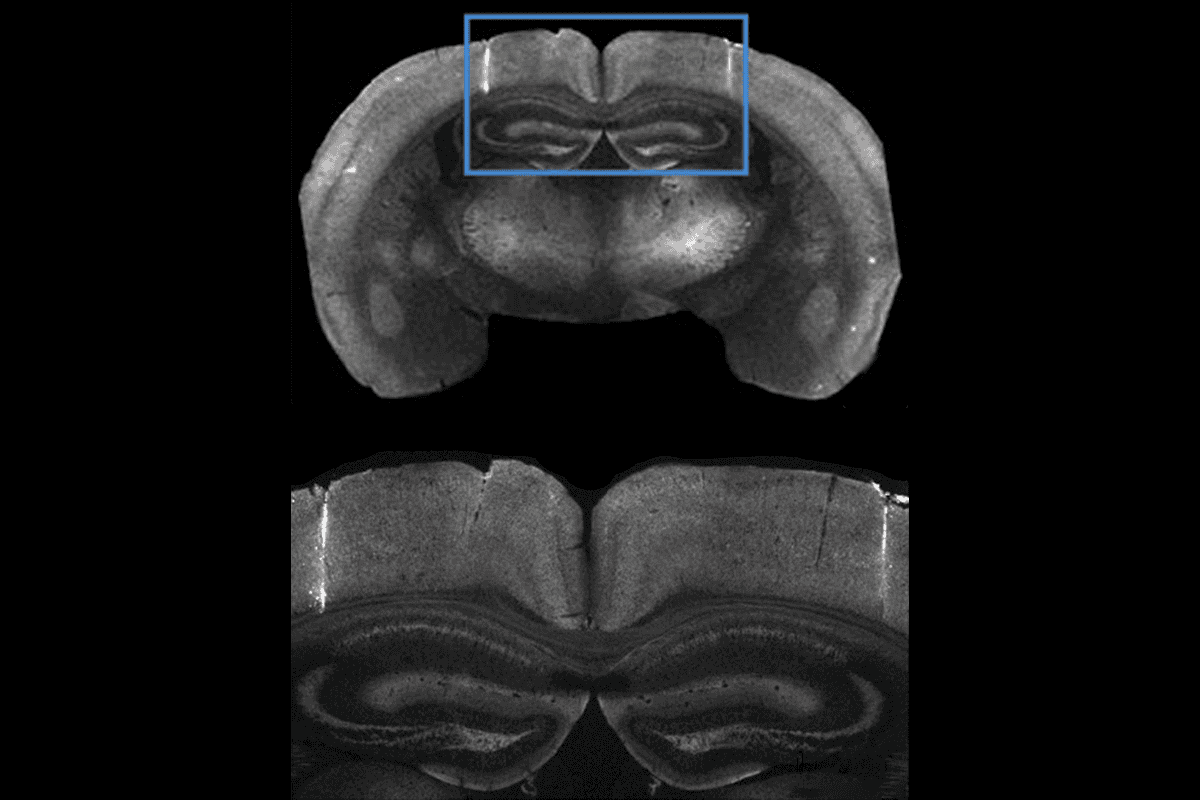
ctivating certain interneurons or inactivating pyramidal neurons using discrete pulses of light—at a frequency that mimics the natural duration of slow waves during deep sleep—produced the “off” pattern during the induced sleep-like state. Between pulses, the neurons resumed normal spiking, generating the “on” pattern. The team delivered the pulses for 30 minutes to just one hemisphere of awake but sleep-deprived mice.When the animals fell asleep, they showed less slow-wave activity in the targeted hemisphere than in the nontargeted one. In other words, the cortical network behaved as if it had already gotten some sleep.
The same was true at the synaptic level: In the targeted hemisphere, two established molecular markers of excitatory synaptic strength—GluA1-containing AMPA receptors and their phosphorylation—decreased as much as they normally would during natural sleep.
The findings support the idea that synaptic renormalization is one of the mechanisms underlying sleep homeostasis, Peyrache says.
The treated mice outperformed their untreated peers on a behavioral test of their memory, called the floor texture recognition task. Given the choice between two floor textures, one of which is familiar, wildtype mice favor the novel one. As expected, sleep-deprived control mice performed worse than engineered mice, which explored the novel floor just as much as well-rested mice did, suggesting that the artificial sleep-like state restored memory consolidation.
The team drew inspiration from a 2016 study that suggests memory consolidation depends on slow waves in the frontal and parietal cortex, Cirelli says. She and her colleagues therefore targeted the same motor and somatosensory cortical regions and used the same behavioral task.
It’s unclear whether the approach would work in other cortical regions, says Luis de Lecea, professor of psychiatry and behavioral sciences at Stanford University, who was not involved in the new study. And it remains an open question whether inducing on/off dynamics in one cortical region can influence global sleep need or whole-brain restoration, Peyrache says.
Cirelli’s next goal is to determine whether comparable manipulations can be achieved in people, she says. “We already have ways of inducing slow waves and on/off patterns non-invasively, through transcranial magnetic stimulation.”