Swim away! Swim away! Unlike their cartoon counterparts, real fish can’t shout to warn others of danger. And yet when a predator is near, schools often manage to scatter all the same. So how do they share the message to escape?
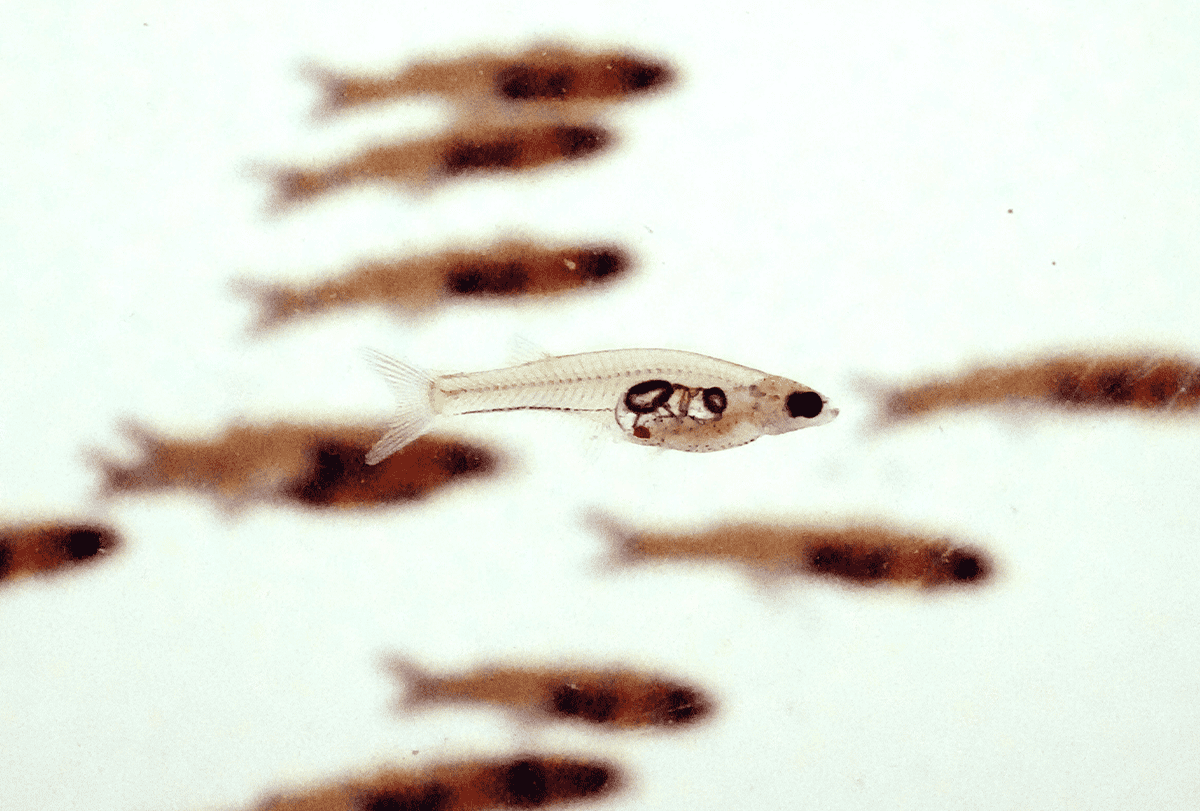
The answer might lie in a group of visual neurons in the midbrain that respond to the actions of social partners, especially during an escape maneuver, according to a study of micro glassfish (Danionella cerebrum) published in Nature in September. The findings show how group actions can emerge from neural computations at the individual level.
Despite a wealth of descriptions and theories concerning collective behavior, to date, there is still little research on how it is implemented in the brain, says Andres Bendesky, associate professor of ecology, evolution and environmental biology at Columbia University, who was not involved in the study. This research showing the neural mechanisms underlying a collective behavior “is really a big step forward” in the field, he says.
The findings build on earlier work from the team showing that these tiny, transparent glassfish—no bigger than a fingernail—rely on vision to school and interact by copying neighbors’ movements. The new study examined how glassfish respond to danger—in the form of a dark sphere representing a looming predator—in different conditions: alone versus in a group and in light versus darkness.
The fish escape faster together than they do alone, a phenomenon called “the many eyes” effect, the results show. And even when their direct perception of the threat is limited, they can still make a quick exit by observing when their companions react to danger.
“Schooling is an interesting window to study a number of topics in neuroscience,” says study investigator Matthew Lovett-Barron, assistant professor of neurobiology at the University of California, San Diego. “Individuals in a group are constantly sensing and acting and deciding in response to each other.”
C
ollective behaviors have been challenging to study in the lab “for a pretty good reason,” Lovett-Barron says. “I mean, what are you going to do, put a microscope on the head of a bird and let it fly off with 1,000 other birds?”But technological innovations have opened up new possibilities for studying the neural activity of natural social behaviors in animals such as glassfish, he says. In this study, the team also created a virtual reality environment featuring realistic fish programmed using video game software. These virtual fish could scatter even without a looming stimulus present, enabling the researchers to see whether a live fish was truly relying on cues from peers rather than via direct threat detection.
The fish responded more naturally when their virtual counterparts moved with a lifelike burst-and-glide swimming motion rather than at a steady pace. “We were having a hard time getting our fish to interact with simple moving shapes,” Lovett-Barron says. But once the virtual fish looked and behaved like real glassfish, the live animals “loved them” and would school alongside, he says. The team then used two-photon calcium imaging to record activity across more than 3,000 neurons as the fish observed their virtual partners.