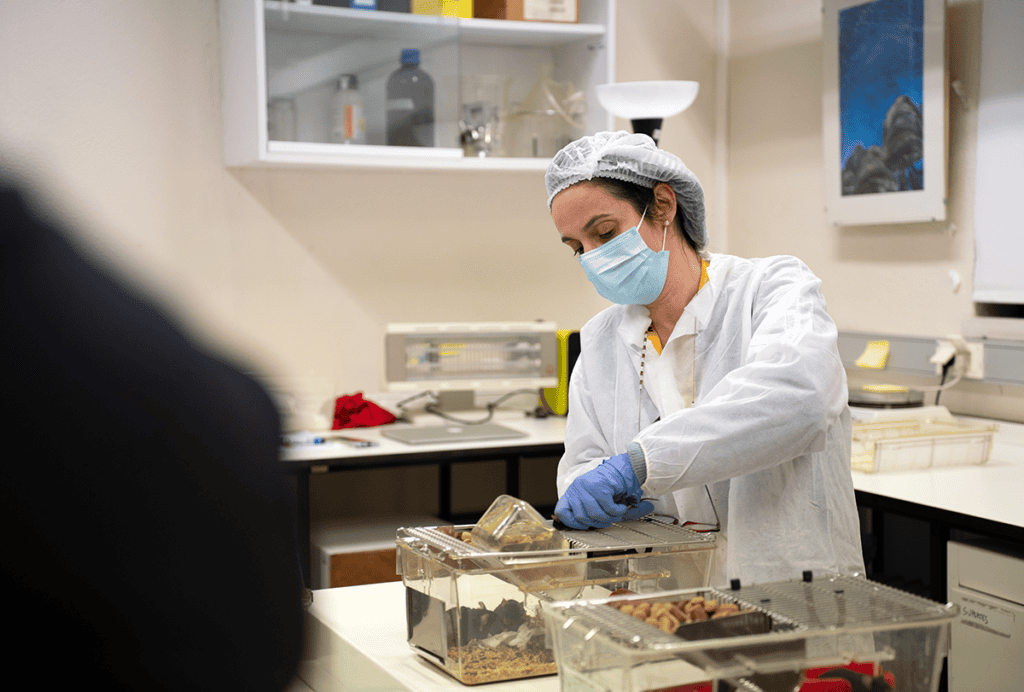
Graduate education has long interested Diane Lipscombe, professor of neuroscience at Brown University, director of the Carney Institute for Brain Science and past president of the Society for Neuroscience. “I’ve always felt [it’s] an incredibly important part of academic research and the educational mission of universities,” she says.
Lipscombe has spent decades overseeing multiple predoctoral training grants, and in 2005 she helped establish an ongoing joint graduate program between Brown and the U.S. National Institutes of Health. That background gives her a useful vantage point at a difficult moment for graduate training: Federal funding upheaval over the past two years has made many programs more cautious about admissions, and faculty less certain they can support new students for the length of a Ph.D. Those pressures raise broader questions about what graduate education is for and how best to sustain it.
Lipscombe, who has won multiple awards for teaching and mentorship, spoke with The Transmitter about how she is thinking about graduate education, what she sees as the biggest trends and concerns, and her advice for new students.
This interview has been edited for length and clarity.
The Transmitter: Graduate programs in the United States are in a lot of flux, given policy and funding changes over the past couple of years. Is now a good time to revisit the purpose of a Ph.D.? How are you thinking about it?
Diane Lipscombe: Fundamentally, it’s incredibly important to bring new voices and earlier-stage career scientists into the system. They are bright, really creative, innovative. Every new generation of scientists is better than the previous one, so it would be such a tragedy not to continue that inflow of new ideas.
Whose responsibility is it? I think it’s collective. Universities must continue to give graduate students the opportunity to dig deep into a particular discipline. But it’s also a responsibility of the funding agencies, because ultimately you want to fund the best science, and the best science is only going to be sustained with early-stage scientists coming into the system, because they have really exciting ideas. So it’s a continual renewal of ideas, innovation and advancing knowledge in the field. I see no other way of doing that.
TT: What trends are you seeing in graduate education?
DL: Certainly generative artificial intelligence: how to use it, how not to use it, what it means. The way you ask a question will determine the output. It’s the same kind of thinking—data in; analysis, information out—but it’s more subtle now.
Then there’s integration across levels of analysis. It has been particularly difficult within neuroscience to go from the molecular to high-level cognitive analysis of brain function, but I’m pretty optimistic and excited about the possibility of new ways of doing that. We’re all envious of the human genome sequencing project and its ability to integrate across so many levels. We live on data, so what are the methods that don’t yet exist that would let us measure information-rich data? I think that’s another area where, as graduate educators, we should be posing those big questions about where the gaps are.
TT: What are some of the biggest concerns in graduate education right now?
DL: There’s certainly a lot of discussion about time to degree. The expectation is five years total, but there are many examples of students extending beyond that. There could be really good reasons for it, and those students can emerge as brilliant scientists. But I think there does need to be reflection on that, because the student really needs to be working toward something productive for an extended time beyond five to six years. There have to be safety nets around all graduate students to make sure it’s in the student’s best interest to continue beyond a certain period of time.
I’m also concerned about the trend of graduate programs expecting students to have master’s degrees before admission. Traditionally in the U.S., those are fee-paying programs, and I don’t think many are need-blind. If that becomes the expectation for getting into Ph.D. programs, you eliminate a very large number of students who can’t afford master’s degrees. It would be a big step backward. The U.S. has always been an incredibly wonderful place to be regardless of your income, and graduate school is typically covered by fellowships. You don’t want to put a financial roadblock in place for students entering Ph.D. programs.
TT: One issue we identified in our survey was a decrease in applications from international students. Is that a concern?
DL: I think we’re at the beginning of that trend, and it’s very concerning. It’s a real risk, even a threat, to the future of scientific research in the U.S. I was just looking at Council of Graduate Schools numbers: Applications to master’s programs from international students dropped by about 40 percent between 2025 and 2026. It’s a big drop, and I think many of us feel a little powerless at this point.
TT: You’ve said T32 programs have had a profound effect on graduate education by creating a more student-centric model. Can you expand on that?
DL: I’m a huge fan. I’ve been involved with them for a few decades, and I think they’re one of the most important mechanisms the NIH has for supporting graduate student development and training. The public investment is pretty small, relative to impact. I think it’s probably, on average, around $50,000 per student per year, give or take.
The impact isn’t just for the students directly supported. The focus on quality within those programs acts as an amplifier of quality generally, so it reaches a much bigger group of students indirectly. Even if an institution doesn’t have a T32, it’s probably going to introduce some of those features, because it makes them more competitive for students.
Most of the programs encourage some kind of rotation, so students can do research in a couple of different labs rather than going straight into one. Students have a committee of multiple faculty around them, not just their adviser. They meet regularly, give presentations and get input from other faculty. And because you’re constantly reporting out on outcomes and on the students’ experience, and typically a group of external advisers comes in, you hear from faculty at other universities and think, “Oh, we should be doing that.” So best practices get shared.
The downside is that T32s can only go to students who are permanent residents or citizens. International students can benefit from the cohort model if they’re in the program, but finding support for them is a gap.
TT: Do you think the graduate degree is losing its appeal?
DL: There’s a lot of disillusionment among graduate students. I think that’s natural when people have been very committed to supporting graduate education through public funds, and suddenly that has been questioned. Within universities, there’s anxiety about the lack of predictability and the number of changes being introduced. Given the option of a clear path and a path that’s somewhat uncertain, students will question what their future looks like. I would say that’s a big risk right now.
TT: Any words of wisdom for incoming students?
DL: I want students to continue to pursue their passion for neuroscience and research. There is no more exciting field with incredible opportunities to advance science and improve health. The lack of predictability and concerns about the future of funding for neuroscience research are real, but historically there has always been a recovery in funding. The economic and health benefits of public funding for neuroscience research are on our side—so stick to your dreams.