Add us as a Preferred Source on Google

Additional data suggest changes in diagnostics underlie increases in autism diagnoses, and more

Here is a roundup of autism-related news and research spotted around the web for the week of 14 September.

By Jill Adams
15 September 2026 | 2 min read

Loose links: Associations between various early-life factors and later-life diagnoses of autism or attention-deficit/hyperactivity disorder appear to be weakening, according to a new study. Children diagnosed with either condition differ from children without these conditions on such factors as birth weight and household income. But an analysis of records from a Danish registry revealed that these differences diminished over the decade studied: 2012 to 2022. The findings suggest that the increase in autism and ADHD prevalence reflect changes in diagnostic practices and specialized health services.

Autism research spotted this week:

  • “Long-read proteogenomic atlas of human neuronal differentiation reveals isoform diversity informing neurodevelopmental risk mechanisms” Nature Communications
  • “De novo structural variants in autism spectrum disorder disrupt distal regulatory interactions of neuronal genes” Genome Research
  • “Autism-risk gene mutations convergently disrupt sexually dimorphic oxytocin circuits to lower social engagement” bioRxiv
  • “Clinical deep sequencing to diagnose pathogenic mosaic variants in malformations of cortical development and epilepsy” medRxiv
    See also: “Patchwork mutations present a new frontier for autism research
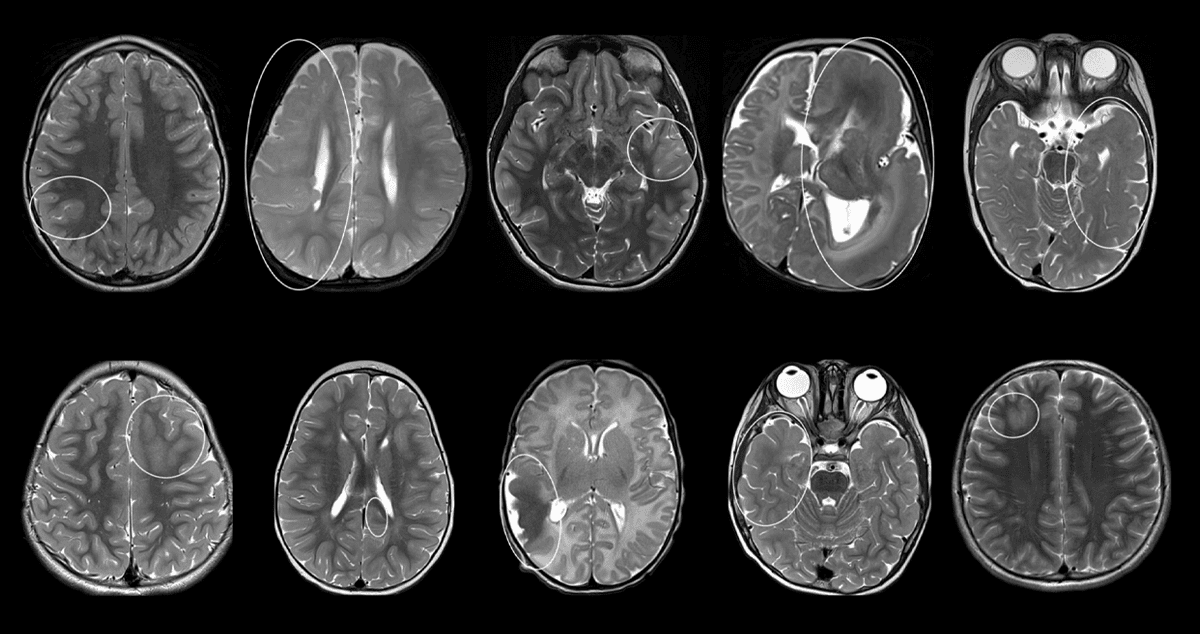
MRI images of malformations of cortical development.
Deep sequencing: MRI images show malformations of cortical development (circled regions), and genetic testing of brain tissue revealed mosaic variants in these 10 people.
  • “Loss of FMRP leads to translationally relevant functional connectivity differences in a rat model of fragile X syndrome” bioRxiv
  • “ERK-dependent hyperexcitability of BLA neurons projecting to dCA3 underlies social dysfunction in a male mouse model of fragile X syndrome” eBioMedicine
  • “Systematic CRISPRi perturbation of 1,408 autism risk genes maps multilevel transcriptional convergence in human cortical neurons” bioRxiv
  • “Longitudinal characterization of giant ANK2-depleted monkeys suggests neurodevelopmental-disorder-like phenotypes” Research
  • “Ultragenyx drug to treat Angelman syndrome, a rare disease, fails late-stage trial” STAT
    See also: “What next for Angelman?

Sign up for the weekly Spectrum newsletter.

Stay current with the latest advancements in autism research.