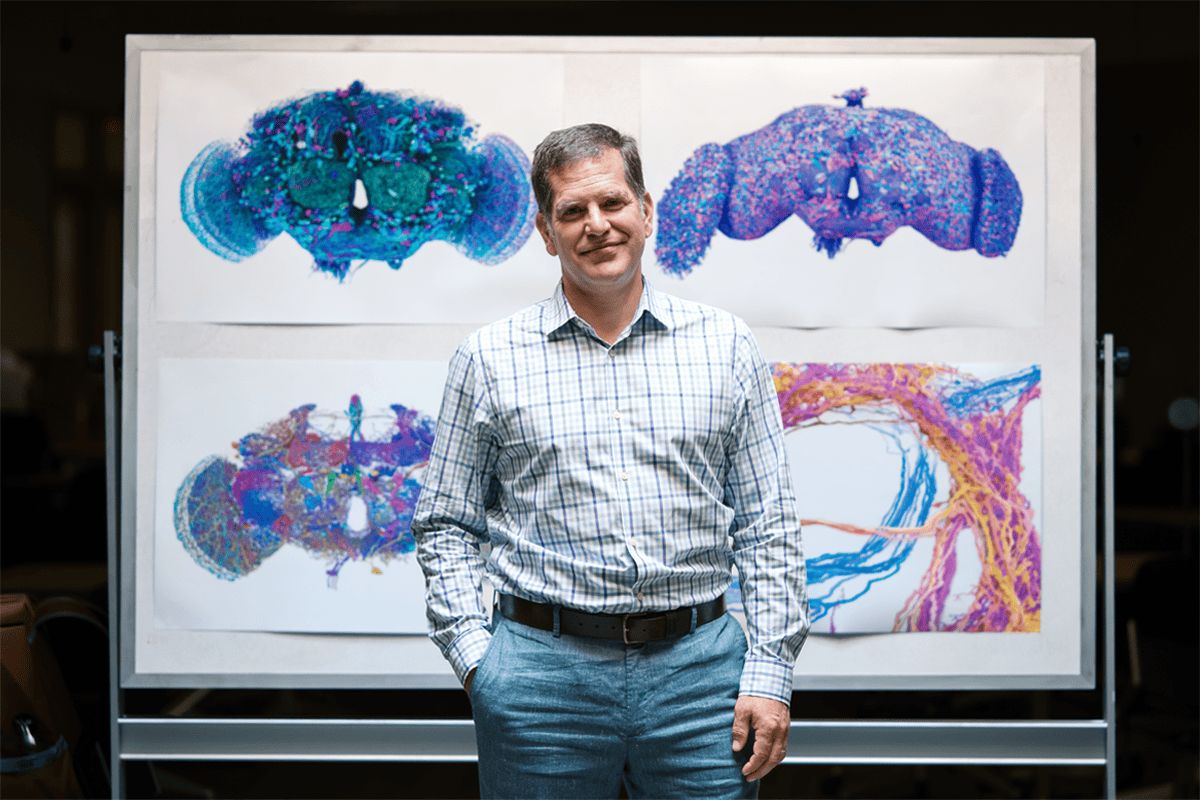
Davi Bock wants to bring the power of volume electron microscopy (EM) to the people.
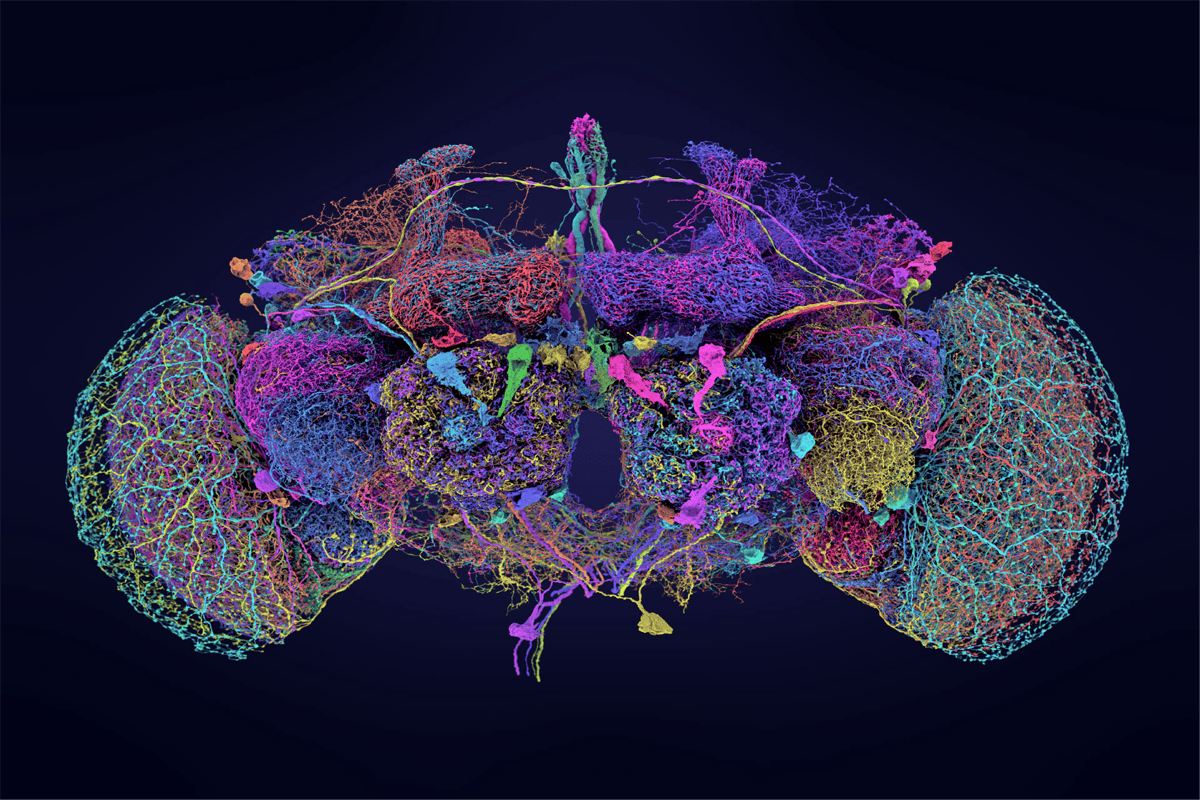
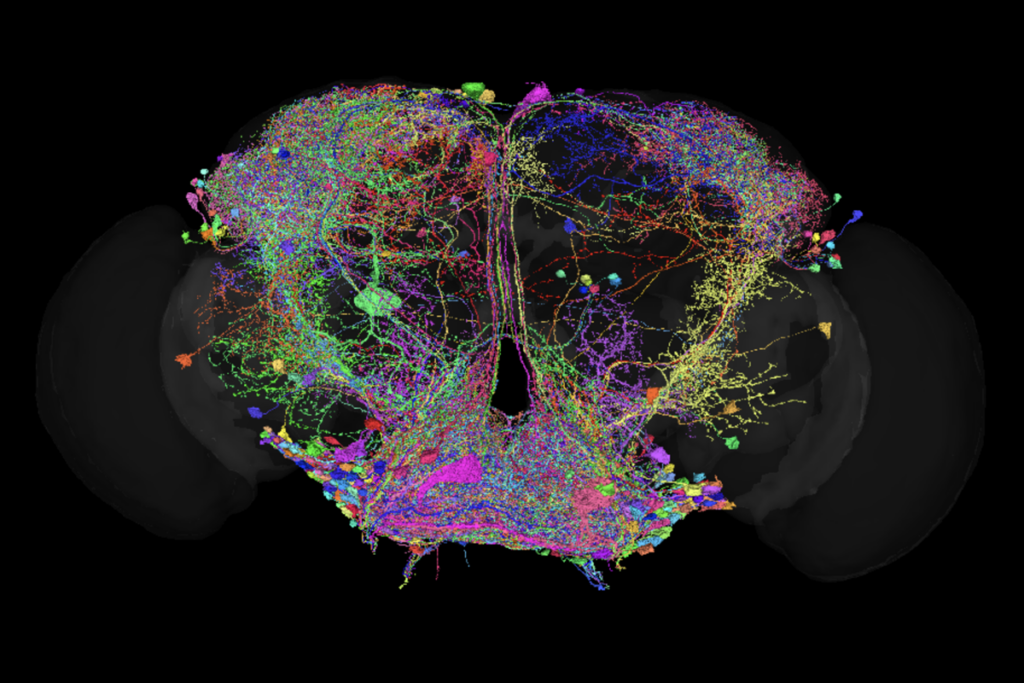
The method’s ability to capture structural details at high resolution on a huge scale has powered the explosion of connectomics—Bock’s lab, then at the Howard Hughes Medical Institute’s Janelia Research Campus, used the technique to produce the 21 million images that became FlyWire, a complete wiring diagram of the Drosophila brain published in 2024.
This technical prowess is expensive, and few labs can afford the necessary equipment—but they could soon obtain the data.
Last month, Bock received a $19 million grant from the U.S. National Science Foundation (NSF) to design a “National Connectomics and Ultrastructure Volume Observatory.” Rather than mapping larger and more ambitious connectomes, the observatory intends to take on smaller projects—requested by outside investigators—that use volume EM to examine how biological structures change in different contexts.
“We should point this high-throughput flashlight across all areas of biology, not only at brain circuit wiring diagrams,” says Bock, now associate professor of neurological sciences at the University of Vermont.
The grant covers a five-year design and testing phase; the team can then apply for an additional five-year award to implement the program. As part of the design process, Bock and his collaborators have four pilot projects planned. One investigates how synaptic changes from learning integrate into hippocampal circuits; one compares the structure of the retina between sharks that live in murky and clear water; another tracks the parasite Toxoplasma gondii as it crosses the blood-brain barrier; and the fourth one pairs volume EM with expansion microscopy to map the distribution of proteins in protists.
Bock spoke with The Transmitter about his goals for the project, the best use of connectomes in neuroscience, and why the White House is interested in this work.
This interview has been edited for length and clarity.
The Transmitter: What’s the current landscape of volume electron microscopy work, and how is the observatory going to be different?
Davi Bock: There’s a handful of groups across the world who have the capability to do high-throughput volume electron microscopy. For the purposes of connectomics, and in general, they focus on ever-larger, monolithic volumes. Maybe it goes from being a whole fly brain to a whole central nervous system, or it goes from the fly to planning for a whole mouse brain. There are smaller projects that these labs will do, but the focus that I’ve seen over the past 15 to 20 years has really been to advance the technology and then take on bigger targets, and just sort of iterate that way.
And as part of my pitch to the NSF, I pointed out that the same throughput gains we’ve enjoyed and collectively worked on could be applied to doing “n of many samples.” Taking smaller samples lets you make structural comparisons across different time points, different experimental conditions, different species, maybe across the development of a disease process.
TT: What was the rationale behind this selection of pilot projects?
DB: To me, the theme across all of the pilot projects—in addition to exercising and validating the pipeline—is information processing across scales. So, in nervous systems and in biology in general, information processing happens subcellularly, at the circuit or tissue scale, and at the whole-organism scale. With high-throughput volume EM, we can span these scales and get an integrated view of the structural bases for that information processing. Having the volume context around a navigating cell, or the full panel of cilia across the surface of a ciliated protist, tells you different things than just a postage stamp, 2D slice through the same object. You get a much more mechanically clear view of how the system operates. The volume context around a biological object of interest is almost invariably enriching and illuminating.
TT: How is the observatory model going to work in practice?
DB: One of my co-principal investigators is Mark Ellisman at the University of California, San Diego, and he runs the National Center for Microscopy and Imaging Research, and I think the way they do it is good. They have a web portal where anybody can submit an inquiry. They work with people who come in cold that way all the time—that allows for people who aren’t on the circuit of fancy science to get in the door with state-of-the-art capabilities. Mark and his colleagues also spend a huge amount of time on the road presenting their work and their capabilities, and so I would foresee that also being a part of the activities of the observatory.
During the award period of the implementation phase, the pricing would probably be pretty cheap or free. But the NSF also cares about the long-term sustainability of its programs, so I will have to think about pricing models—do we get written into people’s grants? Is it fee-for-service? That kind of stuff is not defined. But now we’re looking 10 years out; that’s a long time to look ahead. I would just emphasize this is far from being a University of Vermont-only thing. This is a national resource.
TT: Earlier this year, the White House Office of Science and Technology Policy released the report “Science: A New Golden Age,” and it explicitly mentioned the value of connectome work and that the government could support that type of work. As a leader in this field, what do you make of that?
DB: I haven’t studied that memo in detail. I’ve had my hands full in just getting this thing out the door and through the NSF review process. But I believe I know where they’re coming from, because it’s part of the current thought that connectomics could help motivate next-generation artificial-intelligence (AI) architectures. There are private companies that have received huge amounts of seed funding based on exactly this thesis: that there’s an opportunity to develop some mixture of more robust, more capable or more energy-efficient AI architectures by studying how biological systems process information. There are potentially enormous ramifications that are speculative, so I think it makes sense that the government would have its eye on this approach.
I will say, it’s kind of weird in a way, because when I first got started in connectomics—it wasn’t called that, number one. It didn’t have a name. And number two, everybody thought we were crazy, and they didn’t think it would be useful. Like, there was a large line of argument that said it’s as if you’re studying a forest by learning the position of every leaf on every tree. The details here don’t matter; what matters are the bulk statistics of connectivity in neural circuits. I think, to a large extent, that perspective has been falsified, but it has just been interesting to see the scientific community embrace this category of data, and now not only the scientific community but these startups and other people who I wouldn’t have expected would care so much.