- Autistic people with depression perceive themselves as having more autism traits and worse social interactions than clinician or objective ratings detect, according to a preprint. Research Square
- Okur-Chung neurodevelopmental syndrome, which can resemble autism, is caused by variants of the CSNK2A1 gene, which encodes kinase CK2. Molecular Psychiatry
- The volume of the parasagittal dura correlates closely with cerebrospinal fluid volume and with developmental delay severity. Spectrum has previously reported on excess cerebrospinal fluid as a possible marker for autism. Communications Medicine
Add us as a Preferred Source on Google
Set us as a Preferred Source to see The Transmitter more prominently in your Google Search results.
Okur-Chung neurodevelopmental syndrome; excess CSF; autistic girls
Here is a roundup of autism-related news and research spotted around the web for the week of 21 October.
By
Jill Adams
22 October 2024 | 2 min read
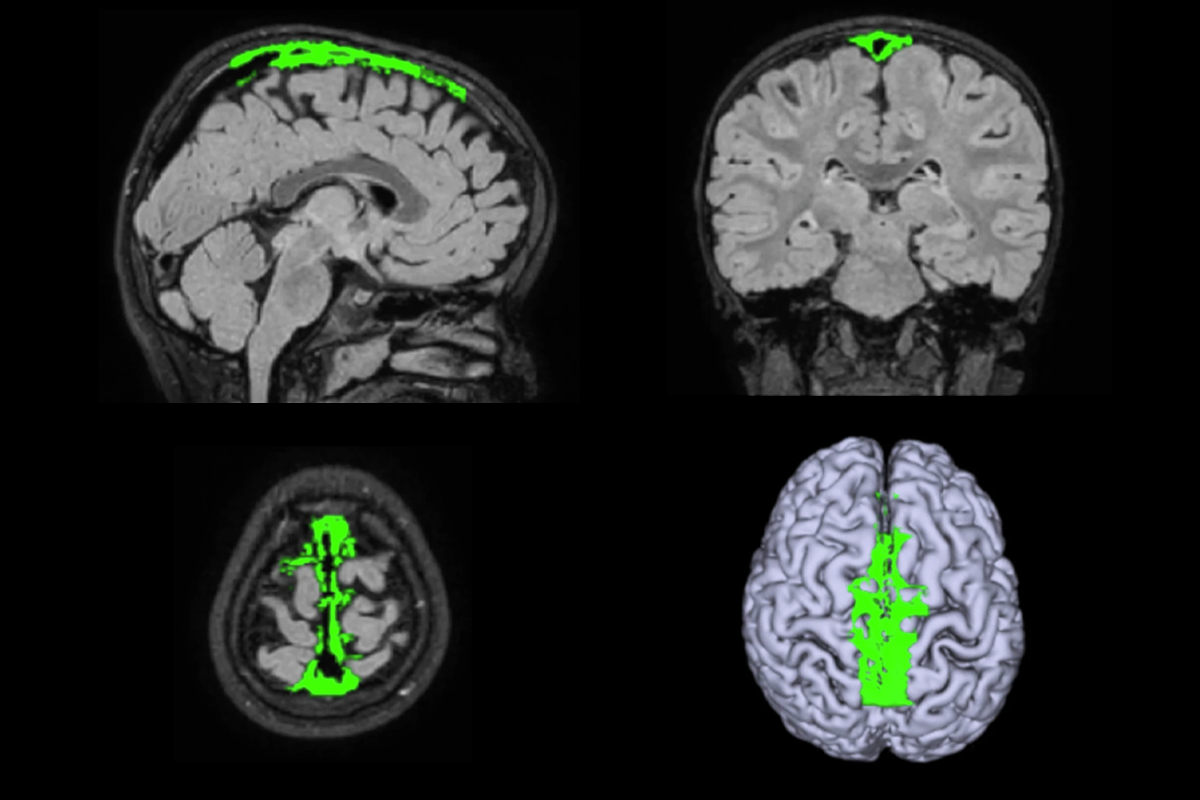
Fluid dynamics: Parasagittal dura volume in the brain, seen here in green, may serve as a marker for autism.
- People with rare recurrent copy number variants and high polygenic scores have elevated odds of autism, attention-deficit/hyperactivity disorder and schizophrenia, according to a preprint. medRxiv
- Various assessments of theory of mind have poorer internal consistency and test-retest reliability in people without a diagnosis of either autism or schizophrenia, according to a review article, thereby undermining the comparisons typically made between clinical and nonclinical populations. Spectrum recently covered discrepancies among theory of mind definitions and measurements. Neuropsychology Review
- The increased likelihood of autism in children whose mothers experienced an infection during pregnancy is largely explained by family traits, according to a cohort study of nearly 3 million people in Taiwan. Spectrum reported on similar results found in a Swedish cohort. Molecular Psychiatry
- Girls who display delayed milestones, such as toileting, or have more problems with thought and attention problems on the Child Behavioral Checklist are more likely to have a positive autism screen using the Social Communication Questionnaire. Journal of Autism and Developmental Disorders
tags:
Explore more from The Transmitter
New projectome captures ‘complex beast’ of serotonin system in mice
By
Madeline Shaw
2 October 2026 | 0 min watch
Silent, motion-resistant fMRI expands scans in behaving mice
By
Diana Kwon
2 October 2026 | 5 min read

Autism-linked variants converge on two molecular patterns in mouse brains
By
Giorgia Guglielmi
1 October 2026 | 4 min read
Cite this article: