- Improvements in in-vivo Perturb-seq, a method that uses CRISPR and single-cell transcriptomics, enable more rapid and efficient targeting of cells throughout the developing brain. Use of the technique revealed that loss of function of the autism-linked FOXG1 gene has cell- and layer-specific effects in mouse cortex. Cell
- A new study challenges the idea that the MECP2 gene, which is linked to autism and Rett syndrome, forms condensates—molecular compartments that act like drops of oil in water—with heterochromatin. In 2020, Spectrum reported on the evidence and uncertainties surrounding these interactions, which could have implications for how MECP2 function is disrupted in Rett syndrome. Nature Communications
- Inconsistencies in age-related changes in brain structure and function have been found in two cohorts of neurodivergent children and adolescents, according to a preprint. bioRxiv
Add us as a Preferred Source on Google
Set us as a Preferred Source to see The Transmitter more prominently in your Google Search results.
MECP2 gene; infant movement and autism; white-matter differences in tuberous sclerosis
Here is a roundup of autism-related news and research spotted around the web for the week of 27 May.
By
Jill Adams
28 May 2024 | 2 min read
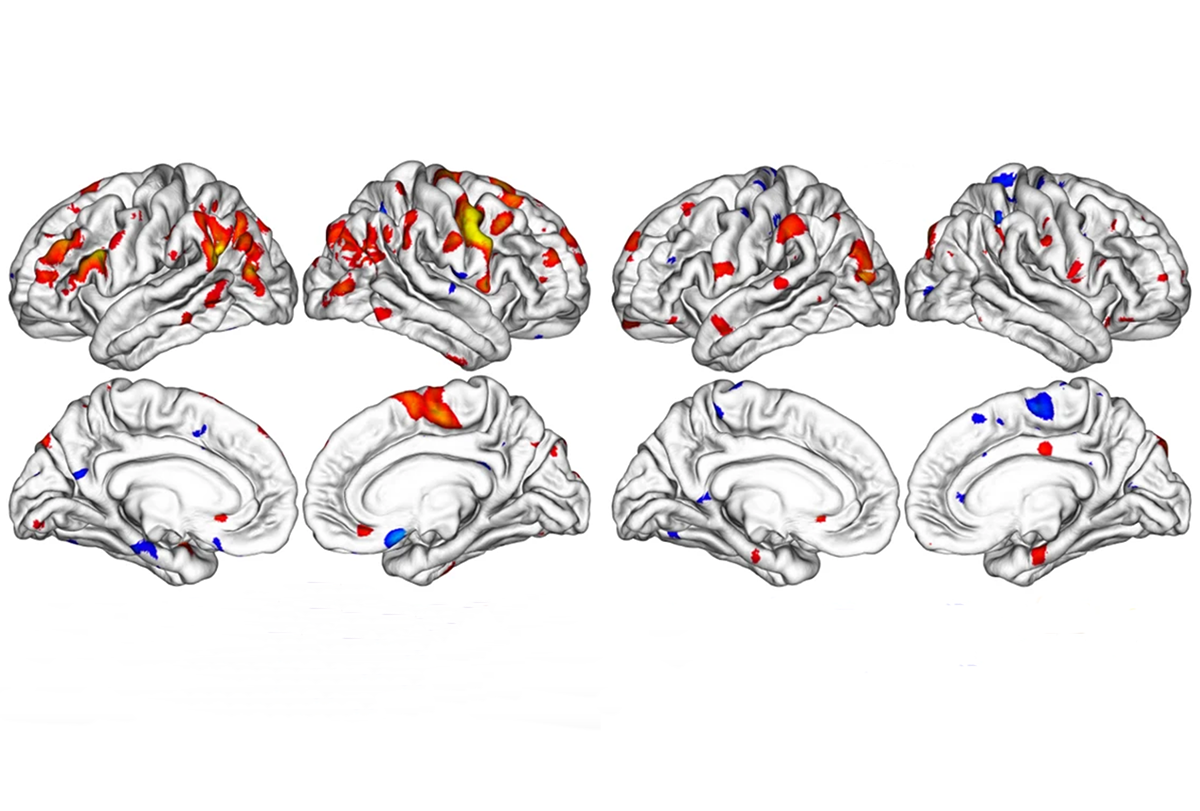
Sex differences: Rates of cortical thinning during development are increased in autistic children (red/orange/yellow), with different patterns in girls (left two) and boys (right two).
- Wearable sensors can detect early movement characteristics that have some predictive value for an eventual autism diagnosis. Autism Research
- Children with tuberous sclerosis complex and autism are more likely to have altered white-matter development than are their peers without autism. Journal of Child Neurology
- The trajectory of cortical thickness in autistic girls differs from that of autistic boys. Molecular Psychiatry
tags:
Explore more from The Transmitter
New projectome captures ‘complex beast’ of serotonin system in mice
By
Madeline Shaw
2 October 2026 | 0 min watch
Silent, motion-resistant fMRI expands scans in behaving mice
By
Diana Kwon
2 October 2026 | 5 min read

Autism-linked variants converge on two molecular patterns in mouse brains
By
Giorgia Guglielmi
1 October 2026 | 4 min read
Cite this article: