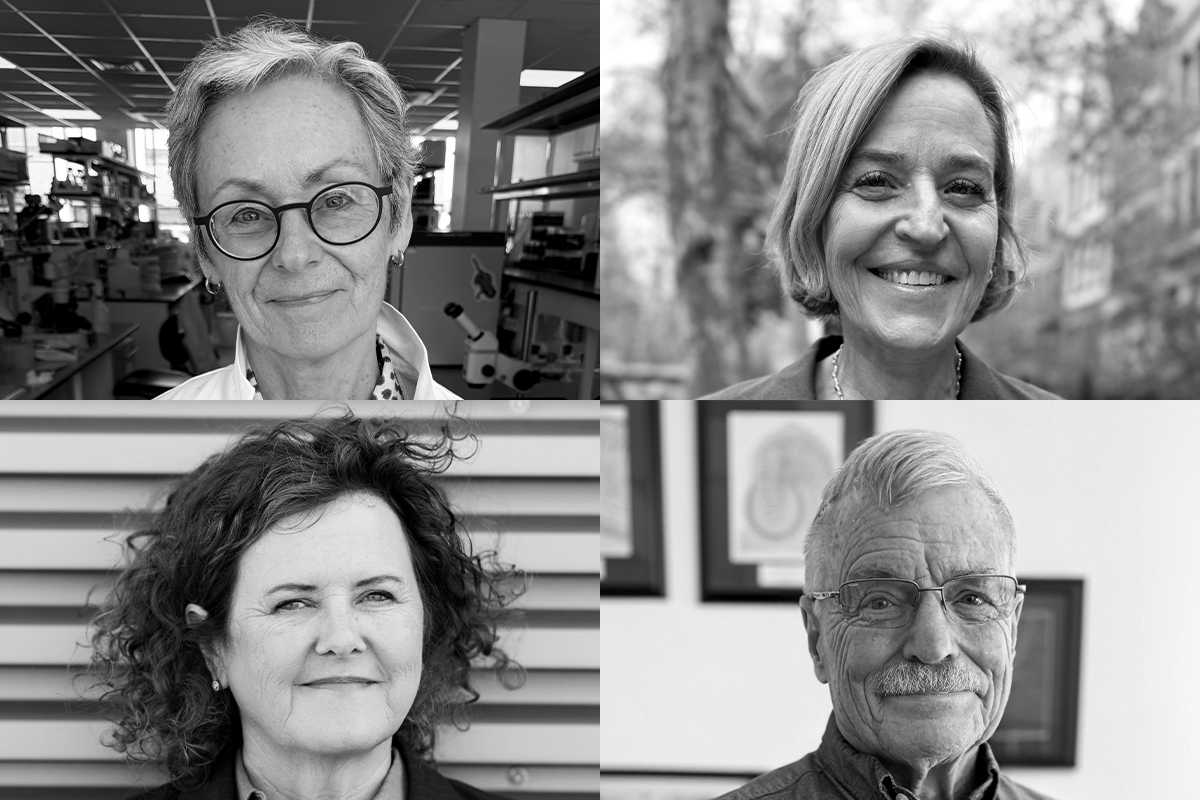
Four scientists whose research challenged traditional views of protein synthesis have won the 2026 Kavli Prize in Neuroscience.
Christine Holt, professor emerita of developmental neuroscience at the University of Cambridge; Kelsey Martin, executive vice president of autism and neuroscience at the Simons Foundation; Erin Schuman, director of the Department of Synaptic Plasticity at the Max Planck Institute for Brain Research; and Oswald Steward, distinguished professor of anatomy and neurobiology at University of California, Irvine will share the $1 million award. (The Transmitter is an editorially independent publication supported by the Simons Foundation.)
Together, their work showed that neurons can synthesize proteins in dendrites and axons and at synapses, not only in the cell body, helping to clarify the mechanisms underlying brain plasticity and memory.
“Their research really broke with what had long been considered almost like a dogma in neuroscience,” says Edvard Moser, director of the Kavli Institute for Systems Neuroscience at the Norwegian University of Science and Technology and chair of the 2026 Kavli Prize Committee in Neuroscience.
S
teward first suspected that protein synthesis happened at postsynaptic dendrites in the early 1980s. He was studying how the rat brain repairs itself after injuries and noticed an increase in protein synthesis—but in the dendrites, not in the cell body where he expected it. Electron microscopy of the dendritic spines revealed polyribosomes at spine synapses, he recalls. “I said, ‘Oh my God, that’s a mechanism for local protein synthesis.’”Steward’s work “got the ball rolling,” says Mark Bear, professor of neuroscience in the Picower Institute for Learning and Memory and the Department of Brain and Cognitive Sciences at the Massachusetts Institute of Technology. “If there are ribosomes there, there must be protein synthesis. And I think the question then became: What possible role is there for this protein synthesis outside of the soma?”
Dendrites are not the only local protein synthesis sites. In one of Holt’s live-imaging experiments in the late 1980s, she severed axons in Xenopus frog embryos and noticed that the growth cone at the axon’s tip continued to develop normally. “So we knew that it could behave autonomously, proving that the proteins that were needed were not from the cell body,” she says. Holt and her colleagues then used laser capture and microarrays to detect hundreds to thousands of RNAs within the cones. “It was a little bit like finding the pearl in the oyster,” Holt says.
Schuman showed in the mid-1990s that messenger RNAs (mRNAs) are translated directly in dendrites of mouse and rat neurons, both at baseline and in response to synaptic activity. She isolated ribosomes with attached mRNA and sequenced those fragments, showing that the ribosome was actively translating the mRNA. “By looking at the subcellular compartments, we could directly determine that protein synthesis was happening,” she says.
A few years later, Martin was studying neurons from the sea slug Aplysia californica. “Because the cells are so large, you can cut off the cell body and stimulate the branch and record from the postsynaptic cell,” she says. Fluorescence protein-labeling and imaging techniques showed proteins being synthesized right at the synapse. The results revealed that local translation enables individual synapses to regulate their strength independently.
This independence is an important detail, Martin says, because every neuron has a single nucleus but can have thousands of synapses. “Local protein synthesis allows for a fast temporal response,” she says.
“In neuroscience, it takes time to be certain,” Moser says. According to him, this body of work is not only excellent in quality, it is the kind of transformative research the Kavli Prize Committee looks for.
Identifying the neuronal functions that uniquely depend on local protein synthesis remains an active area of research, Bear says.
The winners were announced today in an online video. The Kavli Prize, which is awarded every other year, is a partnership among the Norwegian Academy of Science and Letters, the Norwegian Ministry of Education and Research and the Kavli Foundation.