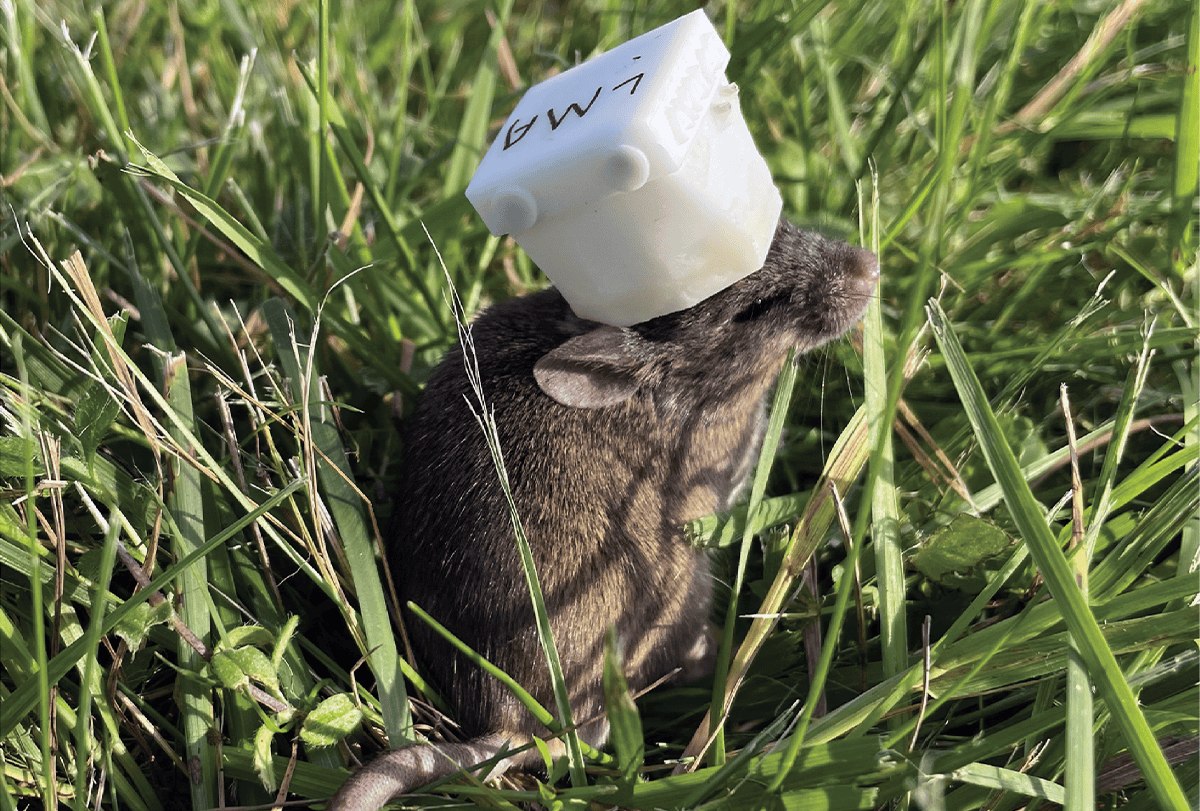
Mouse wearing a white, cube-like device on its head.
Wireless logger: Mice implanted with the device moved similarly to those without it and farther than tethered mice, and they also showed a wider range of social behaviors.
Courtesy of Praveen Paudel
Add us as a Preferred Source on Google

WILD platform levels up ability to record brain activity, behavior in nature

The customizable rig combines multimodal recording, onboard processing and neuronal manipulation to power more complex experiments.

By Simon Makin
29 October 2026 | 6 min read

A new platform records neuronal activity and multiple behavioral measures, and includes optogenetic stimulation, enabling researchers to study the neuronal underpinnings of small animals’ behavior in natural environments. Researchers describe the platform in a paper published last month in Nature Methods.

Previous efforts to record and manipulate neuronal activity in freely moving animals typically used tethers, which interfere with natural movement, especially in social settings involving multiple animals. Wireless devices exist, but these are usually heavy, which can also affect behavior, and they have limited battery life. 

“Our dream was to bring neuroscientific studies closer to the natural behaviors animals express in the wild,” says study investigator Antonio Fernandez-Ruiz, associate professor of neurobiology and behavior at Cornell University.

The device, called WILD (Wireless, Interactive, Lightweight Datalogger), combines recording electrodes with multiple behavioral sensors (a head-mounted camera, a microphone and a motion-tracking unit) and an optogenetic stimulation module. Rather than transmitting neuronal data, the device includes onboard signal processing and a microSD card for storage. It also incorporates a microcontroller unit and Bluetooth wireless communication of control and synchronization signals.

“What makes this impressive is the level of integration into a platform that can do multimodal recording, onboard processing and neuronal manipulation in a package that supports freely moving animals,” says Daniel Aharoni, associate professor-in-residence of neurology at the University of California, Los Angeles, who was not involved in the work. “Bringing these capabilities together makes experiments in complex environments and social settings much more practical.”

The platform weighs 4.7 grams, including a 1.65 gram battery and casing. A 2.5 gram battery would allow about three hours of continuous neuronal recording, using 64 channels and sampling at 20 kilohertz, but the device is highly configurable. “You can enable or disable any component or run it at a reduced sampling rate for longer, so it’s easily tailored to different experiments,” says study investigator Zifang Zhao, a research associate in Fernandez-Ruiz’s lab who led the engineering.

“The idea was to enable a field of research at the intersection between neuroscience and ecology,” says study investigator Azahara Oliva, assistant professor of neurobiology and behavior at Cornell. Previously, researchers could record brain activity while animals performed laboratory tasks, or behavior over longer time frames in nature. “Here we can look at both,” Oliva says. “We can see what animals do in the natural environment and correlate it with changes in light, temperature or the presence of predators.” This opens up experiments investigating everything from the effect of seasons on the brain to the long-term impacts of psychedelic drugs, Fernandez-Ruiz says.
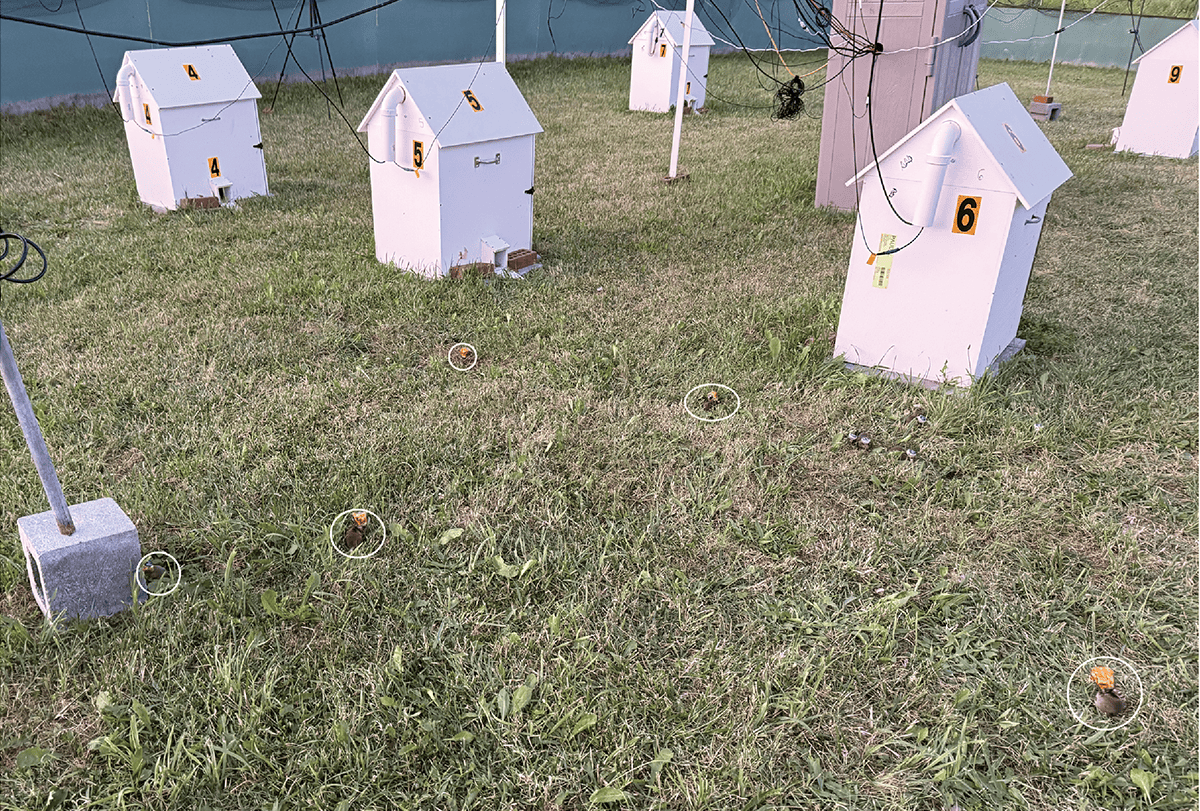
Small white houses atop grass for the study subjects.
On track: Mice implanted with the WILD device (circled) moved less during the day than at night in a large outdoor enclosure containing resource zones (white boxes).
Courtesy of Praveen Paudel

T

o demonstrate WILD, the team recorded the brain activity, pupil dynamics, ultrasonic vocalizations and movement of mice interacting in a large laboratory arena. Mice implanted with the device moved similarly to those without it and farther than tethered mice and also showed a wider range of social behaviors than tethered mice, including circling, sniffing, fighting and chasing. The proportion of time spent on each was similar for mice with and without the device, whereas tethered mice mostly just pushed other mice away.

The device can switch into a minimal-power “idle” mode, either via a control signal or when triggered by events. The researchers used this to record from nine mice over 15 days in a large outdoor enclosure. A crystal oscillator synchronizes multiple WILD devices and external signals, and an ultra-thin plastic coating protects the device from humidity and damage. The team found that the mice moved less and experienced more non-rapid eye movement (non-REM) sleep during the day than at night. “Some of the findings are new, which in itself shows you the utility of this approach,” says Jason Kerr, managing director of the Max Planck Institute for Neurobiology of Behavior, who was not involved in the work. “What surprised me was these mice don’t move around that much.”

During non-REM sleep, activity in the hippocampus is dominated by slow-wave ripples, short, high-frequency oscillations associated with memory formation. Despite more non-REM sleep happening during the day, slow-wave ripple rates were greater during nighttime non-REM, suggesting enhanced memory consolidation, possibly because more new information had just been gathered, Fernandez-Ruiz says. 

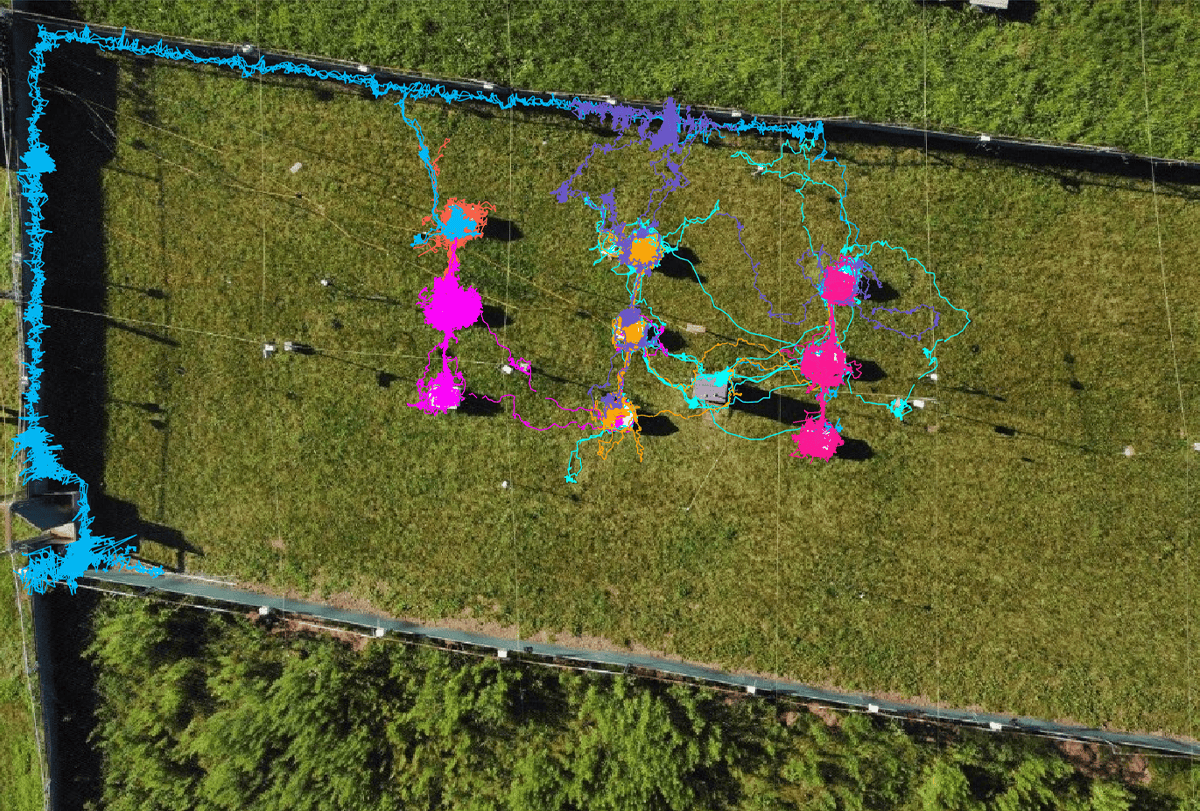
Running wild: The device tracked the animals’ trajectories and gathered the first-ever recordings of place cells encoding locations while mice navigated a naturally complex environment.
Courtesy of Praveen Paudel

The team also gathered the first-ever recordings of place cells encoding locations while mice navigated a naturally complex environment, Oliva says. These were similar to those from laboratory experiments, but the team has also seen differences, which they are pursuing in another study, Fernandez-Ruiz says.  “The traditional model of how these maps are generated is difficult to reconcile with the complexity of natural environments,” he says. “We found that there’s an integration of spatial and social information in the hippocampal map.”

Onboard signal processing and machine-learning algorithms can trigger optogenetic stimulation upon detection of specific neuronal patterns or behavioral signatures, or both. Such “closed loop” manipulation is a powerful tool for studying the neuronal underpinnings of behavior. “A clear example of where this could be useful is social interaction,” Aharoni says. “You could inhibit or excite a brain region, driven by what’s happening in real time, whenever a certain interaction starts.”

The team used off-the-shelf components and made everything open source, with publicly available documentation, to encourage other researchers to use the platform. “They’ve been very successful at making this as open as possible,” Kerr says. “This is the way neuroscience should be heading, in my view.”

WILD is also modular. “If someone wants a new sensor to measure some physiological parameter, they can create their own module and integrate it,” Fernandez-Ruiz says. “If enough people get on board, we’ll have an ecosystem of devices with multiple capabilities that share this basic platform.”

The team hopes to emulate related efforts such as the “miniscope,” a wireless calcium-imaging platform developed by Aharoni and his colleagues, Fernandez-Ruiz says. The open-source nature of the miniscope has led to its use in more than 1,000 labs worldwide.

This effort is already underway. “We’ve been contacted by people wanting to use this in other animals—for example, tiny birds that they cannot record with normal systems,” Fernandez-Ruiz says. “All sorts of studies that we didn’t envision; that’s very nice to see.”

Sign up for our weekly newsletter.

Catch up on what you missed from our recent coverage, and get breaking news alerts.