Purkinje cells—the cerebellar cortex’s primary output neuron—underwent a stepwise shape transformation over the course of human evolution, according to a new preprint.
The cells show varying degrees of dendrite complexity across 11 species of primates, the study reveals. In humans, the cells open like a book, allowing for a bigger dendrite surface and more synaptic input, says study investigator Christian Hansel, professor of neurobiology at the University of Chicago. The findings flag Purkinje cells as a key node for evolutionary change, he adds: “I’m not aware of any other type of neuron that changes that extremely.”
Despite the range of behaviors the cerebellum mediates across vertebrates, it was, until recently, considered “not to have changed much during evolution,” says Robert Barton, professor of evolutionary anthropology at Durham University, who was not involved in the preprint.
The new study adds microstructural detail to a growing body of evidence that “there are all sorts of fascinating adaptations, cerebellar adaptations, across the tree of life,” Barton says.
I
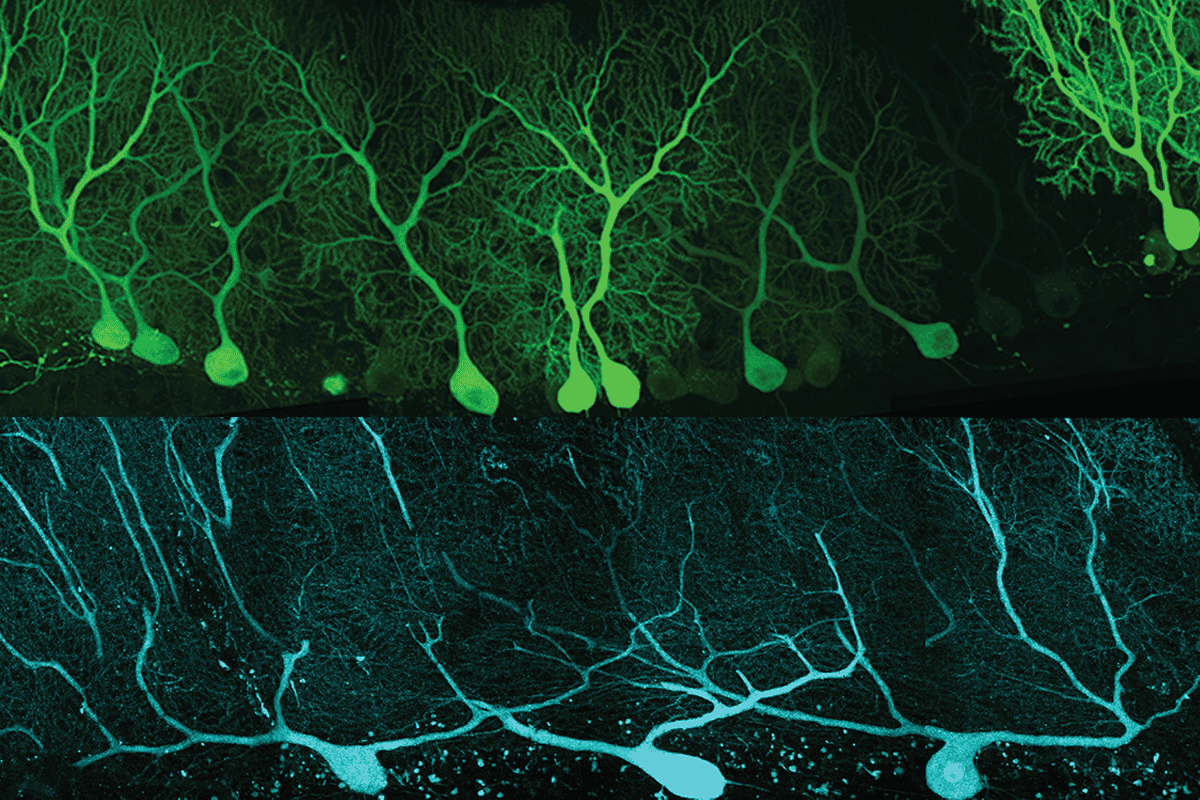
n the new work, posted on bioRxiv in June, Hansel and his collaborators used confocal microscopy to compare the branching patterns of primary dendritic arbors emerging from more than 1,700 cerebellar Purkinje cells across 11 primate species, as well as mice, focusing on a cerebellar region involved in social cognition, emotion and language in humans. They acquired cerebellar tissue samples from a zoo, a brain bank and collaborators’ labs.In spider monkeys and marmosets, only about 4 percent of Purkinje cells have two or more primary dendrites emerging from the soma. This fraction jumps to about 30 percent in nonhuman apes and 55 percent in humans, the researchers found.
Further analyses of various dendritic characteristics, including branch numbers, lengths and angles of primary dendrites, show that “change in one feature doesn’t necessarily predict change in another,” says Silas Busch, who worked on the study as a graduate student in Hansel’s lab and is currently a postdoctoral fellow at Rockefeller University. “This means that each cell morphology, constructed from combinations of dendritic features, is even more unique than the categories reveal.”
Across the species studied, humans have the highest average distance between dendritic branches, and primary dendrites split closer to the soma than in other primates, the researchers found. In humans, primary dendrites are so widely separated that the cells appear horizontal.
Purkinje cells compute cortical input brought by parallel fibers and climbing fibers and send signals to the cerebellar nuclei, which feed information back to the cortex. Canonically, Purkinje cells are thought to have a single primary dendrite that compares input from one climbing fiber neuron and up to a million parallel fibers, depending on the species. Each primary dendrite is a computationally distinct learning unit capable of generating action potentials independent of the cell body, says Samuel Wang, professor of neuroscience at Princeton University, who was not involved in the study. The primary dendrites are placed to detect coincidental input from climbing fibers and parallel fibers that may signal unexpected changes in an animal’s environment, helping it learn and make accurate predictions.
According to a 2023 paper, however, about one in four mouse Purkinje cells with two primary dendrites gets input from more than one climbing fiber, a pattern that is more common in humans. This pattern raises the possibility that some Purkinje cells have multiple learning units. Wider separation between primary dendrites could mean each gets input from parallel fibers carrying information from different cortical areas, Hansel says.
T
he findings align with genomics and transcriptomics research showing that “there was tinkering and smaller changes and step changes within the existing cell types, rather than emergence of many new neuron types,” says Mari Sepp, associate professor at the University of Tartu, who wasn’t involved in the study.But it remains unclear how or why the morphological variations arose. Evolution may have selected for Purkinje cells acting as multiple processing units because they were evolutionarily advantageous, but the morphology could have initially arisen because of scaling laws that dictate “when dendrites get large enough, they split,” Wang says.
Why the proportion of Purkinje cells with multiple dendrites changes in primates is not clear, Hansel says, but in other vertebrates the cells have evolved similar morphologies, hinting at adaptational needs. Compared with zebrafish, weakly electric fish have a higher proportion of Purkinje cells with two or more primary dendrites, which may help them coordinate electro-sensing and motor behaviors, Hansel says. He is studying these neurons in elephants, which, he says, have even more primary dendrites than humans do, possibly to coordinate breathing, smelling and manipulating objects with their trunk. Similarly, he adds, the increased number of primary dendrites in humans might have coevolved with the emergence of language and bipedalism, which brought new sensorimotor demands.