To accurately navigate the world, an animal must learn, remember and continually update how its body position relates to what it sees in the world around it. New findings reveal the circuit mechanisms responsible for this process in fruit flies—and upend a widely held assumption that this kind of learning relies on dopamine.
The research “solves this long-standing problem of how you learn about landmarks in the world,” says Lisa Giocomo, professor of neurobiology at Stanford University, who was not involved in the study. “Over the last decade, some of the biggest insights into how the brain generates algorithms for navigational systems have come from Drosophila,” she says. “It’s been astonishing to see what’s been possible with that system.”
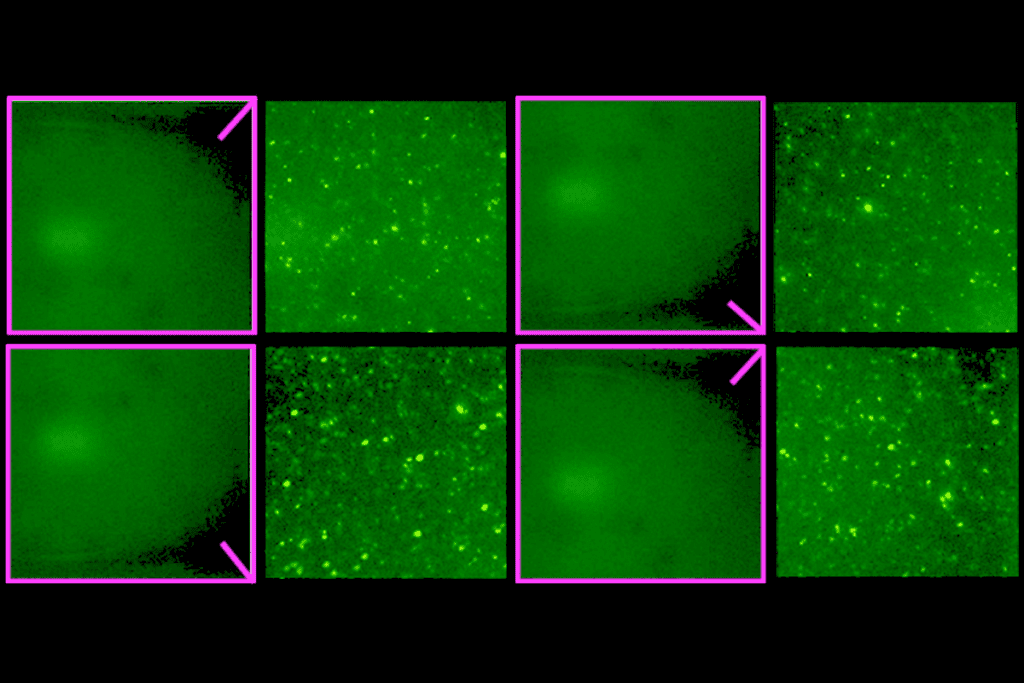
When a neuron in a fly’s internal compass activates at the same time as a cell responding to a visual landmark, a third type of cell called an EL neuron releases the neuromodulator octopamine onto the visual inputs, according to the work, posted as a preprint in December 2025 and presented at the Jane Coffin Childs Symposium in May 2026. Octopamine acts as a signal that modifies the connection between the compass and visual cells, anchoring the fly’s sense of direction to visual cues.
To their knowledge, the synaptic and circuit mechanisms the fly uses to update its internal compass work unlike any yet described, the study investigators say. “It’s a completely new learning mechanism, basically,” says Stanley Heinze, senior lecturer of sensory biology at Lund University, who was not involved in the study.
F
Information about those landmarks reaches the compass via visual neurons, which form inhibitory synapses onto head direction cells that strengthen or weaken with experience, previous work shows. Theoretical modeling experiments predicted that the circuit implements these changes using coincidence detection, whereby the concurrent activity of two neurons causes the connection between them to change.
But it was “puzzling” how an inhibitory synapse, which dampens rather than excites its target, could register that two cells had fired together, says study investigator Mark Plitt, a postdoctoral researcher in Yvette Fisher’s lab at the University of California, Berkeley. “There’s not really a lot of mechanisms known for how you could do that,” he says. Because the synapses are inhibitory, the circuit needs the opposite of traditional Hebbian “fire together, wire together” learning: When the cells fire together, the connection has to weaken.
In mammals, an inhibitory synapse can change in strength through a retrograde signal such as an endocannabinoid. But flies lack endocannabinoids. So Plitt and his colleagues analyzed the existing fly connectome to home in on EL neurons as candidates able to send information from head direction cells back to neurons carrying visual information.
The team recorded the activity of head direction cells and EL neurons as head-fixed flies walked atop a spherical treadmill. Optical cameras tracked the treadmill’s movement to adjust a virtual reality display with certain recurring visual landmarks.
With each turn the flies made, head direction cells activated and relayed those signals to EL neurons, the study shows. Optogenetically silencing EL neurons or genetically disrupting their ability to produce octopamine prevented the circuit from undergoing plasticity and accurately tracking the flies’ direction; activity in head direction cells resembled that of the circuit in the absence of visual cues. EL neurons receive direct input from compass cells, carrying a copy of their activity, and relay it to the visual inputs as octopamine.
Optogenetic stimulation of the EL and visual neurons alone—even without activity in head direction cells—created plastic changes in the circuit, weakening the synapses between the head direction cells and those carrying visual information, the study shows.
Using a neuromodulator to perform coincidence detection at an inhibitory synapse for associative learning has not been described previously, the researchers say. Dopamine also has an effect on plasticity in the visual-compass circuit, but it’s not clear if it has a direct role in driving plastic changes at a specific synapse, as octopamine does.
“I was very excited with this result, because it shows the molecular mechanisms that our computational model predicted, which is pretty rare,” says Sung Soo Kim, associate professor of molecular, cellular and developmental biology at the University of California, Santa Barbara, who was not involved in the work but previously worked on a model of the visual compass circuit in fruit flies published in 2024.
The mammalian head direction system is much more complex and widely distributed than the fruit fly’s, and octopamine is only found in trace amounts. But “mechanistically and algorithmically, there probably is somewhere in the mammalian brain [that uses] this type of inhibitory plasticity,” Giocomo says.
Zebrafish also use a compass-like head direction system, and early models of the head direction system built on mammalian data predicted many features later found in the fly, including landmark-drift correction, she adds. Work on the fly head direction system “has provided some of the strongest evidence that these are evolutionarily conserved algorithms for how the brain solves something like [head] orientation.”
Monoamines such as octopamine are mainly associated with reward-based learning, but they’re increasingly implicated in unsupervised learning, too, says Fisher, assistant professor of neuroscience at the University of California, Berkeley. “I hope everyone in [the field] will keep looking for monoamines to do all kinds of learning. I hope it motivates people to look for motifs like this” in the cortex.