LISTEN TO THIS STORY:
0:00
/
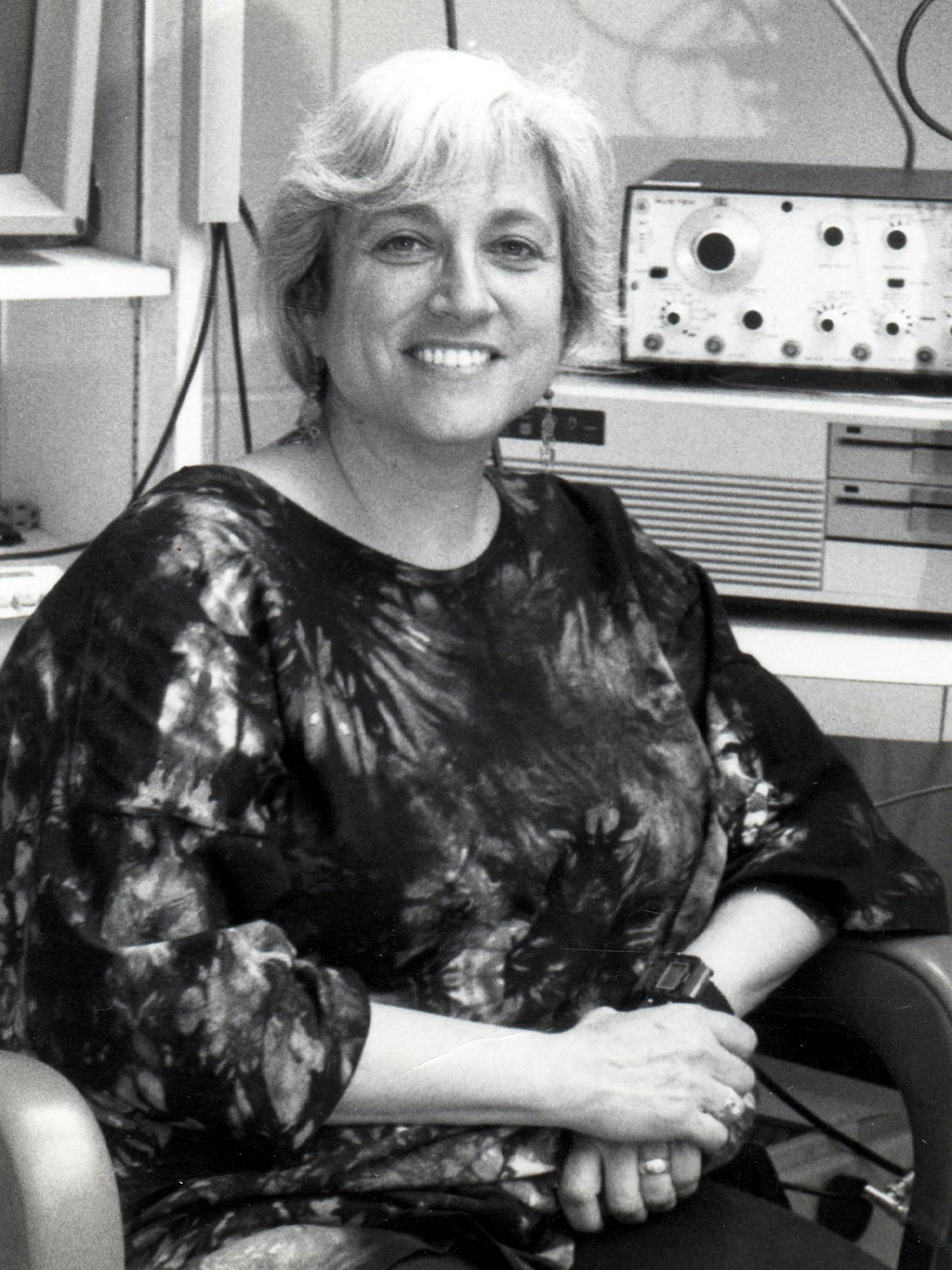
The founding director of the University of Maryland’s Neuroscience and Cognitive Science program brought neuroscience, math and engineering together.
Often it sounded like there was a metronome in Avis H. Cohen’s lab at the University of Maryland. In the ’90s, she and her colleagues wanted to model the neural circuits that produce locomotor patterns in the lamprey, a primitive, eel-like fish, so they hooked a specimen’s disembodied spinal cord to an audio monitor. In a dish, floating in a precise concoction of ions, the spine kept “swimming” for days, and when the nerves fired, evenly timed chirps blurted from the speaker.
This work was a continuation of the first mathematical modeling of lamprey locomotion that Cohen, who passed away on 6 June at age 84, had spearheaded, bringing together academics from neurobiology, mathematics and engineering. “She was the one who organized the whole lamprey community,” says Nancy Kopell, professor of mathematics and co-director of the Center for BioDynamics at Boston University.
Cohen went on to found the University of Maryland’s Neuroscience and Cognitive Science program in 1996, where she assembled faculty and students from a laundry list of backgrounds: biology, electrical and computer engineering, psychology, kinesiology—even English. She believed anyone could contribute to the central problems facing neuroscience and cognitive science, and the program she built at Maryland was one of the first to combine computational methods with traditional neuroscience, says Lewis Wheaton, professor of biological sciences at the Georgia Institute of Technology, who earned his Ph.D. in the program in its early days.
It was Cohen’s multidisciplinary approach that set her apart, says Amir Ayali, professor of neuroethology at Tel Aviv University. Her most notable contribution was “not a specific finding or specific project,” says Ayali, who collaborated with Cohen to study neural locomotion circuits to inform robotic design, but “her general approach.”
B
orn Avis Hope Schulner, Cohen grew up in Chicago and attended public high school. She met her husband, Marshall Cohen, when she was 15. In 1959, she applied to just one university—the University of Chicago—and might not have gotten in without the help of some high school teachers who “had written letters that said she was a genius,” her husband says.The couple married in 1961, and Cohen transferred for her third year to the University of Michigan, where her husband had started his Ph.D. in math. She earned a B.S. in biology and gave birth to their first son in November 1964. The family moved to Princeton, New Jersey, for her husband’s postdoctoral fellowship, and for a while a career in science might have seemed out of reach for Cohen. Books at the time “implied women, careers, marriage and family didn’t go together; you couldn’t do all of them, could you?” she wrote in a self-published autobiographical essay titled “Snapshots of growing up female in the ’40s, ’50s and beyond.”
Around the time their second son was born in 1967, Cohen began attending biology lectures at Princeton University. This was “obviously just straight curiosity,” her husband says, because Cohen had no declared interest in a research career at the time. But in 1968, when her husband took a professorship at Cornell University and the family relocated again, Cohen became interested in catastrophe theory—mathematical models of sudden changes in systems. She organized an international conference on the subject and convinced the French mathematician René Thom, who had developed the theory, to come speak at it.
After the conference, Eric Lenneberg, then professor of psychology and neurobiology at Cornell, who had helped Cohen secure funding for the conference, suggested Cohen apply for the Danforth Fellowship for Women. She won it and enrolled in a Ph.D. program in neurobiology at Cornell, where she studied rat locomotion with physiologist Carl Gans.
In her last year of graduate school, Cohen was “stunned,” she later wrote, when she heard a talk given by Swedish neurophysiologist Sten Grillner. He presented on central pattern generators—neural circuits that model groups of neurons in the central nervous system as an oscillator, coupling them to coordinate rhythmic, unconscious movements throughout a body. Grillner studied them in lampreys because the animal has a simple yet robust nervous system, and not much of a brain.
Scientists had predicted that central pattern generators existed in vertebrates. Cohen sought proof during a postdoctoral position with Grillner at the Karolinska Institutet in Sweden, where she and her family lived from 1977 to 1979. During this time, she and Ph.D. student Peter Wallén established experimental conditions to show that the isolated spinal cord of a lamprey could produce full swimming patterns. This result offered the first “definitive” evidence that vertebrates can have central pattern generators, says Eric Tytell, Cohen’s last postdoctoral fellow and now associate professor of biology at Tufts University.
In the spring of 1979, the family moved back to Ithaca, New York, so Marshall Cohen could continue his professorship at Cornell. This move was “terrible” for Cohen, he says, because she had no academic position. She sat in a basement office in the math department writing research grants and had to be sponsored by professors to even submit them.
Eventually, she was able to set up a small lamprey laboratory at Cornell’s veterinary school. There, along with mathematicians Philip Holmes and Richard Rand, she wrote the first paper, published in 1982, mathematically modeling a central pattern generator and describing each spinal cord section using wave functions offset with a phase difference. This model “has been super influential,” Tytell says.
B
y 1990, Cohen had garnered enough attention that the University of Maryland Department of Zoology (now Biology) offered her a professorship. She asked Cornell for a comparable position, and when the university declined, the family left for Maryland, though Marshall Cohen was able to set up an office and keep his job at Cornell, commuting between the two.Soon after her arrival, she realized the university needed a neuroscience program, and she proposed the Neuroscience and Cognitive Science program to the deans, planning to incorporate linguistics and cognitive science. University leadership approved the program in 1996, and she became the founding director. The mentality at the program was “the future of the field is collaborative,” Wheaton says. As a leader, Cohen championed “bringing students into a program where you felt like you were a part of something bigger.”
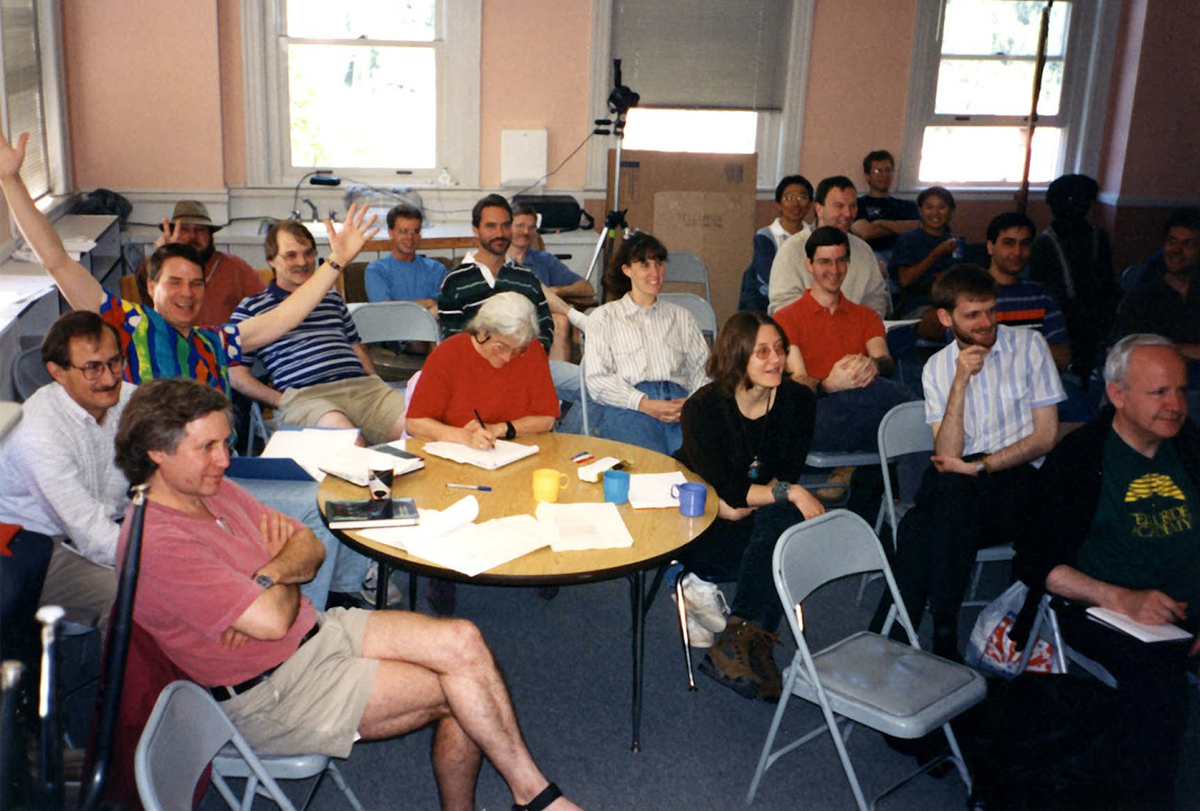
Cohen’s collaborations eventually extended into robotics; she served on the advisory board for the Telluride Neuromorphic Cognition Engineering Workshop and worked with engineer Ralph Etienne-Cummings to apply her foundational models of lamprey locomotion to inspire the design of prosthetics for people with spinal cord injuries.
Cohen’s overarching premise was that research required dialogue between scientists so they could “put all the pieces together,” says Lisa Fauci, professor of mathematics at Tulane University, who worked with Cohen to model the fluid dynamics of lamprey locomotion. And Cohen could achieve this almost by force of personality, Fauci says, because she was “a wonderful person. You just wanted to hug her.”
“We all didn’t speak the same language,” Fauci says. “We didn’t have the same jargon, and so she set the tone that you could ask questions in a comfortable and supportive environment. Nobody was embarrassed to say they didn’t understand that word.”
Once Cohen had her own lab, she became known for helping students of any rank and background. “She was extremely devoted to making sure that that representation was there,” Etienne-Cummings says.
In particular she had “a strong sense of solidarity with the women that she worked with,” says her younger son Philip Cohen, who is a sociologist at the University of Maryland. Ranu Jung, a former postdoctoral researcher of Cohen’s who is now professor of biomedical engineering at the University of Arkansas, recalls applying for a postdoc position with Cohen while seven months pregnant. Jung says she had come across other principal investigators who wouldn’t take you “because you were a woman,” but Cohen was “not afraid to say, ‘I’m going to help mentor her.’”
“She wasn’t afraid of anything,” Marshall Cohen says.
Cohen closed her lab in 2014, and a year later she began to get confused when driving. The confusion turned out to be Alzheimer’s disease, and Cohen began her “long goodbye,” her husband says, adding that the things that made her a great scientist persisted to the end. Even when she didn’t remember what had happened five minutes earlier, “what really remained was her core kindness.”