LISTEN TO THIS STORY:
0:00
/
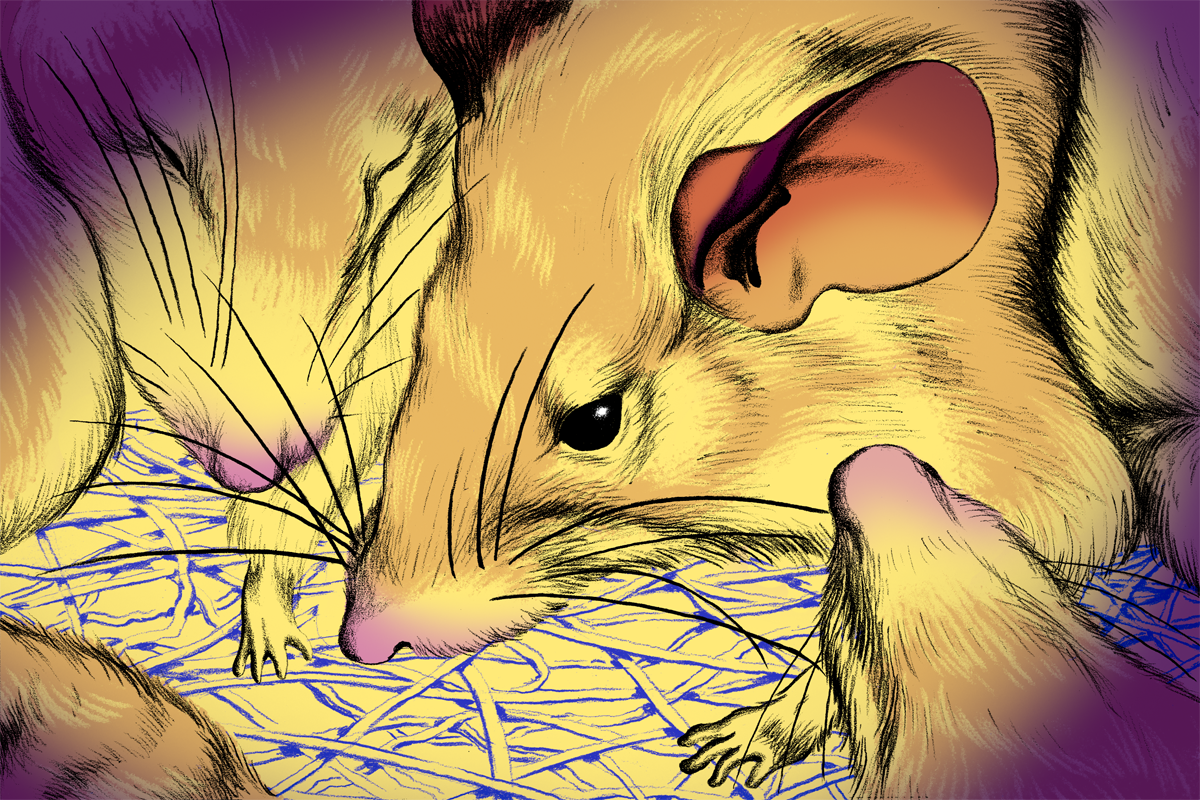
Aubrey Kelly studies the gregarious mammal to explore how the brain controls complex social behaviors “akin to friendship.”
Prairie voles have a reputation as one of the most social rodents, but when Aubrey Kelly tried to use them to study the neurobiology of group dynamics, she discovered limits to their sociability.
“Prairie voles are indeed super social with their pair-bond partner and with their offspring,” says Kelly, associate professor of psychology at Emory University. “But if an adult prairie vole encounters a stranger, they’re going to fight—oftentimes to the death.”
She shifted her focus to paternal care in the voles but stayed on the lookout for a truly social rodent that lived in rich, complex communities. As a graduate student, she had studied the neural circuitry that contributes to such societies in zebra finches, and she hoped to make similar inroads in mammalian brains.
“I got really into the idea of animal societies and how individuals can just get along in big groups, which is something that we do ourselves,” Kelly says.
About four years later, a colleague introduced her to spiny mice. Despite their name, these animals are more closely related to gerbils than to laboratory mice. They live in large, flexible, mixed-sex groups and rarely brawl, the colleague told her. Kelly was intrigued—perhaps these groups were the miniature mammal societies she had been searching for.
Her subsequent work has demonstrated that, indeed, these critters not only tolerate groups but actually prefer them: When given a choice between associating with two peers or eight peers, they spend the majority of their time with the larger group. Now Kelly is digging into the neural mechanisms underlying this communal lifestyle.
Kelly spoke with The Transmitter about spiny mouse “friendships,” custom CRISPR tools and the neurobiology of coexistence.
This interview has been edited for length and clarity.
The Transmitter: What questions can you explore with spiny mice that aren’t feasible using typical lab mice?
Aubrey Kelly: With traditional lab mice, there are going to be some housing restrictions, especially when animals become adults. If you housed them as a mixed-sex group, you’d see mostly aggression between males. But once there’s fighting going on in a cage, basically everyone gets on edge and starts fighting. And if you introduce a newcomer as an adult, that will definitely be a dead newcomer within no time. But spiny mice can live in mixed-sex groups and will accept a new individual into an established group. They don’t form pair bonds, but you can study something more akin to friendship in a spiny mouse than you can in other species.
TT: Are these highly social tendencies shaped by their early life experiences?
AK: What we’ve found thus far is that spiny mice are very resilient. You can tweak the early life environment, and we’ll see some differences, but they’re really subtle. In one study, we manipulated whether they grew up with just their nuclear family or with non-kin neighbors as well. And we saw no behavioral differences.
In the brain, we used immunohistochemistry to look at the expression of dopamine, oxytocin, vasopressin and galanin—doing a survey of systems involved in stress, reward and social behavior—and we found absolutely no differences for oxytocin or dopamine, but we did see something for vasopressin and galanin. If you have that early social experience, you have fewer vasopressin cells in the hypothalamus, a brain region that’s really important for promoting aggression. And not being aggressive is the best way to be a spiny mouse as an adult—it’s the most successful way to get along in a group.
TT: To what extent can you use the tools established for more common model organisms? How much do you have to develop yourself?
AK: It’s probably 50-50. When it comes to adeno-associated viruses (AAVs), for example, there are several different serotypes that we can choose from. The AAV serotypes that work really well in rats and mice don’t work so well for spiny mice, but the ones that work really well in prairie voles also happen to work really well in spiny mice. So a lot of it is just trial and error.
We also have a colleague now at the Achucarro Basque Center for Neuroscience, Arjen Boender, who makes custom CRISPR viruses—this allows us to knock down our protein of choice in a specific brain region. For example, he made a few different versions of an oxytocin receptor CRISPR virus. He has been a great addition to the social neuroscience community; I just take advantage of all those bioengineers who can just make things work!
TT: What questions do you want to answer next?
AK: One thing we want to do is look at the neural mechanisms underlying the flexibility of a newcomer when they join a new group. There’s some variation in how long it takes for them to join the group huddle—most of the time the group is just huddling together. It’s really kind of sad: When you introduce a newcomer, it will stay right nearby, just watching the group—it’s hard not to anthropomorphize!
In a previous study, we basically made the spiny mice fearless by inhibiting neural activity in the lateral hypothalamus using chemogenetics. When we took the lateral hypothalamus offline, the animal immediately joined the huddle, and the group let it happen. So, it seems that any of this hesitation is on the part of the newcomer. Now we want to use fiber photometry to look at what changes in the brain during that one-to-two-week period that allows them to eventually join the group huddle.