LISTEN TO THIS STORY:
0:00
/
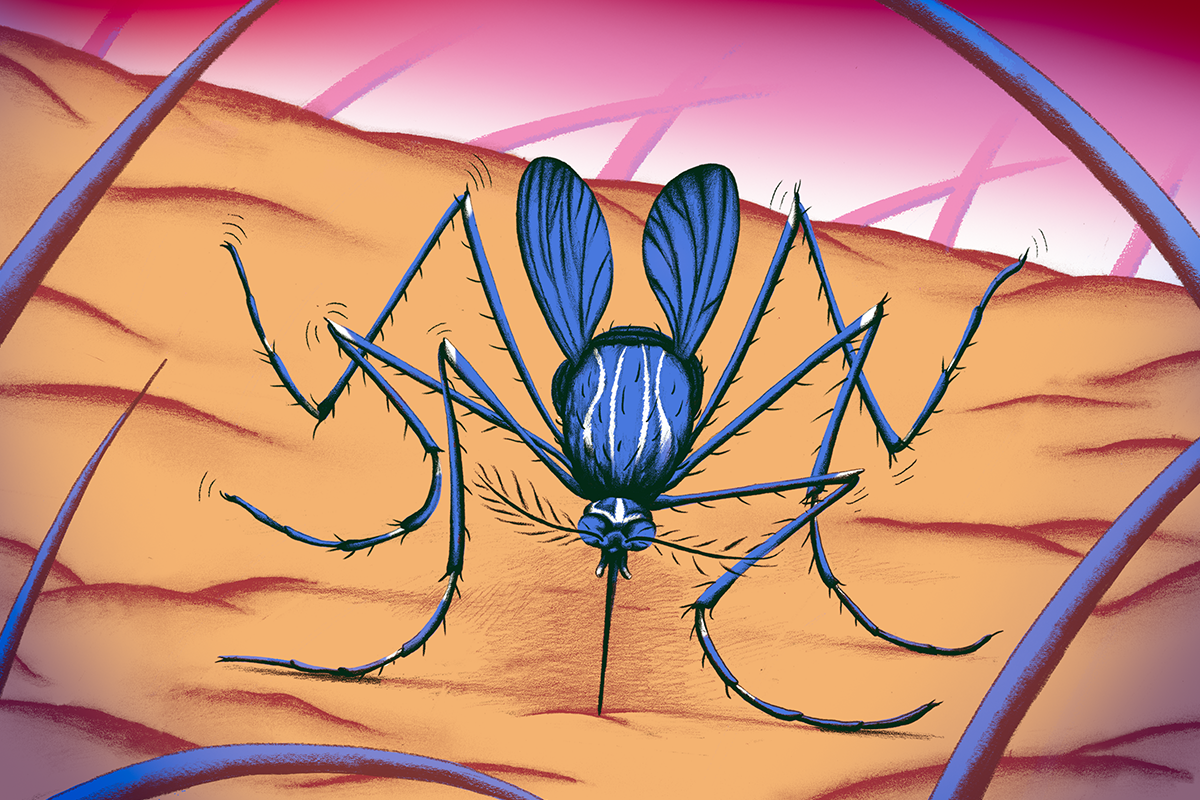
By comparing the proprioceptive systems of mosquitos and fruit flies, Sweta Agrawal aims to uncover fundamental features of the ability to sense self-movement.
Mosquitoes are not elegant fliers. They “look very derpy and kind of clumsy,” and they fly with their legs sticking out in front of them, says Sweta Agrawal, assistant professor of zoology at the University of British Columbia.
But this makes them a useful organism to study how proprioception—the body’s sense of itself in space—contributes to motor control.
Mosquitoes have different bodies and motor behavior than the more popular research insect Drosophila: The blood-suckers are larger, have different leg structures, move slower and walk less often than fruit flies. Comparing the two insects could reveal fundamental principles of how proprioception works, Agrawal says.
Such comparative work has already gleaned insights into other sensory systems. Scientists can generate a “laundry list” of specializations in the visual system that they would expect to find in a nocturnal versus diurnal animal, Agrawal says. “For proprioception, we don’t necessarily have a great framework like that.”
Now Agrawal is studying mosquitoes in addition to Drosophila to untangle how a change in body shape, size or movement affects the proprioceptive system. Agrawal spoke with The Transmitter about the advantage of comparative studies and the potential insights lurking in museums’ insect collections.
This interview has been edited for length and clarity.
The Transmitter: How does the sense of proprioception work?
Sweta Agrawal: Mechanosensory neurons embedded in our muscles, tendons and joints are central to proprioception. They sense the mechanical actuation that happens when our muscles pull on our skeletal systems. They help to disentangle if a movement was generated by me and the activity of my muscles or if it’s coming from the outside world, an effect of the world acting on my body.
TT: How did you become interested in studying mosquitoes?
SA: As an undergrad, I did a summer internship at the American Museum of Natural History, where I did a comparative study of the Dipteran haltere, a mechanosensory organ essential for flight in flies. Most insects have two pairs of wings, but in the order Diptera, which includes “true flies” such as Drosophila and mosquitoes, their hind wings have changed. They no longer provide any lift but have become more or less a purely sensory structure that is important in flight. These halteres are covered in sensors and are thought to be part of why flies are such agile flyers—they can use them to stabilize.
That was my first real introduction to this notion of—I didn’t call it proprioception at the time—self-sensing and its importance for motor control. Studying the evolution of the haltere showed me the importance of the comparative approach, and what it might reveal about these really subtle mechanisms of how the nervous system works.
Since then, I have been interested in doing something comparative, so I was like, “OK, once I have my own lab, I’ll do it then.” Mosquitoes felt like a natural fit.
TT: What makes mosquitoes so useful for comparative studies?
SA: They’re closely related to Drosophila, but at the same time distinct enough that I would expect to see differences in their proprioceptive system. There’s a whole body of work looking at proprioception in locusts and stick insects. But they’re a little bit too different from Drosophila; I found it hard to make some of those one-to-one comparisons, partly because you’re often using very different methods to provide mechanical stimulation to the legs and record the activity of neurons.
Plus, a lot of people have taken tools from the Drosophila world and put them into mosquitoes. The idea of having a species where there’s already a community was really appealing.
TT: What kind of experiments are you working on?
SA: I use a mosquito line that Craig Montell’s lab at the University of California, Santa Barbara created that targets proprioceptive sensory neurons. It enables me to either totally knock out the neurons’ function or use a tool like GCaMP to measure their activity in response to applying different leg perturbations. Then we can compare those results with experiments done with Drosophila.
TT: Do you plan to incorporate any other insects into your work?
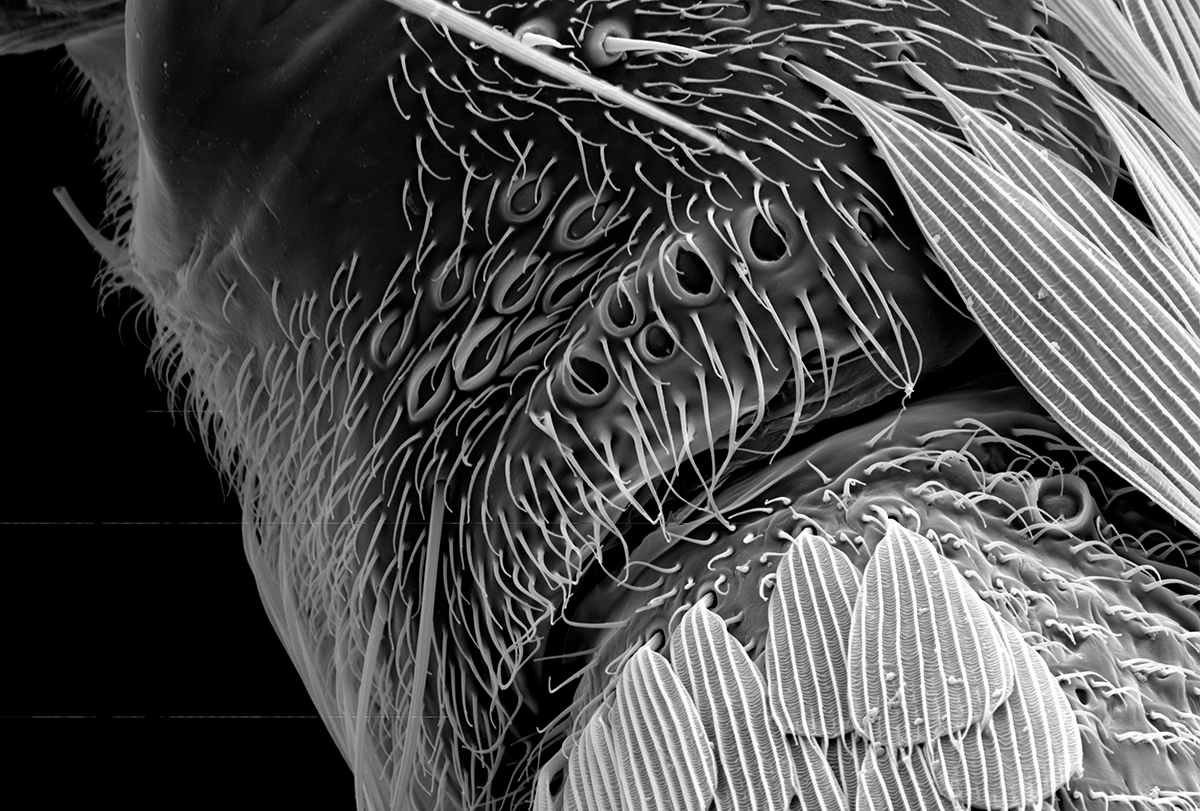
SA: We’re starting with the mosquito and fly work; because of the tool kit, we can really get into measuring neural activity and getting at the mechanistic idea of things. But my lab is also working on a broader project looking at the proprioceptive mechanosensors called campaniform sensilla. The nice thing about them is that they are attached to these domes that are embedded in the exoskeleton of the animal. They’re thought to sense the loading of the body, because as an animal pushes against the ground it causes distortions in the exoskeleton that are sensed by mechanosensory neurons attached to the domes.
The important thing is that you have this dome-like structure in the exoskeleton that tells you a proprioceptive neuron is located there. So we can take specimens from a museum collection, put them under a scanning electron microscope and look at where those sensors are distributed. We can try to disentangle which body features impact sensor distribution versus how much of this might be evolutionary drift.
Model systems are awesome. But there are benefits to looking at other species and doing this compare-contrast process, because I think you can learn a lot.