LISTEN TO THIS STORY:
0:00
/
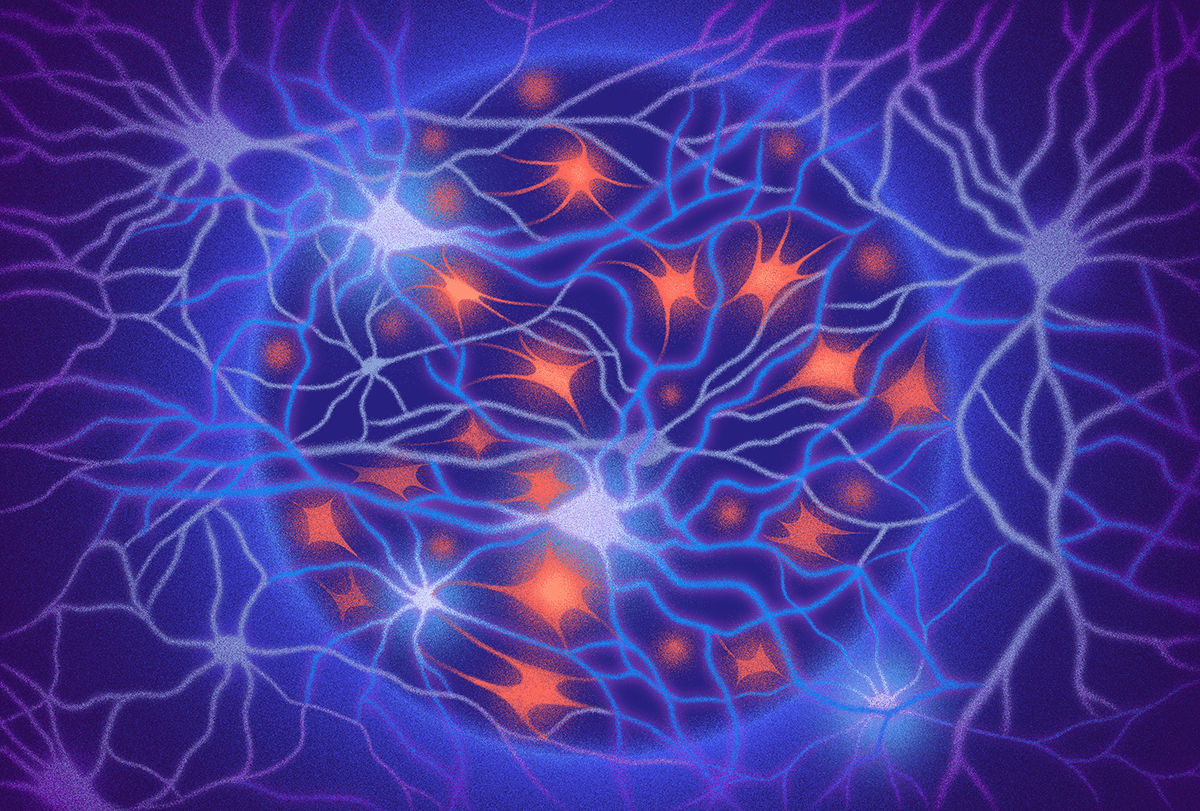
Neurons have long taken top billing in memory, but researchers are making the case for astrocytes.
The engram is nothing new in neuroscience. For decades, researchers have maintained that these neuronal clusters—which activate during learning and fire again during recall—house memories in the brain.
Researchers have shown that small groups of neurons switch on during learning, undergo lasting chemical and structural changes, and then fire again during recall. These groups—called engrams—are now widely accepted as the physical trace a memory leaves in the brain.
But it may not be so simple. Memory traces in the brain also tap astrocytes, says Marta Navarrete, principal investigator at the Cajal Neuroscience Center. The “astroengram,” as she and her team described it earlier this year in a Nature Reviews Neuroscience Perspective, is implicated in the study of memory. No one knows if astrocytes are capable of storing memory rather than providing memory support, “because nobody tested [it] before,” she says.
That’s partially because the activity of astrocytes wasn’t discovered until a 1990 study, and the field had been focused elsewhere. All the current tools for understanding how the brain works are “related with a neuronal cell,” Navarrete says, and researchers haven’t been able to assess “if there are other types of cells related” to this higher brain function.
It’s possible the field would have considered astrocytes in memory sooner “if Ramón y Cajal and [Camillo] Golgi had started with astrocytes,” says Steve Ramirez, assistant professor of psychological and brain sciences at Boston University. Though Ramirez himself showed that reactivating a specific group of neurons was enough to trigger recall, he now thinks astrocytes play some role. “They’re their own computational unit that’s processing their own aspects of memory,” he says. “Either in parallel with neurons, in a synergistic role, or maybe even totally separate from neurons.”
But it needs to be proved. “Now it’s a matter of under which conditions, and when, and why,” Ramirez says.
N
avarrete built her astroengram theory on work showing that a specific subset of astrocytes in the nucleus accumbens—the small structure in the forebrain that processes reward signals—is recruited during learning, and that reactivating or silencing that group is enough to change an animal’s behavior. To demonstrate this, she created a tool called AstroLight and mapped astrocytes in mice as they were trained to correlate a flash of light with the availability of sugar water, located in dispensers on either side of a chamber. Over time, the mice developed a preference for one dispenser over the other.Her team then reactivated those astrocytes using the AstroLight tool, and also with clozapine N-oxide, which switches on a receptor engineered into the tagged astrocytes. In both cases, the mice more strongly preferred the dispenser they had previously favored. The reactivation, says Jun Nagai, a team director at the RIKEN Center for Brain Science, who was not involved in Navarrete’s study, suggests astrocytes are “controlling retrievability of memory network activity.”
When Navarrete’s group then silenced the same group of astrocytes, the mice visited the dispensers more evenly.
Navarrete also points to a study by Benjamin Deneen’s group at Baylor College of Medicine, which tracked c-FOS—a gene that switches on in recently active cells—in hippocampal astrocytes during fear conditioning. Astrocyte FOS switched on when mice were given electric shocks. Days later, when the researchers reactivated those same astrocytes in a room where the mice had never been shocked, the mice froze as though reliving the fear.
And she cites a 2025 study from Nagai’s lab, which tracked astrocyte FOS across the brain during fear conditioning and recall. Nagai found that fear conditioning alone did not activate astrocyte FOS, but it caused adrenaline receptors to ramp up in a subset of amygdala astrocytes, priming the mice to recall the experience when they returned to the chamber the next day. Only during recall did astrocyte FOS surge.
In both cases, manipulating astrocytes changed the animals’ behavior in ways linked to memory. Navarrete says her work checked both boxes on the classical engram checklist: Reactivating the astrocytes was sufficient to shift behavior, and silencing them weakened it. Astrocytes are “necessary and also sufficient for memory,” she says.
B
ut not even the authors of this work fully agree. “It’s too early to say astrocytes are part of the engram,” Nagai says. The strongest evidence still points to neurons as the core of the engram, he says. Back in 2009, Sheena Josselyn’s group demonstrated that destroying neurons recruited during fear learning erased the memory entirely, whereas destroying a similar number of random neurons had no effect. And in 2012, Ramirez and his colleagues showed the reverse: Reactivating fear-linked neurons caused mice to freeze in a place where they’d never been shocked.Those experiments showed that neurons can be a clean on/off switch for memory, Nagai says. And no experiment has shown astrocytes can do anything like that.
But Nagai admits that astrocytes probably help control how neurons access memory, because the astrocyte ensembles his team identified and tagged during recall can help keep a memory consistent each time it’s recalled.
There’s also a question of whether the astroengram debate is conflating memory with emotional state. Ciaran Murphy-Royal’s group at the University of Montreal knocked down receptors that respond to adrenaline-like stress signals on astrocytes in the mouse amygdala. Afterward, the mice became fearless; they wandered to the edge of an elevated platform and peered over the side. At the least, this showed the animals felt a new emotion about their surroundings.
If astrocytes are primarily regulating emotional state, studies based on fear conditioning might simply muddy the waters. “It’s kind of untangling the two [emotional state and memory itself] that’s going to be our challenge,” Murphy-Royal says. He points to Nagai’s astrocyte study and notes that the astrocyte calcium response doesn’t extend beyond about two weeks, which may be too short if astrocytes are supposed to be part of a memory that lasts a lifetime.
The astroengram idea Navarette described in the Perspective requires proving that astrocytes can trigger recall, and that recall breaks without them. “If you get both of those, then you’re cooking with gas,” says Mark Cembrowski, associate professor of cellular and physiological sciences at the University of British Columbia.
P
roving it would require labeling a group of astrocytes identified during a learning task, reactivating them while silencing surrounding neurons, and then testing recall. However, that necessitates “a temporally well-controlled perturbation tool for astrocytes,” Nagai says, and “we don’t have that yet.”Mostly what’s available are chemogenetic and optogenetic tools, and although they work in neurons, they behave unpredictably in astrocytes. “What one tool produces for a result in the brain may not necessarily be reproducible by another tool,” Ramirez says. Chemogenetics “has its own timescale and its own way of modulating the brain, he says, as do drugs and optogenetics.
Even if researchers could independently control both cell types, there’s the problem of keeping the signal contained. Neurons are wired together, and activating one group can ripple into neighbors, Murphy-Royal says. This issue could be worse in astrocytes, which are physically connected by gap junctions that let calcium signals pass from one cell to the next. Experimenters hoping to switch on a specific group of astrocytes might have their signal leak to neighboring cells, tainting results.
An ability to control both types of cells may be getting closer. Tools have matured enough that researchers can now load genetic cargo into engineered viruses and achieve 90 to 95 percent astrocyte-specific targeting, says Dheeraj Roy, assistant professor of physiology and biophysics at the University at Buffalo. And this can be done without accidentally hitting surrounding neurons. In principle, Roy says, researchers could now tag both neuronal and astrocyte ensembles in the same mouse and then use DREADDs—synthetic receptors delivered into cells via the same engineered viruses, and activated by injecting the clozapine N-oxide—to activate astrocytes while silencing neurons to test whether astrocytes alone can drive recall.
But the real question is how to capture cell activity precisely rather than over hours. Navarrete built AstroLight to address that problem, and Nagai developed his own tool, iβARK, to dampen astrocyte signaling in his 2025 study. But “iβARK is expressed forever in the first target astrocytes,” Nagai says, making it impossible to pinpoint which moment matters. What’s required is to be able to silence astrocyte signaling during sleep or before recall, he says, and find exactly what time point we need.
N
ot everyone is convinced that would work. Murphy-Royal points out that if engram neurons—the cells that actually drive the mice to freeze in fear—are silenced, activating astrocytes that modulate those same neurons shouldn’t produce recall. And even if the mice did freeze, the behavior could be caused by general fear rather than a specific memory. To tell the difference, Murphy-Royal says, researchers would need to check whether the mice freeze only in response to a fear cue they previously learned.And an experiment would need to confirm that the neurons are truly silenced and that astrocyte calcium is genuinely elevated, and then track behavior beyond the typical 3- to 10-minute recall window to rule out artificial effects, Nagai says. Navarrete is now attempting that kind of work—tagging the astrocytes that switch on during learning and then trying to tease apart their activity from neuronal activity during recall. But what’s missing are longitudinal tools “to follow the same astrocytic ensembles over days or weeks and fully understand their role across memory formation, storage, and recall,” she says.
Even then, Ramirez cautions, every experiment in this field has limits. “A lot of our perturbation experiments that are revealing how can memory work” may not map onto how memory actually occurs in a normal brain, he says. Still, Ramirez thinks the astroengram concept will find a place in memory neuroscience.
“I am willing to bet the house that astrocytes play a causal role in memories and are very much involved in everything that we call an engram,” he says.