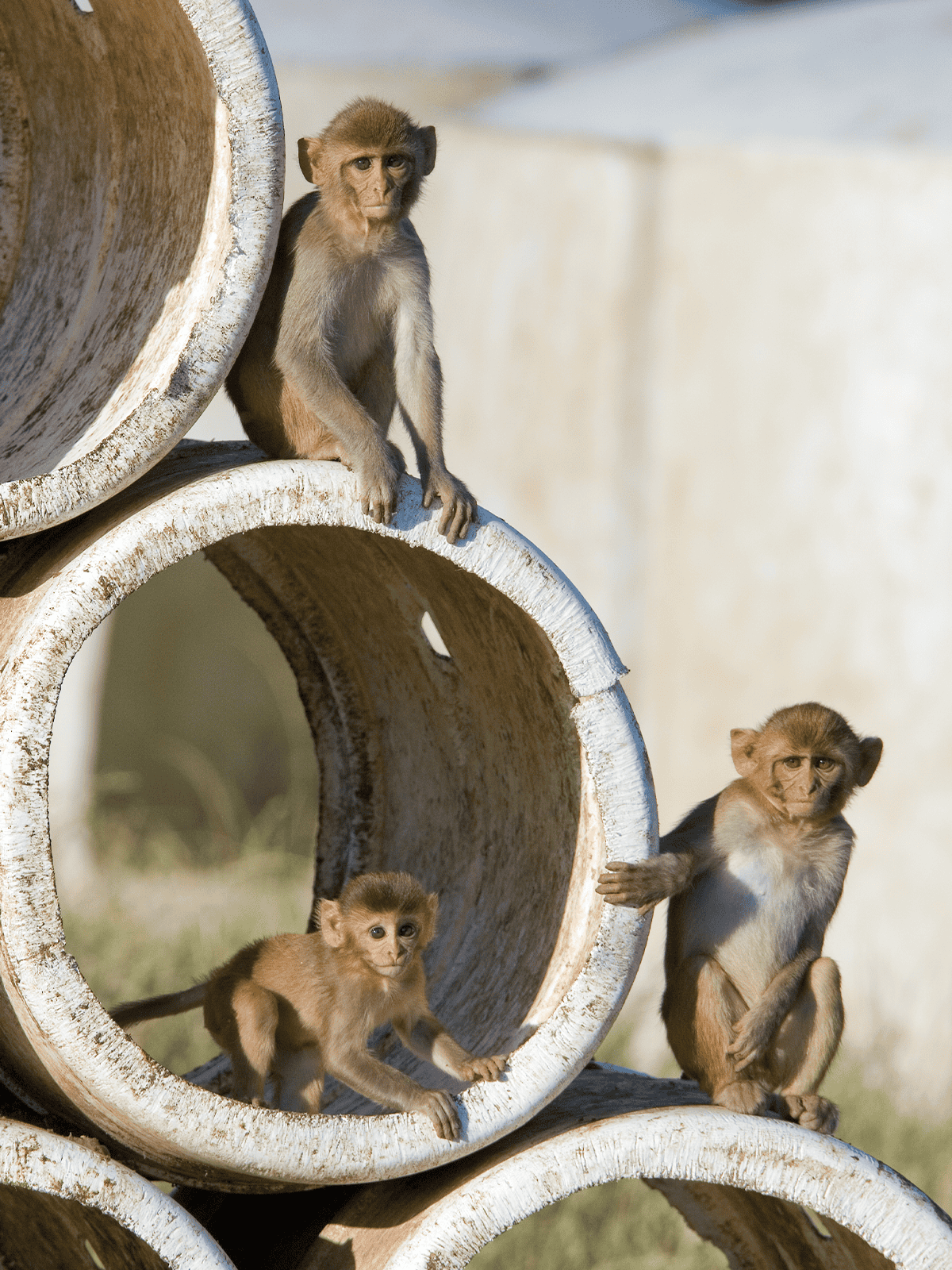
Today the board of directors at Oregon Health & Science University (OHSU) voted unanimously to develop a plan to scale down the university’s primate research center and pivot its focus to new approach methodologies (NAMs).
The resolution calls for university president Shereef Elnahal and his designees to “substantially reduce” the colony size, cease selling primates to other institutions and continue only the research projects that are unique to the center. Currently funded projects, as well as work that would be funded by in-progress grant applications, will be allowed to continue until their completion, Elnahal clarified in a call with reporters after the vote.
The decision follows more than a year of pressure from Oregon politicians and advocacy groups to close the center, as well as a months-long negotiation with the National Institutes of Health (NIH) over converting the facility into an animal sanctuary and ending all research.
“It’s a step forward compared to six months ago,” says Christopher D. Kroenke, professor of neuroscience at the Oregon National Primate Center (ONPRC) and Advanced Imaging Research Center. (Kroenke says his views are his own and do not represent the stance of the university.)
Earlier this month, Elnahal told OHSU faculty that the sanctuary transition was not possible because there was no federal funding to pay for it, The Oregonian reported. At the time, an OHSU representative denied the report and said the university had not yet made a decision.
But at a meeting with ONPRC staff last week, Elnahal confirmed the information, saying, “A sanctuary just isn’t in the cards here at ONPRC.” A recording of the 20 July meeting was shared with The Transmitter.
The new resolution acknowledges that some of the outlined changes could result in losing the National Primate Research Center designation.
“Taking one of our centers offline would have a huge impact on our scientific enterprise,” says Ricardo Carrion Jr., director of the Wisconsin National Primate Research Center. The loss would affect training opportunities for veterinarians and scientists as well as the pool of available monkeys, he says.
The plan must also include a strategy for converting the center into a “national leader in research on the development of NAMs,” the resolution states. Scientists at ONPRC have already been studying NAMs for the past decade, Elnahal said at today’s board meeting.
“Although the concept of alternative methods is good, and having some of that done in nonhuman primates is good, what you would have to give up if you converted the Oregon Primate Center to that is an enormous, irreplaceable loss,” says Judy Cameron, professor of psychiatry at the University of Pittsburgh.
A
“What I can tell you is that not much is going to change in the next couple years, most likely, based on all those constraints,” Elnahal said at the staff meeting.
How the plan-makers determine which research projects are unique is also unclear, Kroenke says. Most work at the center is funded by NIH grants, which are competitive. “You have to be in the top 10 percent in order to get your research supported, and you don’t get in the top 10 percent by proposing something that somebody else can do,” he says.
It’s also important to consider capacity, says Rachael Wolters, research assistant professor of pathobiology and immunology at the ONPRC; just because another facility is capable of conducting similar research does not mean they have the bandwidth to do so.
And eliminating research in this way raises questions about academic freedom, Wolters adds. (Wolters says her views are her own and do not represent the stance of the university.)
The ONPRC houses roughly 4,500 nonhuman primates, according to a 2025 annual report to the United States Department of Agriculture. The facility sold 120 monkeys to outside investigators during the 2024-2025 fiscal year of the center’s base NIH grant, according to a university report.
“My astonishment about what’s going on in Oregon knows no bounds,” says Peter Strick, professor and chair of neurobiology at the University of Pittsburgh, particularly that one of the national primate research centers would move to stop serving as a resource to other institutions.
The United States has a shortage of nonhuman primates that was exacerbated by, and has not recovered from, the COVID-19 pandemic. In 2023, a committee of the National Academies of Sciences, Engineering, and Medicine, which included Strick, examined the current and future needs for nonhuman primates in research. Their final report concluded that relying on imported nonhuman primates “undermines the security of the U.S. biomedical research enterprise” and called for the NIH to invest in and expand the country’s nonhuman primate resources.
“From my perspective, that 268-page report has been ignored entirely by the people in Oregon. The conclusions of the report were really quite clear,” Strick says. “These are supposed to be scientists and science administrators, and where are they basing their conclusions? It’s just nuts,” he adds. “It’s Alice in Wonderland. We’re in an alternative universe.”