By clicking to watch this video, you agree to our privacy policy.
Add us as a Preferred Source on Google

A new atlas of abstracts visualizes the field of human brain mapping—where does your work fit?

Satrajit Ghosh talks to Mac Shine about a community-built tool that places every abstract from the 2026 Organization for Human Brain Mapping meeting inside a semantic map of the broader neuroscience literature. Finding your neighbors in that space might matter more than you think.

By Mac Shine
9 June 2026 | 3 min read

Every year, thousands of neuroscientists descend on a single city for the annual meeting of the Organization for Human Brain Mapping (OHBM). They come from functional MRI labs, EEG labs, computational groups, clinical teams and software projects, united by a shared interest in one of the hardest problems in science. And every year, most of them see only a small slice of what is presented there: With more than 3,000 abstracts spread across four or five days, navigating OHBM has always been as much a matter of luck as strategy.

Satrajit “Satra” Ghosh, a principal research scientist at the Massachusetts Institute of Technology’s McGovern Institute for Brain Research, has been thinking about this problem for a long time. His group, the Senseable Intelligence Group, works at the intersection of machine learning, brain imaging and mental health—but Ghosh is perhaps equally known for the community infrastructure he has helped build over the years: data repositories, analytical pipelines, and now, the OHBM Abstract Atlas.
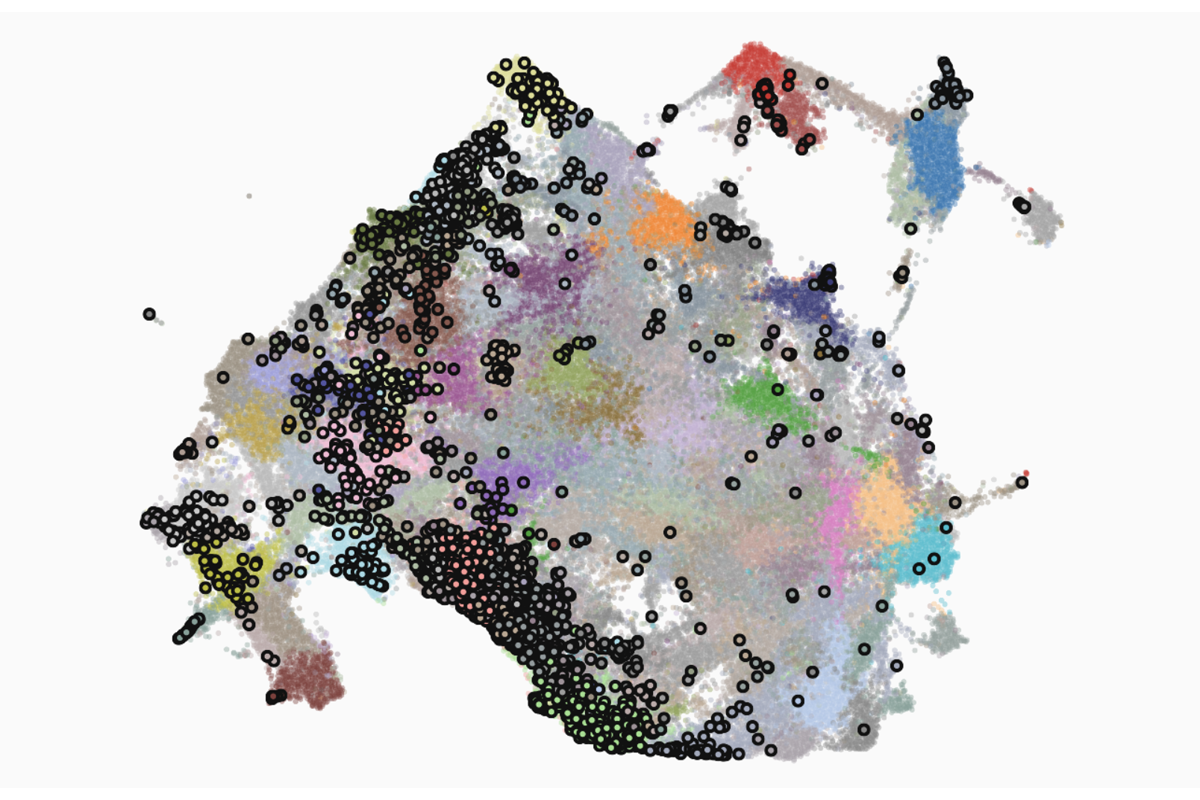
Data visualization of 2026 OHBM abstracts in the context of field-wide publications.
Brain map: The corpus that Senden created forms the backdrop of this neuroscience atlas; the OHBM 2026 abstracts (black circles) are projected onto this landscape, illustrating where the conference sits within the broader literature.
Courtesy of abstractatlas.brainkb.org / Satrajit Ghosh

The atlas, released ahead of the 2026 meeting in Bordeaux, France, places every accepted abstract inside the semantic landscape of neuroscience that computational neuroscientist Mario Senden constructed from nearly half a million PubMed articles spanning 1999 to 2023. (See my interview with Senden.) Each abstract becomes a point on that map, so attendees can see not only how OHBM abstracts relate to one another but also where they sit within the broader literature. A poster on resting-state fMRI and one on cerebellar circuitry might look like neighbors on the conference program; the atlas might reveal they are on opposite sides of the field or closer than either author expected.

The tool grew out of a long-running community effort that began at the 2017 Vancouver Brainhack, when Ghosh and a small group of collaborators built a basic abstract search engine in a couple of days. The version that exists now is considerably more sophisticated, and it carries an ambition that goes beyond conference navigation: Ghosh wants it to become a living map of the field, updated in something closer to real time, so that knowledge generated in a lab on a Tuesday can find its way to someone who needs it on a Wednesday.

Here, I speak with Ghosh about how the atlas was built, what it reveals about where OHBM sits within the broader field, and why he thinks the accidental discovery of a poster you never knew you needed to see might be just as important as a targeted search of the emerging literature.

Watch our conversation.

Sign up for our weekly newsletter.

Catch up on what you missed from our recent coverage, and get breaking news alerts.