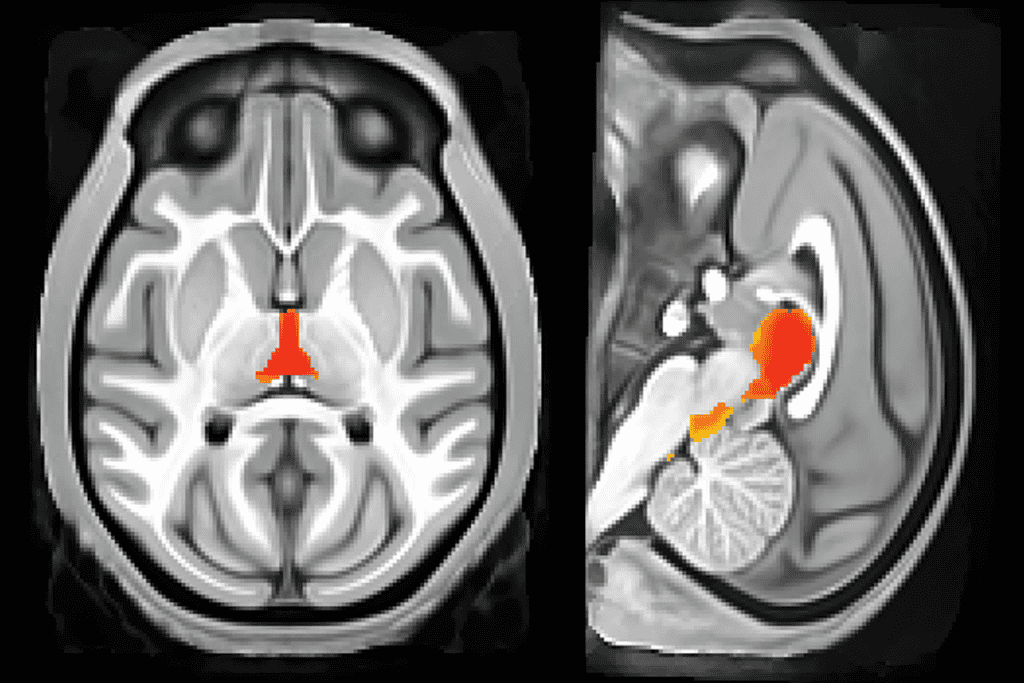
A White House report on U.S. scientific priorities released this week recommends a “moonshot infrastructure” to map connections in mammalian brains.
The initiative would seed collaborations between industry and academia to increase the translational benefit from connectome research, “much as the Human Genome Project commoditized genetic sequencing,” according to the report, titled “Science: A New Golden Age,” published 21 July by the Office of Science and Technology Policy. “For medicine, these circuit diagrams would offer a way to map the circuitry implicated in depression, addiction, and autism.”
Such a moonshot approach threatens to draw even more funding away from basic research, which has already sustained major federal funding cuts, says Jason Shepherd, professor of neurobiology at the University of Utah. “I think there’s room for these sort of large programmatic projects that span multiple acts, multiple kinds of science; it’s great,” but given finite federal funding, “I’m really worried that basic science is going to get squeezed to the point where people can’t really do just curiosity-based research.”
T
he report’s author, Michael Kratsios, director of the Office of Science and Technology Policy, told members of Congress in a hearing earlier this week that the guidelines in the 72-page report “ensure that taxpayer-supported science produces the largest returns possible for the benefit of all Americans.” Kratsios previously served as chief of staff at the investment firm Thiel Capital.To reap those returns, the U.S. government must explore “various ways to support scientific progress that depart from the university-based, principal investigator-driven grant,” the report states. It should also test new grant-awarding strategies—such as “a deliberate, portfolio-based approach,” much like a venture capital firm—and stay on the bleeding edge of artificial-intelligence advances.
Putting more government funding in the hands of industry scientists instead of basic researchers at universities might not surface the kind of work that stands to benefit humanity the most in the long run, says Jeff Lichtman, neuroscientist and professor of molecular and cellular biology at Harvard University, who is known for pioneering connectomic imaging techniques.
Industry researchers have already started to participate in and accelerate large-scale efforts to map the mouse and human connectomes, he adds, but the field “didn’t start with an industrial desire to do it. It started at universities.” There’s an irony baked in, because “if you just have an entrepreneurial system where everybody’s in it simply to get rich, connectomics would never exist.”
T
he report’s section on budget recommendations for the fiscal year 2028 outlines several core research missions, including artificial intelligence, quantum computing, fusion energy, space, robotics and semiconductors.Providing long-term funding for teams focused on specific scientific missions “is a positive development,” says Jan Wessel, chair of psychological and brain sciences and neurology at the University of Iowa. “The problem is that, especially in neurosciences, there is so much basic research that still needs to happen for things to be translatable.”
The report says that startups and not just universities are performing basic research, giving early-career scientists a new path. But universities have served as the bedrock for curiosity-driven basic science for centuries, in part because they are nonprofit environments, Wessel says. “In the worst-case scenarios, the truth is not profitable,” he adds. “Science is not profit-driven; science is truth-driven.”
History has shown that investing in university-based basic science has helped the United States excel at scientific enterprise, says the chair of a neuroscience department at an R1 institution, who asked to remain anonymous because they said their university asked them not to publicly comment on issues tied to the administration. By turning away from funding universities, “we are really throwing away our future,” the scientist says.
Overall, the report is “kind of out of touch with the brutal reality of what’s happening to American science in real time,” says Thomas Insel, former director of the National Institute of Mental Health.
“Why are we having to make impossible choices?” Insel asks. “Why are we saying either you’re going to support industry or you’re going to do university-funded or academic research? We need both.”