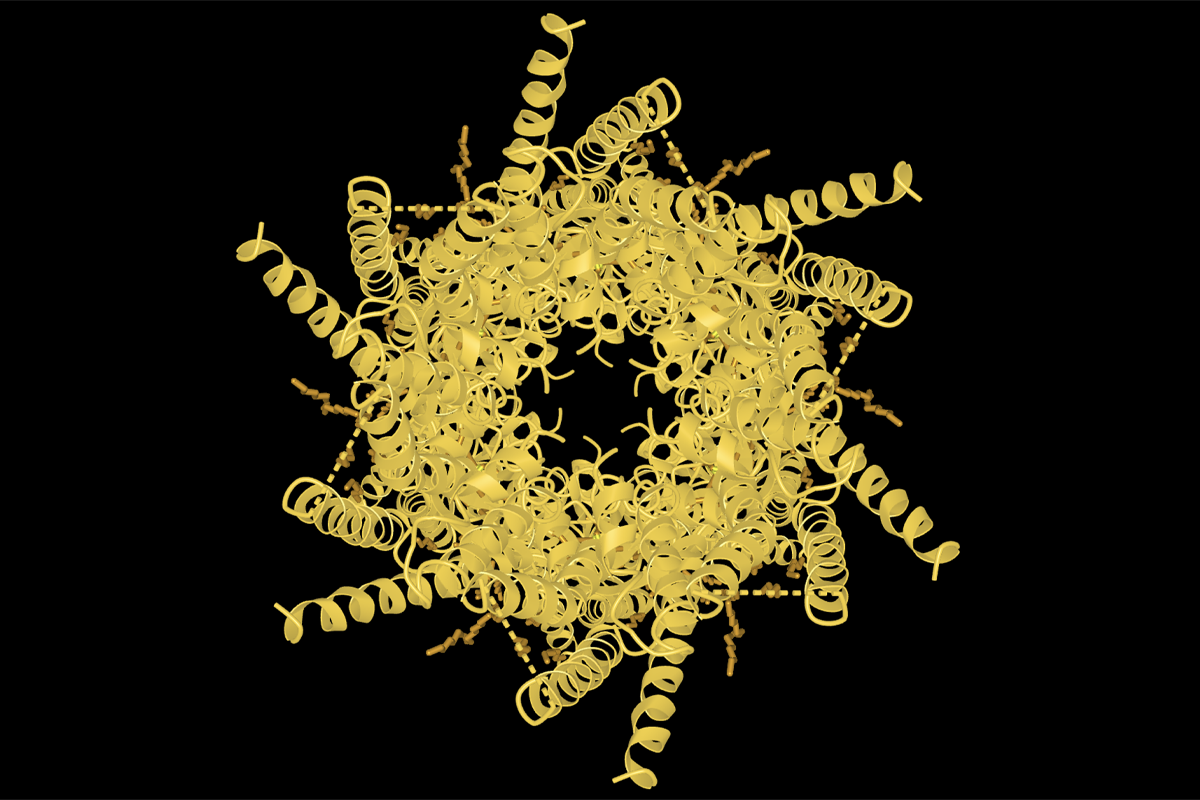
A new tool makes it possible to probe brain circuit function without the kind of external stimulation required in optogenetics and chemogenetics.
The method uses engineered electrical synapses to edit brain circuits. These designer synapses function in living mice, altering activity in cells, circuits and networks, with corresponding effects on behavior.
In contrast to tools that involve external stimulation, the result is autonomous. “Here, all the information is completely natural; it’s only how the brain manipulates this information that’s being altered,” says Ithai Rabinowitch, assistant professor of neurobiology at the Hebrew University of Jerusalem, who was not involved in the work. “This is really important, in my view.”
The technique, called LinCx (long-term integration of circuits using connexins) could be used to investigate relationships between circuit structure and function, as well as the duties of natural electrical synapses. “It’s potentially a useful tool if it’s used intelligently and thoughtfully to ask questions about the role of electrical synapses in brain circuits,” says Eve Marder, professor of biology at Brandeis University, who was not involved in the study.
Electrical synapses consist of gap junctions that, in vertebrates, are composed of connexin proteins, of which there are 21 isoforms in humans. These proteins sit in the membranes of touching cells, docked together to create channels that ions pass through, coupling the cells’ activity.
Gap junctions in invertebrates are composed of innexins, which don’t interact with connexins, so expressing a mammalian connexin in Caenorhabditis elegans enabled researchers to rewire an olfactory circuit and flip the worms’ behavior from odor attraction to avoidance, according to a 2014 study.
Adapting this approach for more complex brains presented a problem, however: Because virtually all connexins dock with connexins of the same type, in “homotypic” junctions, adding new connexins of the same type to an entire population of neurons can create hyperconnected networks and hyperexcitability. “We ran into a brick wall when we started thinking about how you would pull this off in a mammal, which has many cells of the same type,” says study investigator Kafui Dzirasa, professor of psychiatry and behavioral sciences at Duke University School of Medicine.
To get around this, the researchers needed connexins that would dock only with specific partners to form “heterotypic” junctions, and not with Cx36 or Cx45, the primary connexins in mammalian neurons and astrocytes, respectively. “It became a biochemistry problem,” Dzirasa says. “Instead of having these gap junctions work like stickers like they did in C. elegans, we needed them to work like magnets, where we have a positive end and a negative end, which we deploy to cell types.”
The team chose a well-studied pair of connexins from white perch fish, Cx34.7 and Cx35, which form junctions with each other. But after screening a library of Cx34.7 and Cx35 variants using an assay they developed, they were unable to find a Cx34.7 variant that didn’t interact with Cx36.
“We selected for one property and still had to engineer the other one,” says study investigator Elizabeth Ransey, who led the work while a postdoctoral researcher in Dzirasa’s lab and now runs her own lab at Carnegie Mellon University.
With the aid of computational modeling, Ransey and her colleagues identified key amino acids in Cx34.7 and Cx35 that, when mutated, cause the pair to dock exclusively with each other. The work was published last month in Nature.
“The approach they took is really elegant and beautiful,” Rabinowitch says. “For me, as someone who is engineering synapses, it’s something I’ve always wanted, and here someone successfully did it.”
A
rmed with this pair, called Cx34.7(M1) and Cx35(M1), the team first replicated a finding in worms. The real challenge, though, was showing that the approach worked in mice.The first demonstration involved a microcircuit between prefrontal cortex pyramidal neurons and interneurons. The engineered synapses boosted phase-amplitude coupling between theta-band and high-frequency oscillations, a sign of strengthened communication in the circuit. The LinCx-edited mice also displayed a greater preference than controls did for a social stimulus.
They next chose a long-range circuit Dzirasa’a group had previously implicated in stress responses: projections from the mouse infralimbic cortex to the medial dorsal thalamus. Expressing Cx34.7(M1) in the infralimbic cortex and Cx35(M1) in the medial dorsal thalamus enhanced oscillatory coupling between the regions, and LinCx-edited mice showed reduced stress-related adaptation in a tail-suspension test.
A potential complication is that connexin molecules can form oligomers with neighboring molecules in cell membranes. “If they’re not pure, their docking properties might change,” Dzirasa says. An important aim of “LinCx version 2.0” will be “making sure it’s extremely clean in terms of side-to-side interactions,” Ransey says.
Adding electrical synapses could also influence cells’ chemical synapses, which could contribute to the observed effects. Teasing such possibilities apart is complex, Dzirasa says. Effects will also vary because cell types have different properties. “Every connection of cell types is going to be different,” he adds. “So you’ve got to test it out for each cell-type pair.”
LinCx may prove to be a powerful new tool for basic neuroscience, but clinical applications—Dzirasa’s ultimate goal—remain distant. While others work on brain delivery systems, Dzirasa’s team has a more fundamental question at hand. “We’ve got to figure out if human tissue can tolerate them,” he says. “We’re currently expressing and testing them in human organoids to address exactly this question.”