LISTEN TO THIS STORY:
0:00
/
In most mammalian retinas, rods outnumber cones. But that ratio is flipped in ground squirrels, a quirk that helps Seth Blackshaw explore how retinal cells develop their identities.
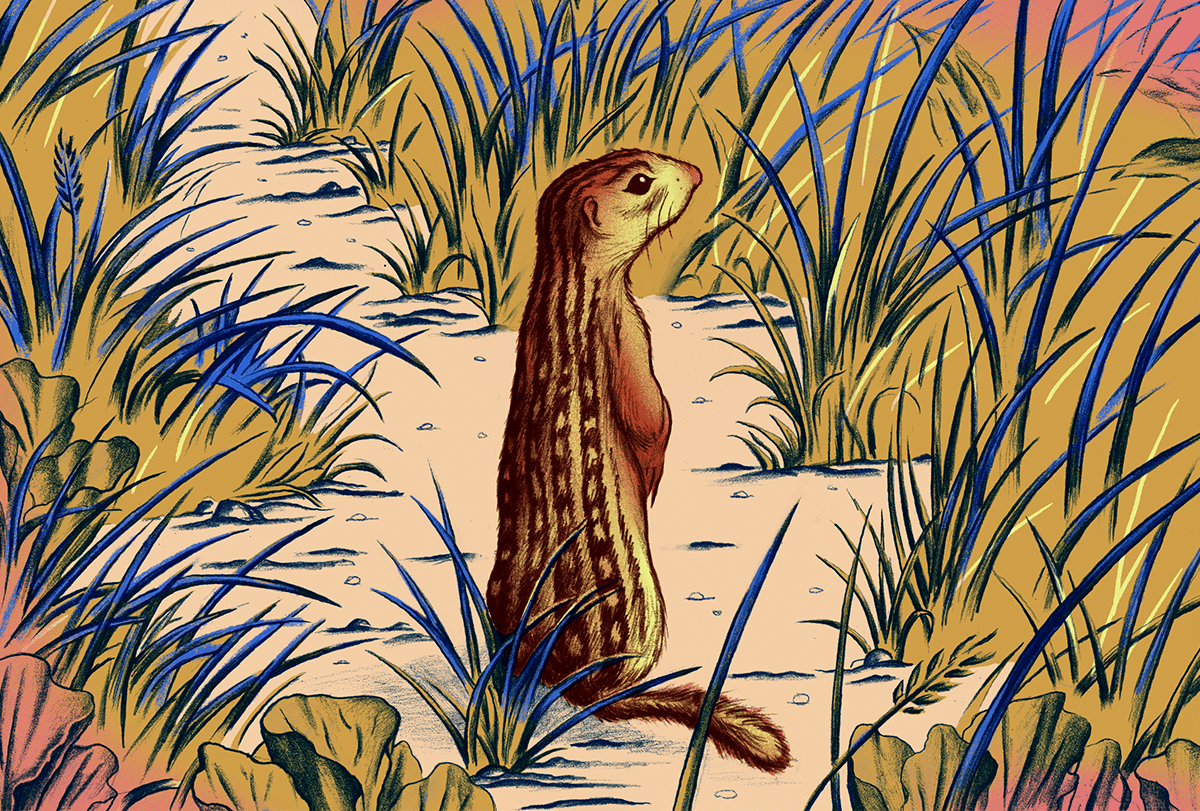
The thirteen-lined ground squirrel’s most striking feature may be the baker’s dozen of stripes on its back, but what truly sets it apart from other mammals is harder to see.
In most diurnal mammals, rods—photoreceptors in the retina involved in sensing dim light—outnumber those responsible for color vision, or cones. This imbalance reflects a nocturnal bottleneck during the Mesozoic Era, when mammals hid in dark holes and caves during the day and emerged at night to skirt dinosaur predators.
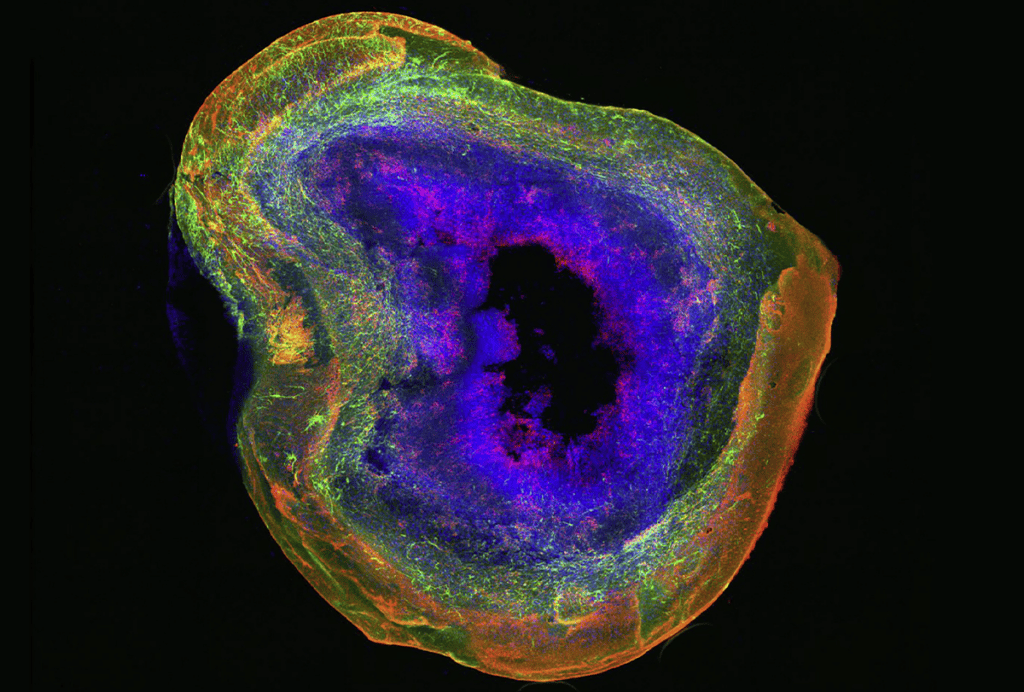
“But ground squirrels have completely flipped the script,” says Seth Blackshaw, professor of neuroscience at Johns Hopkins University. The rodents have six to seven times as many cones as rods. In fact, scientists assumed the ground squirrel retina contained only cones until a 1975 electron microscopy study identified a small population of rods.
Blackshaw says he wants to uncover how and why ground squirrel retinas became so jam-packed with cones. Increased expression of a variety of transcription factors boosts cone production in the squirrel’s developing retinal neurons, Blackshaw’s group reported in February. Next, he says he plans to investigate how retinal cells differentiate.
Blackshaw spoke with The Transmitter about what exactly ground squirrels can see, their tricky breeding schedule, and what he hopes to study next.
This interview has been edited for length and clarity.
The Transmitter: How did you learn about thirteen-lined ground squirrels and decide to work with them?
Seth Blackshaw: We started working on thirteen-lined ground squirrels for another topic: cellular changes during hibernation. Ground squirrels are deep hibernators. During hibernation, massive degenerative changes occur in the nervous system; this is all reversed within about six hours following exit from hibernation.
But the squirrels are very interesting for an unrelated reason, which ties in to my interest in photoreceptors. They are one of two major mammalian clades—the other being tree shrews—where the rod-to-cone ratio is reversed. How did this happen? Can we use this to learn more about molecular mechanisms that specify cone receptor identity? So that’s how we got into this.
TT: Because ground squirrels have so many cones, does that mean they have color vision like humans?
SB: They’ve got a lot of cones, but they are to a large extent colorblind because they have only one type of color-sensitive cone. By contrast, humans are trichromatic. Our original non-mammalian ancestors had four separate visual cone pigments. During the nocturnal bottleneck, mammalian ancestors lost two of those. Human ancestors later developed trichromatic cones. Ancestral placental mammals had a green-sensitive and a UV-sensitive cone that are both retained by the ground squirrels.
TT: What questions does the ground squirrel allow you to explore that you couldn’t probe in other model organisms?
SB: The mechanisms driving shifts in retinal neuronal subtype identity have not really been investigated in any context, so that’s really what makes this a uniquely useful species. We have really comprehensive single-cell multiomic data from the developing mouse retina; we have it from the human retina too. So, by taking similar data from the squirrel, we can directly overlay those with mice and identify changes in gene expression and regulation that directly drive the increase in cones and the decrease in rods.
TT: What did you find out by overlaying the datasets?
SB: It turns out that cones are generated almost through the whole course of neurogenesis, and rods only at the very, very end. This right away suggests that there’s a shift in the window in which cones are generated. Then the question was: How did that shift happen? There’s a temporal expansion of expression for a handful of transcription factors that, in the mouse and the human, are only active in early stage progenitors. So that provided a mechanism right there.
TT: What are some unique challenges when working with ground squirrels?
SB: The big challenge is the difficulty in doing any kind of functional study. Ground squirrels are seasonal breeders, so you have one shot at breeding every year. You can certainly freeze tissues, but with only one litter a year in the spring, this really limits the number of experiments you can do. We work with our collaborator, Dana Merriman at the University of Wisconsin Oshkosh, who runs the main breeding colony in the United States.
Ground squirrel embryo organoids have basically proven more or less impossible to make so far. Squirrel-induced pluripotent stem cells have been made, and direct differentiation of neurons was reported. However, it’s really unclear why retinal organoids have been so difficult to make.
TT: What are you studying next?
SB: The question of photoreceptor versus other retinal neuron specification. Rod-dominant species tend to be photoreceptor dominant. In ground squirrels, the ratio of photoreceptors to other retinal neurons is completely reversed. In addition to this rod-to-cone switch, there’s an expansion of inner retinal cells at the expense of photoreception. Now we’re digging into how that happens. And we’re looking at the mechanisms that controlled the evolution of the nocturnal bottleneck in the first place.