“All men by nature desire to know” is the first line of Aristotle’s work “Metaphysics.” New findings show that this statement extends across the animal kingdom to mice, too.
Mice seek information even if it does not correlate with receiving a reward—a positive payout such as food and water—and they will, in fact, give up a reward in exchange for information, according to a study published in Nature Neuroscience this July. The orbitofrontal cortex represents the value of information differently from the value of a reward.
The major contribution of this work “is showing that mice also value information in the same way that we know that humans and other primates do,” says Joe Kable, professor of psychology at the University of Pennsylvania, who was not involved in the study. This “makes it possible to study this particular cognitive process of information seeking in an animal model that has many, many, many more tools than the tools that we have to investigate this in humans and other primates.”
T
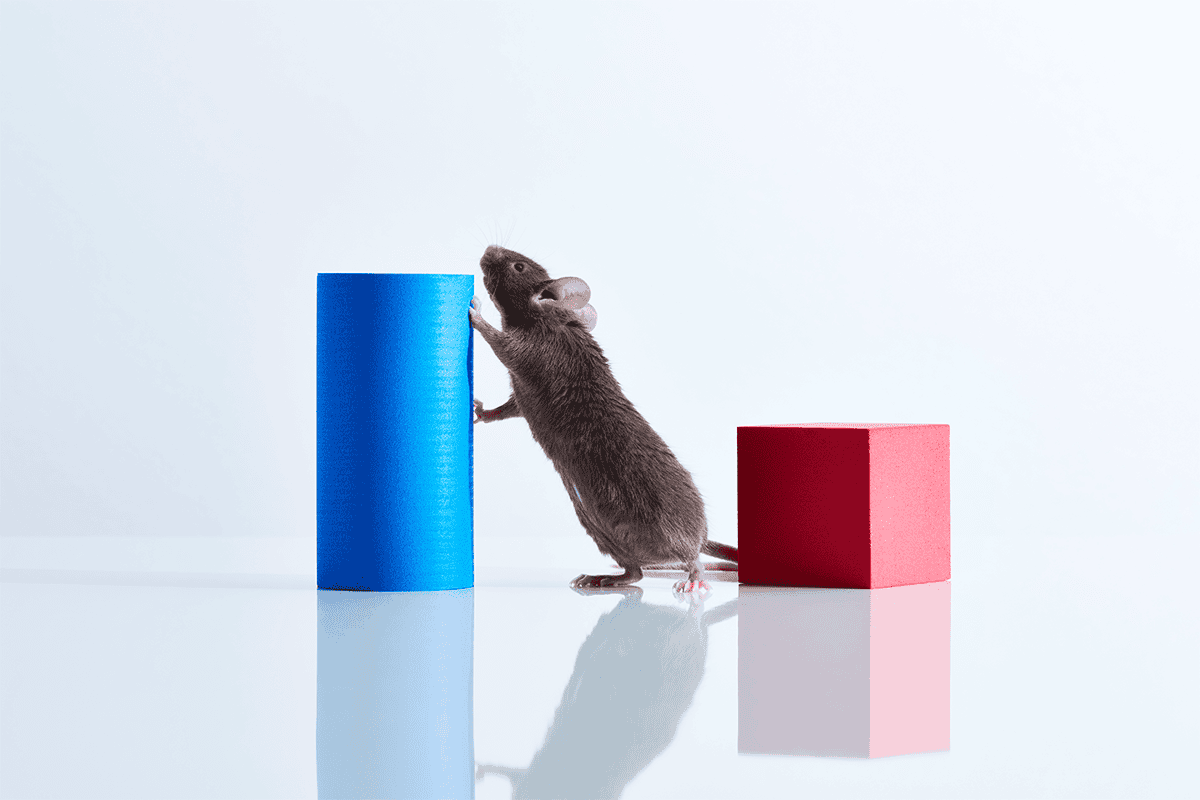
In this new work, the researchers trained water-deprived mice to poke their noses into one of two ports that provide equal chances of a sip of water: At the “information” port, the animals smelled odors that always indicated whether or not they would get water; at the “no information” port, odors provided no clues.
After mice learned the task, the team let the animals choose between the two ports.
Mice chose the information port 78 percent of the time. They also entered the information port faster than the no information one, by an average of 220 milliseconds. At the information port, they would wait to lick the spout until the cue was given, whereas at the no information port, they would start licking immediately. These observations suggest that the mice prefer information, because the probability of receiving water was identical at the two ports.
Even after the researchers decreased the amount of water dispensed at the information port, the mice still preferred it—so long as it was only 4 to 6 microliters short of the amount provided at the no information port.
“It’s important to convince both yourself and the field that you’re studying the behavior and the strategy and the cognitive process that you are intending to study, right?” says study investigator Jennifer Bussell, a postdoctoral neuroscientist in the Axel lab at Columbia University. It took many iterations of the task for her to convince herself and colleagues that the mice really are seeking information without other confounding factors, she says. “I hope we have convinced everyone at this point, at least about the behavior, because we struggled for such a long time to find a version of the task that we thought would work.”
C
Ben Hayden, professor of neurosurgery at the Baylor College of Medicine, says he is “jazzed” about this paper because he has been following these experiments for years, although he was not involved in the work. He has worked on a similar study looking at nonhuman primate information seeking and its representation in the orbitofrontal cortex, but says, “You can do much better neuroscience with a mouse than you can with a monkey” for the purpose of studying the neural circuitry that underpins information seeking.
The new study’s initial representational mapping draws similar conclusions to previous work done in non-human primates, but next, Bussell would like to do “activity-dependent labeling and tracing, which is one of these things that is somewhat straightforward in a mouse and potentially not possible in other model systems.” She would like to also look beyond the orbitofrontal cortex at “places like medial prefrontal cortex and the insula.”
This paper is “landmark,” says Jacqueline Gottlieb, professor of Neuroscience at Columbia University, who was not involved in the work, because it sets up a behavioral paradigm to study information seeking in mice, where “there are more manipulations that can be done. You can monitor neurotransmitter release. You can do genetic manipulation. So it opens the door to a deeper understanding of the biology.”