In Frameshift, neuroscientists with careers outside academic labs discuss their work and how they made the transition.
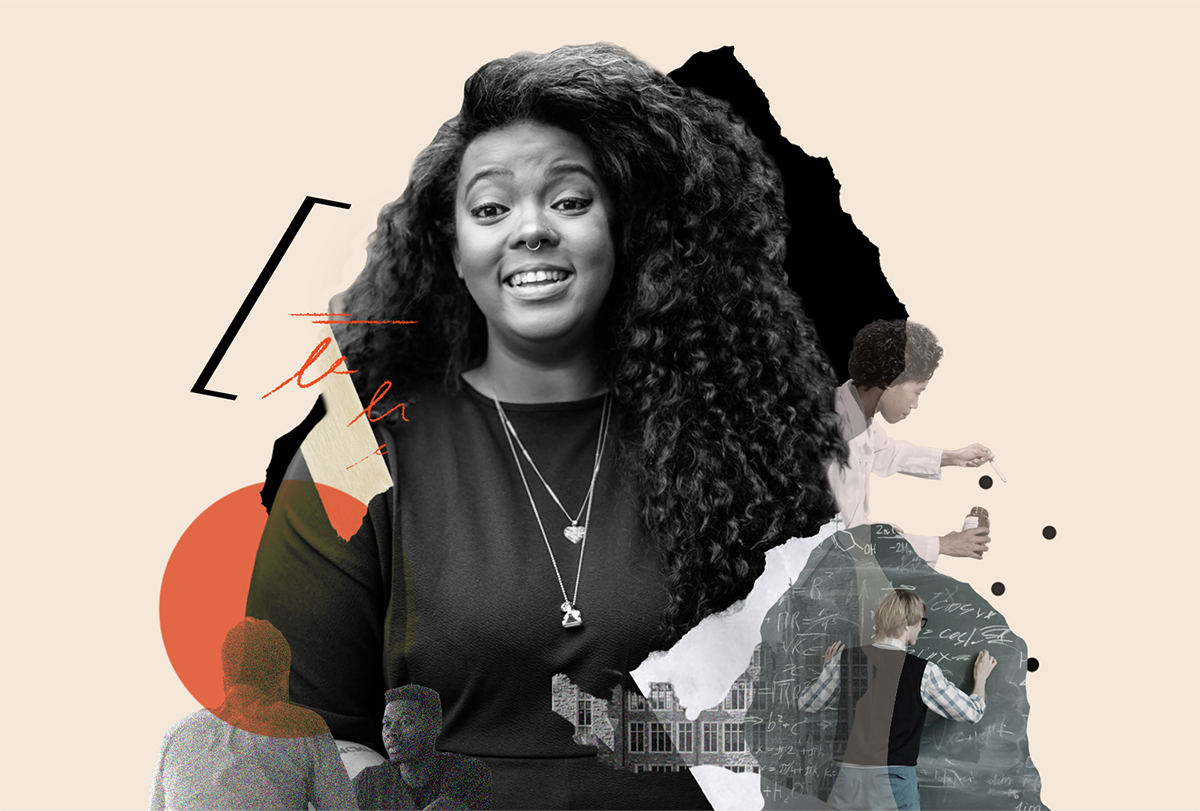
Fund friend: Kaela Singleton spends her days reading papers on Alzheimer’s research and talking to investigators about the Cure Alzheimer’s Fund's grant processes.
Illustration by
Michela Buttignol
Add us as a Preferred Source on Google
Set us as a Preferred Source to see The Transmitter more prominently in your Google Search results.
Getting grants feels good, but giving them is even better
As director of grants management at the Cure Alzheimer’s Fund, Kaela Singleton bets on bold science and shares in the joy of discovery.
By
Katie Moisse
19 June 2026 | 8 min read
Kaela Singleton was two years into her postdoctoral position when research stopped being fun. She was good at it—getting the grants, publishing the papers—but couldn’t imagine doing it for the rest of her life. “It was a weird sort of, like, ego death,” she says of realizing the principal investigator (PI) life wasn’t for her. But a mentor helped her see what she loves about science and reframe her idea of success. Now, as director of grants management at the nonprofit organization Cure Alzheimer’s Fund, Singleton gets to bet on bold science and share in the joy of discovery—but without the parts of research that just didn’t resonate with her.
This interview has been lightly edited for length and clarity.
The Transmitter: What does a day in your work life look like?
Kaela Singleton: My goal is to recruit bold science for us to fund and then walk researchers through our funding process. I have days where I’m reading—everything from Alzheimer’s disease in the news to cool new science papers to grants I need to process. I have days where I’m writing—taking all the information I’ve read and synthesizing it for different audiences, such as donors, people on my team or our board. And then I have days where I’m networking—taking Zoom calls with investigators or going to conferences. It’s a lot of different tasks, but they’re all about recognizing cool science and people doing innovative work.
TT: What do you love about your job?
KS: I really love learning about new science and seeing how researchers are thinking about new approaches for managing Alzheimer’s progression and prevention. As director of grants management, I get to be with them on the precipice of discovery even though I’m not at the bench anymore. I also really love the team that I work on. Everyone is so smart and charismatic and fun and excited about cool research.
TT: It sounds like you need to really know your science but also be a good “people person.”
KS: Most of the folks on the Cure Alzheimer’s Fund research team have a Ph.D., so we’re all really immersed in the field. If a new paper on Alzheimer’s comes out, we’ll read it and then reach out to the researchers to explain our grants process. Then we work closely with them to craft aims and think through the impact and deliverables. I think there’s more social interaction than most people would expect.
TT: When did you realize life at the bench wasn’t for you?
KS: In graduate school, like many grad students, I wanted to be a PI. When I started a postdoc at Emory University, all the pieces were falling into place: I was getting grants and thinking about my future lab. But suddenly everything stopped being fun. The job was less about physically doing science, which is the part I always loved, and more about imagining new projects, new grants, new hypotheses. And while I excelled at all of that, it really felt more daunting than reinvigorating. There was a lot of grief in realizing, “Oh, this thing that I worked at for almost 20 years, I really don’t want anymore.” But I had a really supportive postdoctoral mentor and a lot of great resources at Emory, like career coaching, and they helped me figure out what I love about science and reframe the way I think about career success.
TT: How did that lead you to the nonprofit world?
KS: I had some experience with nonprofits through Solving for Science and Black In Neuro. Black In Neuro started in 2020 as a social media movement to show that Black people are neuroscientists too. I was president for a year and helped us set up the internal structure. It was wildly successful, but I think everyone on the organizing committee in the beginning would say we were the blind leading the blind. We weren’t sure how nonprofit structures work and what mission-driven work looks like in a practical sense, but we figured it out. We became an official nonprofit with 501C3 status that does everything from mentorship to talking about neuro-racism to reminding people why diversity, equity and inclusion is important. It has been amazing, and one of the reasons I felt like I could move into the nonprofit space.
TT: What are some skills from your Ph.D. that transfer to your current role?
KS: You need to be able to complete tasks and work with other people. That takes internal motivation, and I think that’s something everyone with a Ph.D. has. Finishing your Ph.D. is so gnarly. You have to have the self-motivation to get over the finish line. I also think the experience I got through Black In Neuro of leading a team and collaborating remotely was important, as I work remotely now and interact with researchers based all over. And I didn’t realize how important writing would be. So much of working in science outside academia is about communication.
TT: What are some things trainees can do now to help prepare them for this kind of career?
You can build your communication skills in grad school by writing blogs about research or science careers, getting on mock grant committees and trying out teaching and guest lectures. Also, consider volunteering outside of academia. I volunteered at local elementary and middle schools and worked with local artists in Washington, D.C., for newsletters and magazines. Really, anything that helps you expand your audience and practice discussing things you’re passionate about is good experience.
TT: Do you miss academia?
KS: When I was a postdoc, I was also an adjunct professor at Agnes Scott College, where I did my undergrad. There’s something about being in a classroom that just grounds you and keeps you young. I miss students, their eagerness to learn and their ability to ask any question.
I also miss using my hands the way I did when I was a researcher. I think that’s something you kind of take for granted when you’re doing science. So I’ve taken up hobbies, like gardening, knitting and puzzles, and I’m really into pottery.
TT: What’s your advice for researchers who are realizing they have maybe fallen out of love with the lab?
KS: The first thing I would say is, “Don’t panic.” It’s way more normal than we talk about. It can feel overwhelming because it feels like a loss. You might feel like you’re a quitter or giving up, or at least I did. I’m a person who had always had a plan and then, all of a sudden, I had no plan. I was really hard on myself about that, but I knew I was unhappy and couldn’t stay.
I think my biggest advice is to talk to people who have been there—reach out to people at your career development office and look for those connections. I ended up going to a career coach, and it felt like career therapy, in the best way. It was really helpful in building my confidence and helping me to not put so much pressure on myself to have everything figured out all at once. Take advantage of those resources, but also believe in yourself and know that you’ll figure it out. You’ve figured out hard things before, and you’ll figure this out, too.
Finally, reflect on the type of life you want to build, the impact you want to make on the world. I think many people go into science to make an impact—I know I did. But there’s more than one way to do that. One thing I think about is bell hooks’ idea of queerness: One facet of queerness is who you sleep with, yes, but another is being at odds with the heteronormative way of seeing society. Now, instead of being super ambitious about work—which I do care about—I’m super ambitious about things like mutual aid, my local government, rest, building a home I feel like I can grow in, hobbies and living a full life. It’s about shifting the way that you focus your energy and not beating yourself up, because people are allowed to change.
Editor’s note
A previous version of this article stated that the entire Cure Alzheimer’s Fund research team has a Ph.D.
Explore more from The Transmitter
What to do when traditional mechanistic approaches no longer work
By
Bence Ölveczky
19 October 2026 | 8 min read
University probe leads to retraction of four neural tube studies
By
Claudia López Lloreda
16 October 2026 | 6 min read

Highly cited autism paper earns expression of concern over data duplications
By
Madeline Shaw
16 October 2026 | 4 min read
Cite this article: