In Frameshift, neuroscientists with careers outside the lab discuss their work and how they made the transition.
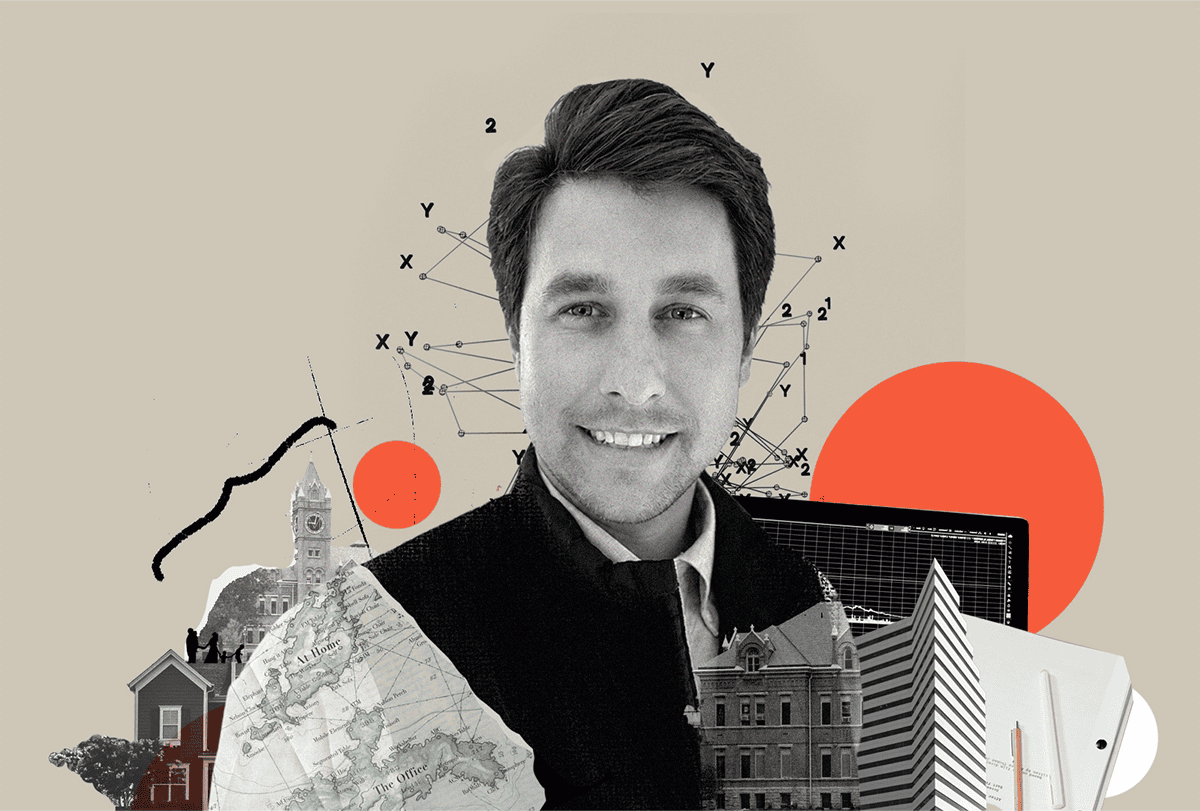
Data diver: In his current role, Taylor Bolt uses his research experience to help companies and government agencies formalize their questions and make evidence-based decisions to solve them.
Illustration by Michela Buttignol
Add us as a Preferred Source on Google
Set us as a Preferred Source to see The Transmitter more prominently in your Google Search results.
The fun and flexibility of data science
Taylor Bolt spent his Ph.D. and postdoc digging through brain imaging data for clues to cognition. In industry, the datasets are different but the joy of answering questions with data remains.
By
Katie Moisse
18 August 2026 | 7 min read
Taylor Bolt loved the challenge of mining terabytes of brain imaging data for clues to cognition. As an industry data scientist, he uses his research chops to help companies and government agencies make evidence-based decisions.
This interview has been lightly edited for length and clarity.
The Transmitter: What does an industry data scientist do?
Taylor Bolt: I’m currently in a government contracting role with CPMC, a consulting firm, where I work with federal scientists on data mining and analysis of large-scale government datasets. Before that, I worked in human resources for Deloitte, where my research involved understanding and improving the experience of employees. For example, we had a major problem with turnover during the pandemic, and we wanted to understand what was contributing to turnover so we could predict it and potentially intervene with different kinds of incentives when we really wanted people to stay.
There are data science positions across every single industry, but the common denominator is you’re working with lots of data collected by the company or agency you work for or a third party and extracting insights from that data. Ultimately, you’re making some kind of recommendation based on those insights.
TT: What led you to an industry data scientist position?
TB: I’ll be honest, I kind of stumbled into data science. My Ph.D. advisor, Lucina Uddin, was good at making sure her trainees knew what was out there beyond academia. I was a neuroimaging scientist, which has a heavy computational focus. I was pretty good at data analysis, and I really loved programming, so data science felt like something I could do.
About six months into my postdoc, I started shooting out applications for entry-level data science roles and was fortunate enough to land an interview at Gallup for a job as a computational social scientist. I got the opportunity and was there with a bunch of other Ph.D.s who were fresh out of their programs. We did a lot of research trying to help companies engage with their employees through surveys. We also worked on R&D contracts with some government agencies.
TT: What made you leave academia for industry?
TB: I did a Ph.D. because I was dead set on being an academic. But I had other desires, too, like settling down with a family. And at a certain point during my postdoc, the desire for a more stable career path and the ability to live where I want to live became more important to me. My wife and I were in Atlanta and ready to settle down. If I wanted to go for a tenure-track position, I would probably have had to move and maybe take another postdoc first.
When I was looking for a role in industry, I wanted something where I could focus purely on research and data analysis. Data science fit the bill, so I tailored my resume and just started shooting it to all kinds of places. I focused on experiences and skills in academia that would be attractive to potential employers, like programming, statistics and large-scale data mining and engineering. I also highlighted my ability to work independently and see a project through to completion. This was in 2018. I think the landscape has changed and even entry-level jobs are harder to get now, but I think a Ph.D. gives you a leg up. It’s not necessarily required, and you’ll meet people in data science with backgrounds in software engineering and other disciplines. But I can’t imagine being as effective as I am in my role without the Ph.D.
TT: How does a Ph.D. give you a leg up in data science?
TB: Most companies will not be able to formulate the problems they have in a manner easily translated into a data analysis. For example, the question “How can we reduce turnover?” is ambiguous and messy. You could go down many roads with that question, but it’s your job as a data scientist to direct the company towards research projects that are feasible and rigorous. You might propose a statistical analysis of internal human resources data that would help identify key predictors of attrition, the idea being that if you could predict when an employee might leave, you could offer them a retention bonus. You need to formalize a company’s questions and make them more concrete, then use available data to deliver practical insights, then communicate those insights to different people. These are things you do all the time as a Ph.D. You learn to be an independent contributor who can take a project from start to finish.
TT: Do you miss academia?
TB: I never fell out of love with research, but I didn’t love some of the other things principal investigators have on their plates. Like, it was hard for me to write grants, and that’s a major part of your job as a PI. My dream would have been to stay a postdoc for the rest of my life. There was a level of freedom to pursue what I thought was interesting, and if I wanted to pivot, it didn’t require much buy-in from my supervisor. In industry, you can tell leadership, “Listen, I don’t think this is the route we should be taking. I think we need to pivot.” But it does require more buy-in.
The great thing is, I didn’t leave academia for long. After about two years out of academia, I approached my Ph.D. advisor and said, “I’ve got some ideas. Would you mind if I started doing some research part time? You don’t have to pay me; I just want your resources.” So I basically moonlighted as a scientist. I wrote some papers, and we got them published. Eventually it became a little more formalized and I am paid now for about 5 to 10 hours a week. I even went to the annual meeting of the Organization for Human Brain Mapping last year in Australia. I would say most industry teams are very supportive of maintaining that academic connection, even if it’s outside of your industry field. I think it’s becoming more accepted that the academia-industry connection isn’t one-way; it’s a revolving door.
TT: What’s your advice for trainees who are interested in industry jobs in data science?
TB: First, be proud of what you’ve already accomplished. Doing a Ph.D. takes a lot of hard work. If you’re early in your Ph.D., you can consider training opportunities that make you more competitive for data science positions, particularly in the realm of technical skills like Python and data analysis. But it’s never too late to make a pivot. Talk to people who have moved from academia to industry so you can learn more about their roles. You’ll also build connections and a network to leverage. This is more important today than it was when I pivoted in 2018, because even entry-level data science roles get about 400 to 500 applicants, particularly for roles that are remote. But you have a leg up because you have a Ph.D. and it’s a pretty exclusive club of folks who have made that transition. Internships are great, too, if you’re willing to work for lower pay for a year or two. But if you have that Ph.D., you’re in a great position. You’ll break in, and once you break in, it becomes much easier.
Explore more from The Transmitter
What to do when traditional mechanistic approaches no longer work
By
Bence Ölveczky
19 October 2026 | 8 min read
University probe leads to retraction of four neural tube studies
By
Claudia López Lloreda
16 October 2026 | 6 min read
Highly cited autism paper earns expression of concern over data duplications
By
Madeline Shaw
16 October 2026 | 4 min read
Cite this article: