In Frameshift, neuroscientists with careers outside the lab discuss their work and how they made the transition.
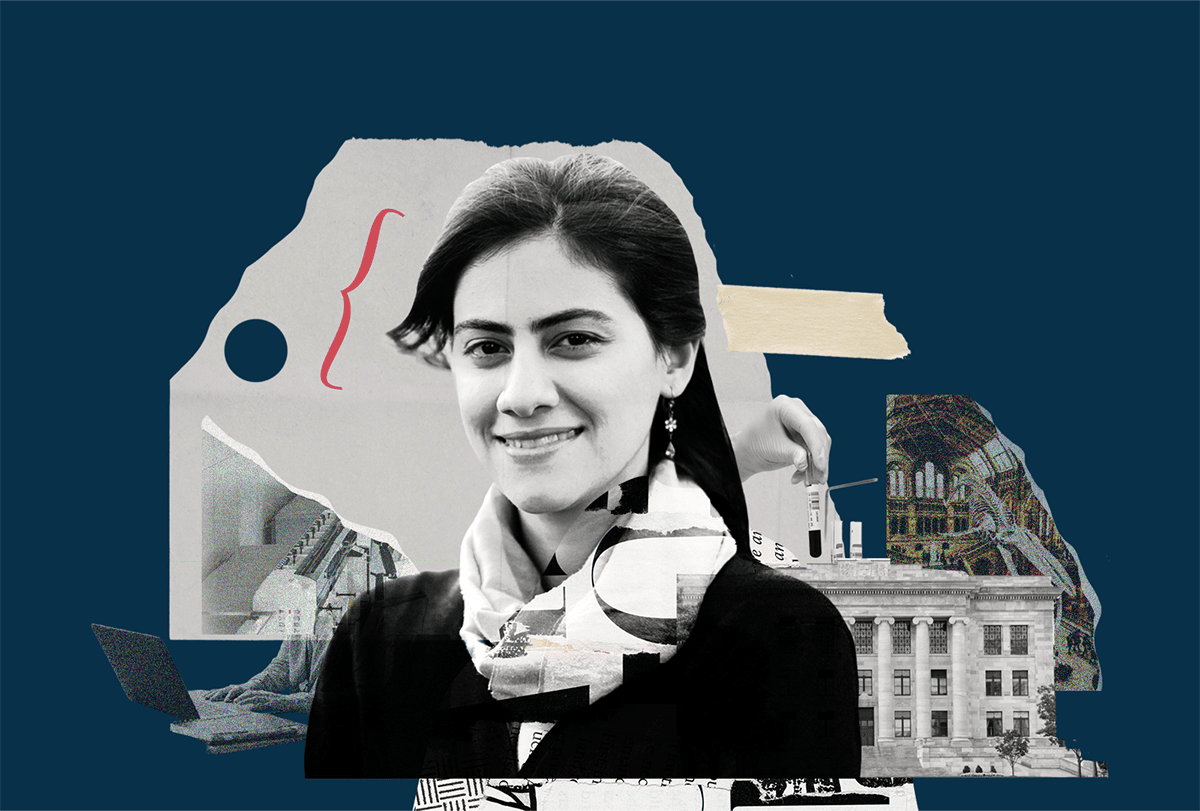
Macro manager: Soha Ashrafi makes sure conditions throughout the neurobiology department allow researchers to conduct their work.
Illustration by
Michela Buttignol
Add us as a Preferred Source on Google
Set us as a Preferred Source to see The Transmitter more prominently in your Google Search results.
Making an impact through academic administration
As executive director of research at Harvard Medical School’s Department of Neurobiology, Soha Ashrafi supports more than 300 scientists, students and staff members.
By
Katie Moisse
15 July 2026 | 7 min read
Soha Ashrafi knows neuroscientists do their best work when they have access to top-notch facilities, equipment, training and mentorship. As executive director of research at Harvard Medical School’s Department of Neurobiology, Ashrafi makes sure students and staff have what they need when they need it—even as changes in funding make the task more challenging.
This interview has been lightly edited for length and clarity.
The Transmitter: What does your job entail?
Soha Ashrafi: I work directly with the chair of neurobiology to make sure the department runs smoothly: making sure funding flows as needed to faculty and core facilities, we’re hiring strong support staff, and keeping conditions just right for everyone’s research. We’re a really big department—more than 300 people, including faculty, postdoctoral researchers, graduate students and staff—and we have labs that study everything from the visual system in nonhuman primates to behavior in fruit flies, not to mention computational neuroscience. We have to meet the needs of all kinds of people working on all kinds of things.
TT: That’s a big department!
SA: It’s huge. We have 24 faculty right now. The department was founded in 1966, so we’re one of the first dedicated neuroscience departments. There’s a long tradition and history here. I manage a team of six people who handle our events, facilities, community-building efforts and funding opportunities. A peer of mine is director of finance, and her job is to manage our team of eight or nine grant managers.
TT: What led you to this role?
SA: I did my Ph.D. in neuroscience and then a two-year postdoc. Within the first year of my postdoc, I knew the academic path wasn’t for me. I kind of fell out of love with the day-to-day of doing experiments. I remember the precise moment: I was running a PCR experiment I’d run maybe 100 times, and the experiment just stopped working. I tried everything for about a month. My adviser and I came up with a path forward, but I went back to my desk and thought, “I don’t want to do this anymore.” I liked the thinking and writing parts of science, not the chores. A friend of mine once said being in a lab can be like working on a farm. You wake up and you have chores. You’ve got to feed the sheep. And I was like, “I don’t want to feed the sheep.”
I did a couple teaching gigs, and eventually I got a full-time job as a brain educator at the American Museum of Natural History in New York, where I developed interactive educational programming for museum visitors of all ages, from kids to retirees. I’m particularly proud of a hands-on exhibit we organized on model organisms in neuroscience. We partnered with local scientists from New York City institutions to bring in live flies and worms and share neuroscience breakthroughs enabled by studying these animals.
Then my partner got a job in Boston, so we moved here. I continued to work remotely for the museum, but I sent a cold email to an unmanaged inbox for the Harvard Brain Science Initiative. Somehow my resume landed on the desk of our former department chair, Michael Greenberg. He was looking to hire a grant writer. I wasn’t thrilled about the job description, but I really wanted to meet him—he’s a scientific hero of mine. The power of the cold email should not be ignored!
I met with Michael and learned that the job was to help write big collaborative grants, as well as narratives for donors, all having to do with neuroscience at Harvard Medical School. I got excited and ended up doing that job for five years. Grants with multiple investigators are a big production, and they need someone who can pull it all together. We were quite successful, in that lots of grants came in, and new centers emerged as a result. Then, about five years ago, the person who was in my current position retired, and so I took on her role.
TT: You’ve been in this role during some turbulent times, especially this past year.
SA: Our department went through a lot in the last year, with grants terminated and the stability of funding especially precarious. The scary times are far from over—every U.S. institution is still in a state of uncertainty—but we made it through the year as best we could.
We really wanted to make sure people could focus on their science, but we also wanted to keep morale up. We had movie nights to provide opportunities to be social, and we had information sessions to make sure people knew their rights. I would say that the immigration worries have been deeply felt in our department, and, as an immigrant myself, I wanted to be sure that we could empower our trainees with the knowledge and community support they needed. Now the challenge is to keep going, and that’s hard. But I’m lucky to work in a place that values people, and I think everyone feels valued.
TT: Do you miss doing research?
SA: You know, you can get your neuroscience fix in other ways. It’s phenomenal to see research go from an idea to a paper, but you can get that same scientific satisfaction through teaching, writing or administration. I get to go to seminars to see unpublished data from all these phenomenal labs. I get to see the trajectory of a postdoc and know I’ve done something that has helped them on their way. There are so many paths to scientific joy, even if you’re not doing science in the traditional sense.
I also tend to get bored easily, so I love that we have 24 labs. It’s always different and new.
TT: What about transferable skills? Are there any from your Ph.D. or postdoc that have been useful in your role?
SA: Project management is a huge part of what I do, just like it’s a huge part of doing a Ph.D. or postdoc. At any given moment, I have to know where things stand on multiple projects with multiple stakeholders, and I ultimately have to move them across the finish line. I also need to understand the importance of things that may seem small but are actually huge for a student, postdoc or faculty member. I could not do this intuitively without being a scientist myself. It also helps that I have done fly, mouse, rat and monkey experiments, because I understand the minutiae of the different contexts. For example, I know that once you start a training period in mice or monkeys, you can’t pause because of a power glitch or temperature fluctuation.
TT: What advice do you have for trainees who aren’t sure if they want to feed the sheep, so to speak?
SA: We all think the faculty position is the pinnacle of what trainees want, and many do, especially here! But there are a lot of things that faculty have to do that I’m not sure students and postdocs understand, because you only experience those things when you’re running a lab. Things like compliance, environmental health and safety, the finances, the human resources stuff. My advice is to look for opportunities to learn more about faculty life. In our department, we ask our junior faculty to talk to our postdoc club about their first year, and the postdocs in the room are like, “Oh my God, you have to do all of that?” We all get trained on how to do the science, but nobody trains you on how to be an accountant, how to hire, and all the other things.
Explore more from The Transmitter
Remembering Barbara Finlay, ‘maverick’ of evolutionary neuroscience
By
Calli McMurray
23 October 2026 | 8 min read

Prevalence of profound autism declines with new definition
By
Brianna Abbott
22 October 2026 | 5 min read
Cite this article: