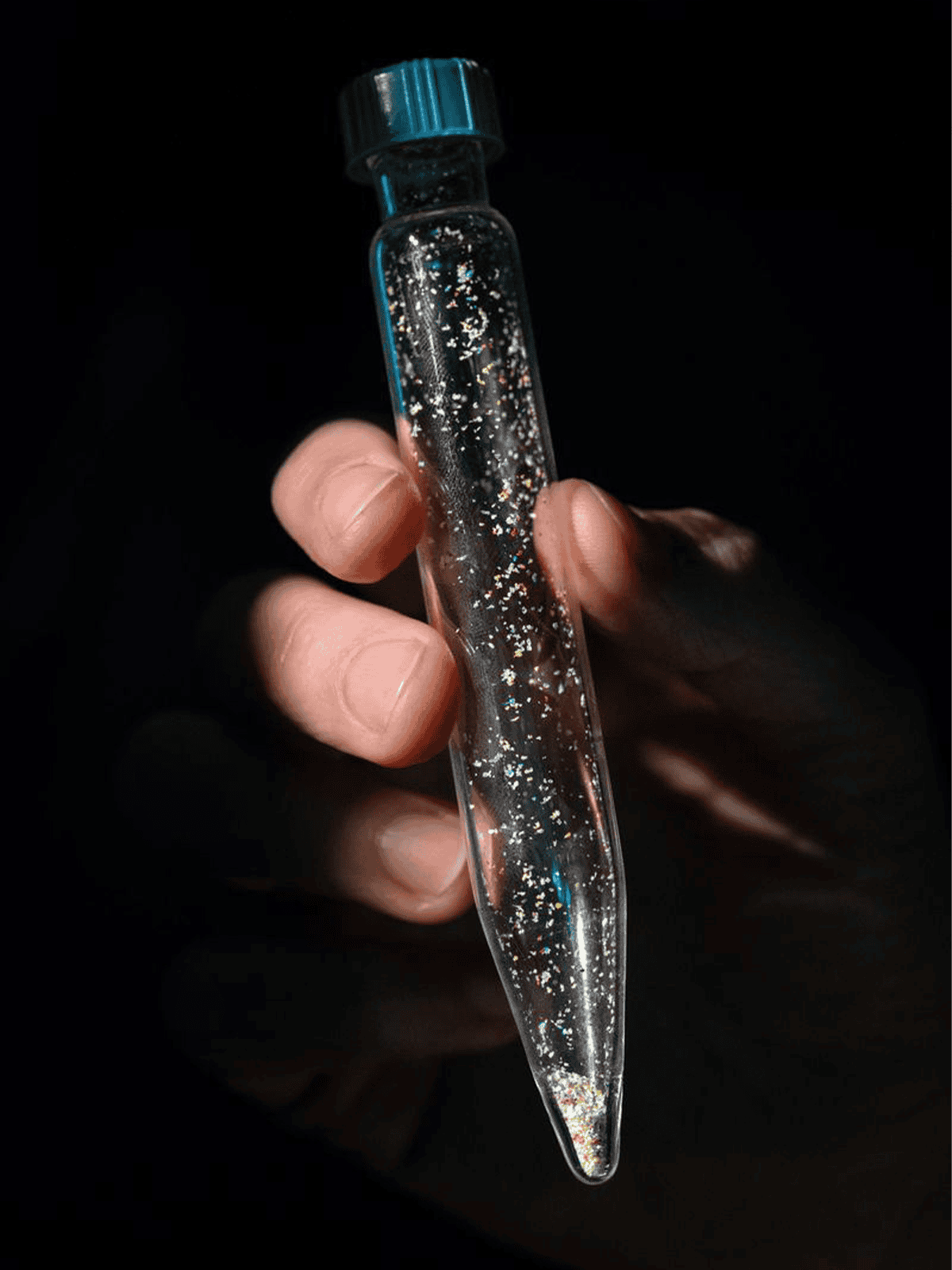
When toxicologist Matthew Campen and his colleagues published a paper in Nature Medicine in 2025 estimating a surprisingly high content of plastic in the average human brain, the reaction was swift. The study, and others, came under fire for methodological issues such as the potential for contamination and false positives, both of which could have artificially raised the quantity of plastic measured.
That discussion revealed the evolving state of the research: Determining how much plastic has lodged in a body is difficult, but discerning the amount that resides in the brain is harder still, says Dušan Materić, research group head at the Helmholtz Centre for Environmental Research. In part, that’s because plastic particles, though diverse in shape, size and composition, show up as remarkably similar to the composition of the brain in certain analyses, and he says scientists don’t always adopt the best methods of distilling only plastic from brain tissue.
Precise quantitation matters, because people are constantly exposed to diverse bits of plastic that might be neurotoxic themselves or act as vehicles to deliver neurotoxic environmental compounds. Before scientists can fully address the health implications, they need a basic understanding of how plastics and brains interact. The presence of plastics in specific parts of the brain, and potential associations with pathology, might also provide clues about how the brain works, suggests Elaine Bearer, professor of pathology at the University of New Mexico.
“We need to know how they are moving through our bodies; we need to know what is the uptake, what is the accumulation, and how long do they stay there?” says Jaime Ross, associate professor of biomedical and pharmaceutical sciences at the University of Rhode Island.
The U.S. government seems to agree; in April, the Advanced Research Projects Agency for Health (ARPA-H) announced a $144 million program to fund tool development to measure, study and ultimately remove micro- and nanoplastics from the body.
Most, if not all, of the papers regarding human micro/nanoplastics studies don’t have “sufficient quality control,” Materić says. It’s important to know “how much plastic we are exposed to and what types,” he says, but that has to be done “in a strict scientific way, supported by fundamentally correct measurements.”
T
he complexity of plastic makes quantifying it hard. Consider a disposable knife. It’s made of polyethylene, but with a variety of carbon chain lengths, says Campen, professor of pharmaceutical sciences at the University of New Mexico. Analyzing a new plastic knife via mass spectrometry would identify a slew of components, he says.
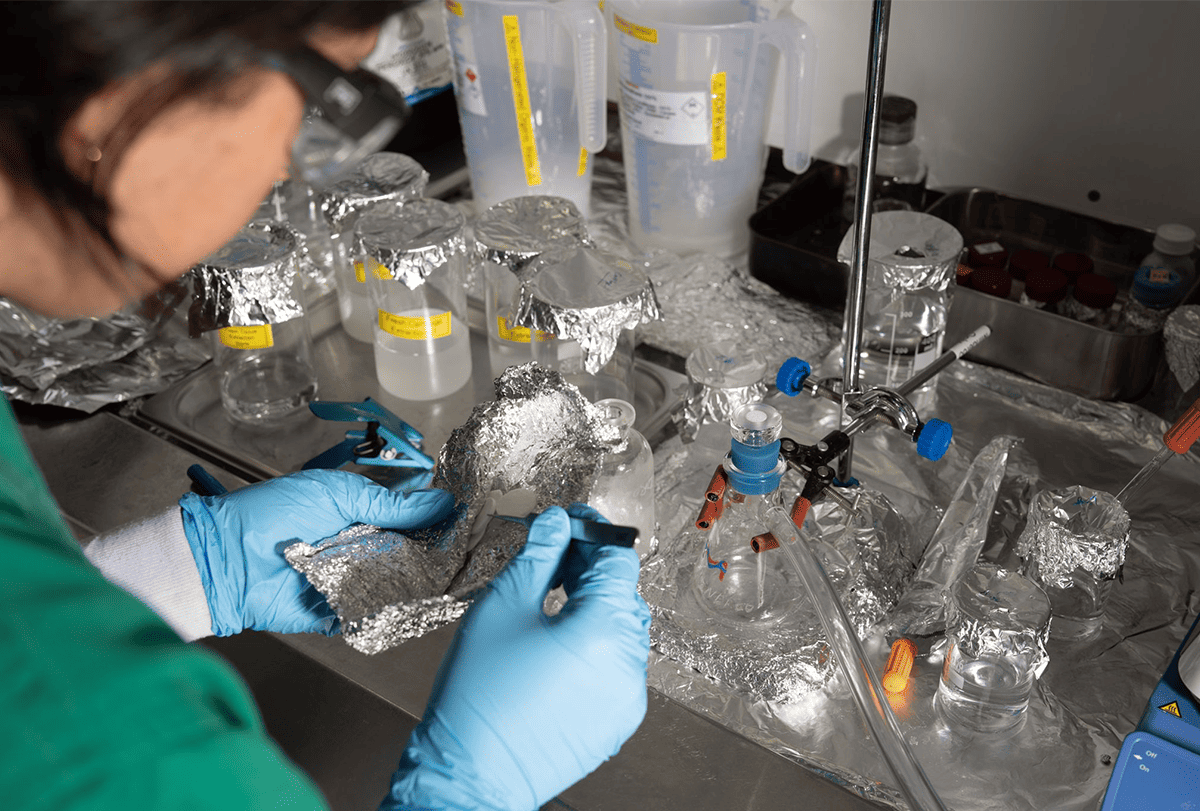
Plastic-free: Researchers in Cassandra Rauert’s lab use aluminum foil to minimize plastic contamination.
As plastic ages, it gets even more complex. If a knife is left in a rubbish heap for a few years, exposed to sun, water and wind, “we get, first, microplastics; then we get nanoplastics,” Materić says. Fragments that flake off become surrounded by other molecules, Campen says, in what’s called a “degraded corona.” They might also combine with other plastic particles, such as polypropylene, polyvinyl chloride and polyester.
When a plastic shard enters an animal via inhalation or swallowing, the body modifies the corona. The plastic might interact with acid in the stomach before being wrapped in lipids as it slips through the intestinal wall and into the bloodstream. And it might enter the brain—particles of roughly 50 nanometers or less seem able to cross the blood-brain barrier, says Brandon Pearson, assistant professor of environmental and molecular toxicology at Oregon State University.
So by the time Campen’s team gets a hold of a brain sample for testing, “What does that chemistry even look like anymore?” he says.
Then there is the biology of the human brain itself. The organ is about 60 percent fat, and the fatty acid chains in lipids, in terms of the ratio of carbon to hydrogen, aren’t so different from some plastic polymers, Pearson says. So when scientists such as Campen and Materić digest and filter their samples to isolate plastic particles and then burn up the bits and run the fumes through gas chromatography-mass spectrometry, leftover lipids could scramble the results.
This can leave researchers struggling to disentangle the plastic from the biological matrix. In fact, confounding between brain fats and plastic was one of the criticisms that Materić and others leveled at Campen’s 2025 paper.
There are other options to detect plastics, but none meet all of scientists’ needs. “No individual technique can fully characterize particle size, morphology, localization and chemical composition simultaneously,” says Carmela Rita Balistreri, associate professor of clinical pathology at the University of Palermo. “Available approaches vary considerably in terms of analytical sensitivity, spatial resolution, sample preparation requirements and their effectiveness in detecting nanoscale particles in complex biological environments.”
One of the most promising approaches, Balistreri says, is Raman spectroscopy and its variants. It yields both shape and chemical information about materials based on how their molecules vibrate in response to laser light, and some versions also provide the location of the molecules in tissue sections. Conventional Raman microspectroscopy works best for particles down to about 1 micrometer, but stimulated Raman spectroscopy, with faster imaging and a stronger signal, is promising for both micro- and nano-sized particles, she says. But, she notes, the procedures are time-consuming. In comparison, she says, Fourier transform infrared spectroscopy can be faster, but it is also best suited for micrometer-sized particles.
“There’s major tradeoffs to any one of these technologies,” Pearson says, which is why “you need multiple modalities.”
T
he burn and gas chromatography-mass spectrometry techniques used by Campen’s lab work well for environmental samples with high concentrations of plastics, says Cassandra Rauert, senior research fellow in environmental health sciences at the Queensland Alliance for Environmental Health Sciences. But where it struggles, she says, is with samples that have low concentrations of plastics within complex matrices, such as human tissues. Based on her own analyses in blood, Rauert concluded that Campen’s methods can’t adequately distinguish polyethylene or polyvinyl chloride from human tissues.
“Science is never perfect immediately,” she says, and “the analysis techniques that we are currently using are not actually fit for purpose.” Many methods were designed to detect chemicals rather than particles such as plastics.
Rauert also worries about contamination, and she built a special plastic-free room in her lab. It’s air-locked, with stainless steel walls, floor and ceiling; a stainless steel fume hood and biosafety cabinet; designated cotton lab coats and a metal trolley that never leaves. The room’s air runs through HEPA filters every three minutes, and it has about 100 times less plastic than in the rest of the lab, Rauert says.
The size of brain tissue sampled also matters, Ross says. A small sample can give an incomplete picture, she says. And particles sometimes glom together like infinitesimal Styrofoam peanuts. They also seem to congregate in certain spots, such as along blood vessel walls, Bearer says.
To combat that, Ross digests entire animal brains, filters out the plastic bits and counts each individual particle using light microscopy. So far, though, she hasn’t done this with brains naturally exposed to plastic in the wild; she has applied it only using lab animals she has exposed to standardized plastic beads. But she hopes to devise an approach for animals that acquire plastics in the natural environment.
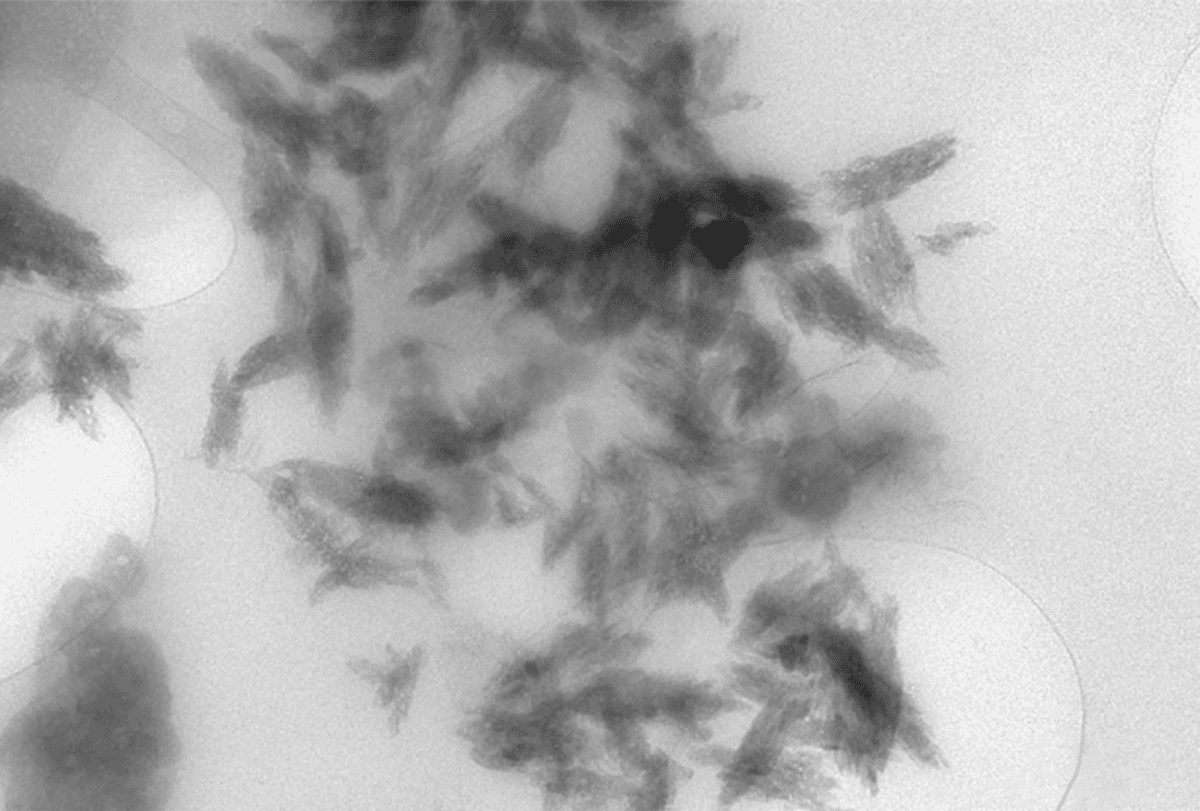
Piles of proof: Researchers in Matthew Campen’s lab isolated what they identified as plastics from human brains. They further extracted material from those isolates for transmission electron microscopy, revealing the shard-like particles shown here.
C
ampen stands by his methods. He notes that no one else has tested his group’s approach with human brains, and that his team also used electron microscopy and other techniques to confirm its results. And he says when he and his team use microscopy to observe digested samples of wild rodent brain tissue from six decades ago, they don’t see the “piles” of plastic shards that are clearly observable in modern rodent brains, further suggesting that the greater amount of plastic seen in current tissue is significant.
He also says his group has added new steps to the protocol it used in the 2025 paper, including an additional wash step, further purifying the plastic and yielding more consistent results “that corroborate our initial findings,” he says. Those additions should help “resolve artifacts from true signal,” says Pearson, who has seen Campen present the updated techniques at conferences.
Campen says accuracy in quantifying plastics is less important than achieving results that are consistent and comparable across experiments. He thinks the technology is ready to do that now, with “strict controls and understanding of your experimental design.” Rauert, though, doesn’t think the methods are there yet.
Because people want to know how much plastic they’re unwittingly carrying in their brain, and because such papers garner news coverage and attract additional research funding, the result is a dangerous rush for measurements, Materić says. And when researchers new to this kind of science enter the fray, he suggests that basic steps, such as applying the right blanks and understanding sources of false positives, or testing in animals, are getting short shrift in the stampede for results.
Incorrect results could have real consequences, Materić adds. Rushed and inaccurate plastics measurements could be a shaky foundation for future studies, and that could lead to inaccurate public understanding of the true risk and problematic regulatory policies.
For now, these measurements come with unavoidable limitations, but Pearson says they’re still valuable. “With any sort of newer kind of science, there’s always going to be these hiccups,” he says. “We have to sit in that uncertainty for a bit.”