Pruning method: Many neurons in the prenatal brain are rife with copy number variants, most of which are eliminated before birth or shortly thereafter, a new study reports. Investigators conducted whole-genome sequencing in neurons from human postmortem brains from before birth to older than 90 years. On average, 25 percent of prenatal cortical neurons carried copy number variants, but the number of neurons with aberrant genomes dropped more than fourfold after birth. Neurons with high numbers of copy number variants also showed altered expression of synaptic genes, suggesting that these cells failed to form connections—and ended up targeted for removal.
Add us as a Preferred Source on Google
Set us as a Preferred Source to see The Transmitter more prominently in your Google Search results.
Prenatal pruning of neurons with copy number variants; and more
Here is a roundup of autism-related news and research spotted around the web for the week of 2 November.
By
Jill Adams
3 November 2026 | 2 min read
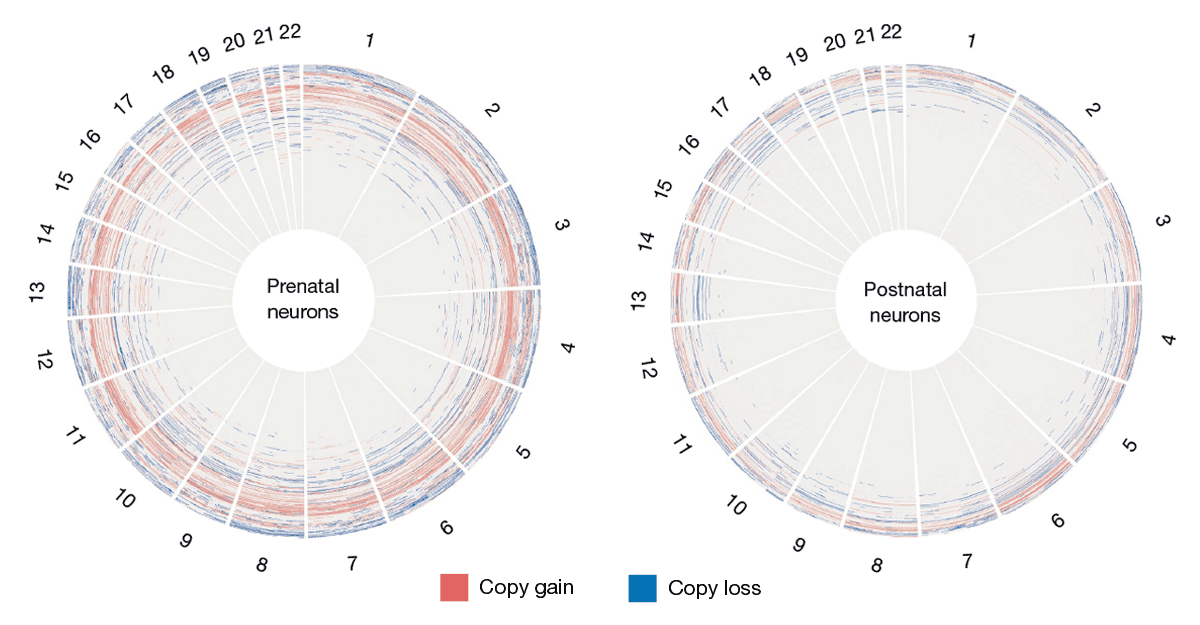
Developmental pruning: Copy number variants, both deletions (blue) and duplications (red), are rife in prenatal cortical neurons (left) and much decreased postnatally (right).
Autism research spotted this week:
- “Systematic functional interrogation of neurodevelopmental disorder risk variants” bioRxiv
- “Parkinsonism co-occurrence among older autistic adults, adults with intellectual disability, and a control sample of adults in national health care claims data” Autism
See also: “Large study links autism to Parkinson’s disease” - “Machine learning-derived subtypes of autism reveal distinct genetic contributions from common and rare variants” medRxiv
See also: “The spectrum goes multidimensional in search of autism subtypes” - “Associations between simple and complex executive function skills and adaptive function in a sample of 3-year-olds enriched for variation in autism and ADHD traits” The Journal of Child Psychology and Psychiatry
- “Comparing the phenotypic and genetic differences between autistic regression and autism without regression using the SPARK cohort” medRxiv
Explore more from The Transmitter
‘Brain Flows: How Network Dynamics Compose the Human Mind,’ an excerpt
By
Michael W. Cole
3 November 2026 | 9 min read
New Stanford initiative aims to build digital twin of human brain
By
Natalia Mesa
2 November 2026 | 0 min watch
The genome offers a recipe, not a blueprint, for the brain
By
Ila Fiete
2 November 2026 | 8 min read
Cite this article: