Stanford University’s Wu Tsai Neurosciences Institute is launching a new large-scale brain imaging project to create a digital twin of the human brain, the institute announced today.
The team behind the project intends to train the artificial-intelligence (AI)-based model, also known as a foundation model, on about 14,000 hours of imaging data that they aim to collect from roughly 100 people over the next five years. Billionaire venture capitalist Mark Stevens and his wife, Mary Stevens, are supporting the effort, dubbed the Stanford Digital Brain Project, with additional funding from philanthropist Clara Wu Tsai. Stanford declined to disclose the amount of funding the project will receive.
The project “is very needed, and I’m happy that somebody was able to commit the resources and the time to do this,” says Mariya Toneva, faculty member at the Max Planck Institute for Software Systems, who is not involved in the project. But even the project’s supporters can’t say how much data will be enough, and a model that predicts the brain well may still reveal little about how it works.
The bet is that AI-based models of the brain, when trained on large amounts of data, will accurately predict brain activity and can be used to generate hypotheses to later test in people, says Dan Yamins, associate professor of psychology and computer science at Stanford University and faculty scholar at the Wu Tsai Neurosciences Institute, who is involved in the initiative. But rather than training on internet-scale data as large language models do, the new effort will build on existing AI models that already predict some brain activity, he adds.
The project is “very timely,” says Nikolaus Kriegeskorte, professor of psychology and neuroscience at Columbia University, who is not involved in the Stanford initiative but is part of the Digital Brain Project that Meta launched in August. The two projects share not only the same name but also “the same general vision,” Kriegeskorte says. Meta donated $15 million to the project, which aims to collect 15,000 hours of imaging data. So far, nine research teams have received funding, and initially plan on imaging at least 90 participants performing various tasks, including interactive games.
Whether either project will generate enough data to predict how the human brain computes is “a very difficult question that I don’t have a good answer to,” he says. Current AI-based models mimic only portions of the brain, such as the visual cortex, and predict only about half the variance in responses seen in these regions; modeling the entire brain will likely take much larger datasets than those that currently exist, he says.
Others question the premise that foundation models will work as well for brain data as they have for language. “I’m kind of skeptical of all ventures in science and engineering where people are like, ‘Name hard problem X. Let’s build a foundation model for problem X,’” says Bing Wen Brunton, professor of biology at the University of Washington, who is not involved in the project. She has “a lot of respect” for the researchers on the Stanford project and their past work in this area. But no one knows yet how brain models scale with data, she says. “What’s the evidence that this is going to work, besides that we’re hoping it does?”
I
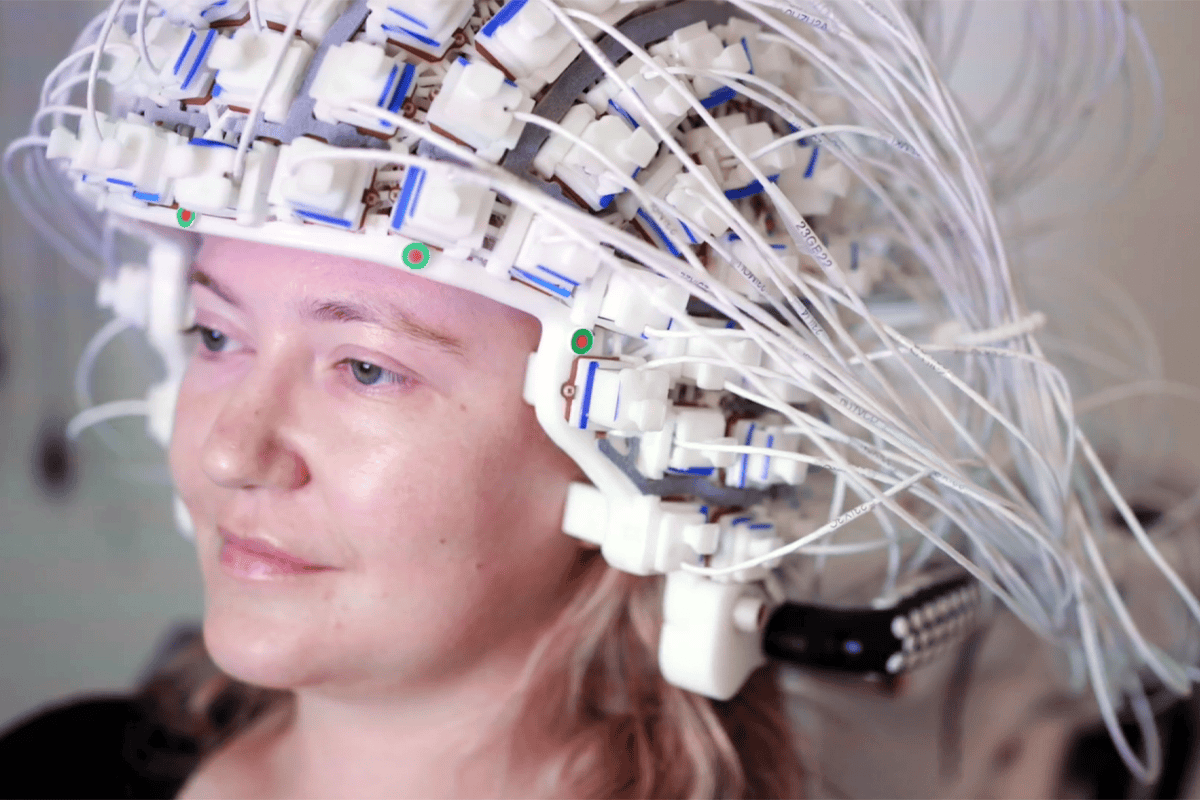
n the Stanford initiative’s first of 10 data collection “campaigns,” 10 people will have their brain scanned about twice per week for a year with each of two technologies: 7-tesla functional MRI (7T fMRI), which tracks changes in blood flow at roughly millimeter resolution but lags neural activity by several seconds, and optically pumped magnetometer magnetoencephalography, which detects the brain’s magnetic fields on a millisecond timescale but locates their sources less precisely. At first, the participants will watch videos and participate in simple decision-making tasks during their scans; eventually, they will play video games and complete tasks in virtual reality.