Survey
Recent articles

How will neuroscience training need to change in the future?
Training in computational neuroscience, data science and statistics will need to expand, say many of the scientists we surveyed. But that must be balanced with a more traditional grounding in the scientific method and critical thinking. Researchers noted that funding concerns will also affect training, especially for people from underrepresented groups.
How will neuroscience training need to change in the future?
Training in computational neuroscience, data science and statistics will need to expand, say many of the scientists we surveyed. But that must be balanced with a more traditional grounding in the scientific method and critical thinking. Researchers noted that funding concerns will also affect training, especially for people from underrepresented groups.

How will the field’s relationship to industry change over the next decade? Will a larger neurotechnology sector emerge?
Interactions between academic neuroscience and industry will grow, and the neurotech sector will expand, most survey respondents predict. The current funding upheaval in the United States may accelerate this trend as the field searches for new funding models.
How will the field’s relationship to industry change over the next decade? Will a larger neurotechnology sector emerge?
Interactions between academic neuroscience and industry will grow, and the neurotech sector will expand, most survey respondents predict. The current funding upheaval in the United States may accelerate this trend as the field searches for new funding models.

What are the fastest-growing areas in neuroscience?
Respondents pointed to computational neuroscience, systems neuroscience, neuroimmunology and neuroimaging, among other subfields.
What are the fastest-growing areas in neuroscience?
Respondents pointed to computational neuroscience, systems neuroscience, neuroimmunology and neuroimaging, among other subfields.
How have funding cuts affected early-career scientists’ futures?
Some say they feel terrified and anxious over all the uncertainty; many are thinking about leaving the United States, academia or science altogether; others plan to stay the course.
How have funding cuts affected early-career scientists’ futures?
Some say they feel terrified and anxious over all the uncertainty; many are thinking about leaving the United States, academia or science altogether; others plan to stay the course.
What should the field prioritize over the next 10 years?
Respondents pointed to a range of challenges in basic neuroscience—such as understanding naturalistic behaviors, intelligence and embodied cognition—and called for more circuit-level research, more precise brain recordings and more work in alternative models. Just as many pushed for a translational pivot.
What should the field prioritize over the next 10 years?
Respondents pointed to a range of challenges in basic neuroscience—such as understanding naturalistic behaviors, intelligence and embodied cognition—and called for more circuit-level research, more precise brain recordings and more work in alternative models. Just as many pushed for a translational pivot.
Is neuroscience a coherent field? Or is it becoming more fragmented?
The latter, say about half of the neuroscientists we surveyed. They note the sheer volume of research being generated, an increasing trend toward specialization in neuroscience education, and competition among labs. About another quarter told us it is “becoming much more interconnected.”
Is neuroscience a coherent field? Or is it becoming more fragmented?
The latter, say about half of the neuroscientists we surveyed. They note the sheer volume of research being generated, an increasing trend toward specialization in neuroscience education, and competition among labs. About another quarter told us it is “becoming much more interconnected.”
How do you anticipate the field changing in the wake of recent funding cuts?
Most survey respondents said they are bracing for a major reduction in the scientific workforce in the United States; some foresee research and staff shifting from academia to the private sector; and a few predict growth in translational studies and research on artificial intelligence.
How do you anticipate the field changing in the wake of recent funding cuts?
Most survey respondents said they are bracing for a major reduction in the scientific workforce in the United States; some foresee research and staff shifting from academia to the private sector; and a few predict growth in translational studies and research on artificial intelligence.
What are the most transformative neuroscience tools and technologies developed in the past five years?
Artificial intelligence and deep-learning methods featured prominently in the survey responses, followed by genetic tools to control circuits, advanced neuroimaging, transcriptomics and various approaches to record brain activity and behavior.
What are the most transformative neuroscience tools and technologies developed in the past five years?
Artificial intelligence and deep-learning methods featured prominently in the survey responses, followed by genetic tools to control circuits, advanced neuroimaging, transcriptomics and various approaches to record brain activity and behavior.

Neuroscience funding: A source directory
Our list features expected and lesser-known governmental and nongovernmental sources of funding for basic neuroscience research.
Neuroscience funding: A source directory
Our list features expected and lesser-known governmental and nongovernmental sources of funding for basic neuroscience research.
Which sources fund your neuroscience research?
Government sources are the main overall contributors to neuroscience labs, but funding breakdown varies across labs, career stages and neuroscience subfields, a survey by The Transmitter shows.
Which sources fund your neuroscience research?
Government sources are the main overall contributors to neuroscience labs, but funding breakdown varies across labs, career stages and neuroscience subfields, a survey by The Transmitter shows.
Explore more from The Transmitter

Prevalence of profound autism declines with new definition
The updated, more precise definition used in a CDC study includes adaptive scores.
Prevalence of profound autism declines with new definition
The updated, more precise definition used in a CDC study includes adaptive scores.
Is it time for neuroscience to shift its focus from a computational mind to a navigating mind?
Andrea Hiott explains her navigational approach to the mind, and why now is the time to embrace seemingly paradoxical findings in neuroscience.
Is it time for neuroscience to shift its focus from a computational mind to a navigating mind?
Andrea Hiott explains her navigational approach to the mind, and why now is the time to embrace seemingly paradoxical findings in neuroscience.
Human brain organoids come of age—but still have room to grow
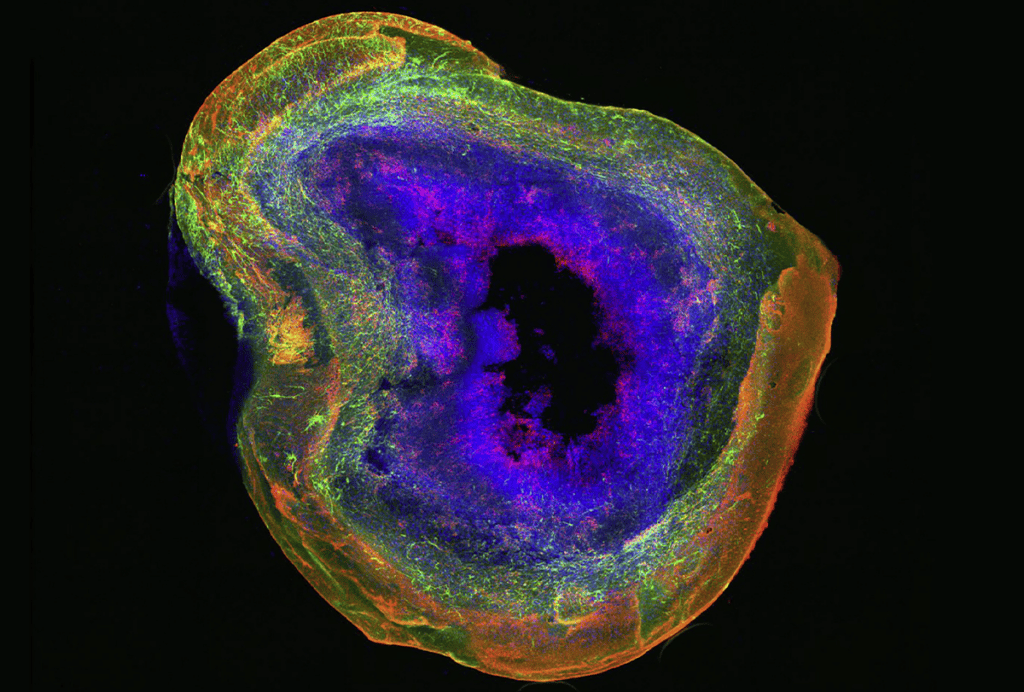
The U.S. government has touted organoids as an alternative to animals for studying the brain. The model has improved since its debut in 2013, but scientists are still working to overcome key limitations: immaturity, consistency and the lack of vascularization.
Human brain organoids come of age—but still have room to grow
The U.S. government has touted organoids as an alternative to animals for studying the brain. The model has improved since its debut in 2013, but scientists are still working to overcome key limitations: immaturity, consistency and the lack of vascularization.