During vertebrate retina development, waves of electrical activity spontaneously emerge and sweep across the tissue in random directions. This seminal discovery of the 1990s was predicted by theoreticians in the 1970s with surprising accuracy and has since become a classic and fundamental cornerstone of brain development: The waves ensure that neighboring neurons fire together more often than those farther apart in the retina. This, in turn, ensures that neighboring synapses in the brain are selectively strengthened and those farther apart are pruned, following the concept of Hebbian learning.
Remarkably, the spontaneous waves are generated by retinal ganglion cells without sensory input, before photoreceptor cells in the retina are mature; they are generated solely from the internal state and dynamics of the developing retina. In an enforced binary categorization of “nature versus nurture,” the retinal waves are pure nature—part of the genetically encoded developmental program that unfolds prior to any environmental input or learning. But if the process requires spontaneous activity waves and Hebbian learning, can it truly be considered genetically encoded?
The answer depends on our interpretation of the word “encoding.” Retinal waves are not written in or explained by the genome; instead, they emerge from the dynamics of cell interactions. Explanations of this kind are common in physical chemistry. Take “dissipative structures”—ordered patterns, such as whirlpools, that emerge and persist by dissipating energy. These structures follow two basic rules: They occur as an irreversible process in time, and they are formed by components that create a new mechanism through their interactions, with individual components on their own revealing nothing about that mechanism.
Retinal waves meet these criteria. Individual retinal ganglion cells excite their neighbors, generating wave properties, such as wave directionality and speed through cell interactions in time. Individual neurons are oblivious to the wave they are part of, simply reacting to their neighbors’ activity.
Based on their dissipative properties, retinal waves bear similarity to a standard example of self-organization: Rayleigh-Bénard convection rolls, which form when you heat a liquid with the right viscosity, creating highly organized and often beautiful patterns. The mechanism of convection rolls, like the mechanism of spontaneously emerging, unidirectional retinal waves with distinct speeds and random directions, can only be described in terms of the interactions of their respective constituent components in time. There is no such thing as a wave at a single moment.
S
o, is it useful to understand this type of self-organization as a mechanism in brain development? Brain organoids that develop from induced pluripotent stem cells into patterned brain structures are sometimes described as beautiful examples of self-organization. But where is the mechanistic insight in this? To state that the entire brain is self-organized is plausible yet nonexplanatory, as is the equally correct notion that all of brain development is based on molecular interactions.An explanatory mechanism of brain development must, above all, provide understanding of how a system can increase internal order. Just as convection rolls in a heated liquid represent a more ordered or lower entropy state, a specifically wired brain network is more ordered than a network with random connections. The retinal waves offer such understanding, in this case by morphing initially imprecise synaptic connectivity into a patterned structure with more specific synapses.
Part of the difficulty is the issue of what constitutes an explanation. For molecular neuroscientists, explanatory power lies in specific molecules and their measured interactions or properties. For computational neuroscientists, explanatory power lies in the understanding of algorithmic computation, whatever cells or molecules happen to execute the computation. This is what Evelyn Fox Keller called different epistemological cultures. Your mechanism may not be my mechanism, because we have different ideas of what constitutes an explanation.
I argue that self-organization constitutes its own category of explanation, shared by theorists and experimentalists. Models and mechanisms of self-organization have already proven helpful across biological systems, are well established for pattern formation in developmental biology, and may offer a key for understanding the development of brain wiring beyond the famous retinal waves.
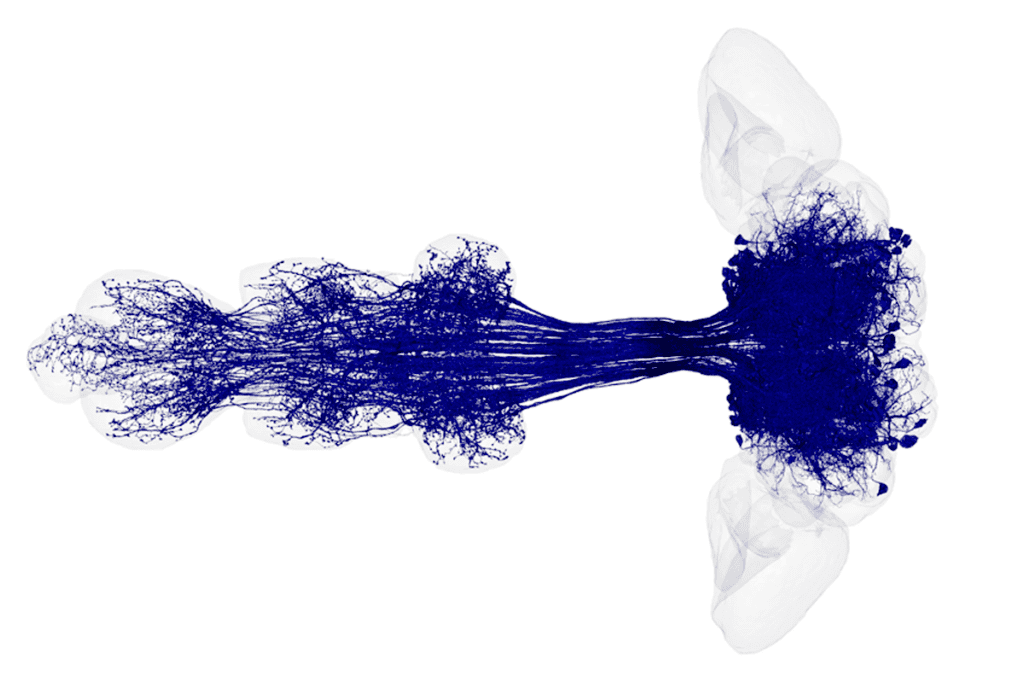
During Drosophila brain development, for example, photoreceptor axons rewire to create a specific pattern of connectivity within a short developmental time window—just 15 hours. Contrary to a mechanistic framework of attractive or repulsive guidance, these axons aren’t seeking a specific downstream target and do not follow a specific chemical gradient; rather, thousands of growth cones spontaneously self-assemble for this purpose into a temporary sheet, a brain structure that does not exist before or after the transformation. Without it, the brain will not wire up correctly. The fleeting conglomeration of growth cones moves toward its new connectivity state without any target other than its own searching dynamics. It’s as if a group of concert-goers are driving to the venue before it has been built; most remarkably, the theater will come into existence only if the fans seek it out. It’s the interaction of the agents, or axons, that creates the guidance mechanism, and the target only comes to be in a process that must play out in growth dynamics in time. These are, again, the criteria of self-organization for dissipative structures.
What can we learn from these examples? To provide explanatory power, self-organization mechanisms must meet two key criteria: First, new mechanistically relevant rules emerge through the interactions of a system’s components, though the individual components do not reveal those rules. Second, the mechanism itself is a process in time; no static state or depiction of the system explains the mechanism.
To find such mechanisms, we developmental biologists might do well to look beyond the more typical molecular gradients or target molecules and consider more deeply how structures can self-assemble. Spending more time interacting with our neighbors’ epistemological cultures may be one way to do this, particularly with physicists and theoretical neuroscientists. As Ila Fiete argues in a companion essay, “We need theorists who treat development as seriously as they treat learning, and who ask what other minimal rules could produce a given structure.” (For more, see Fiete’s essay, “The genome offers a recipe, not a blueprint, for the brain.”) I would add that we equally need developmental biologists who treat theory as seriously as they treat genes and molecules. Think of the coming together as an act of self-organization that may well increase explanatory power.