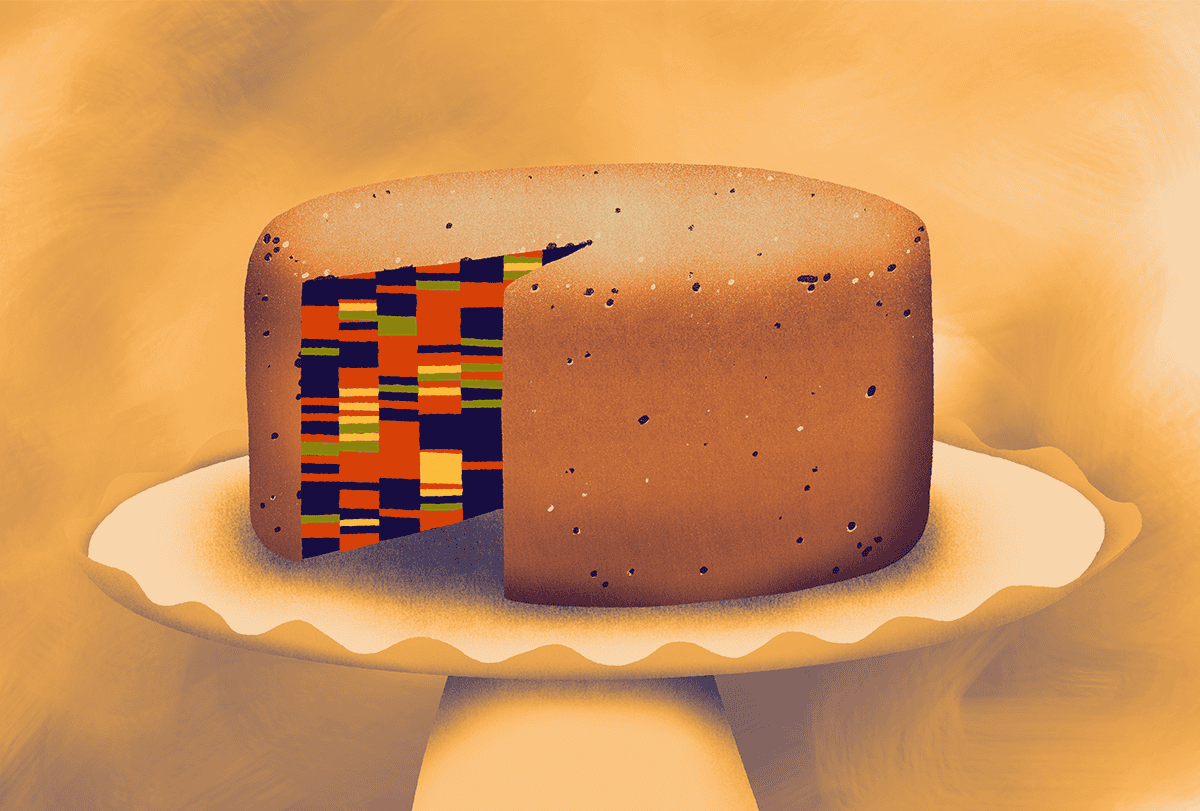
Picture a box of cake mix and then imagine the fluffy, fragrant cake on your plate. Everything about the cake was already, in some sense, “in the box,” yet nowhere in the box will you find the crumb or the aroma of the cake. These qualities emerge only after you add water, turn on the oven and wait. Gradually, proteins open up and tangle, starches dissolve and gel, gas bubbles expand, and Maillard reactions begin. None of these processes are printed on the box, yet their unfolding transforms a set of simpler components into the rich macro-structure of cake.
I have come to think this is the right way to think about the developing brain. Genes specify ingredients and a short list of directions, outlining which things to combine, in what quantity and when. They don’t specify the border between the secondary visual cortex and its neighbor, or the wiring between each pair of neurons, or the precise size of the cortical sheet in each individual’s brain. Instead, these quantities emerge through the playing out of simpler processes that can lead to the self-organization of complex structures.
This is an old idea. In the middle of the previous century, Alan Turing and John von Neumann showed that simple local rules, applied over and over, can generate rich structure from simple components. Then, in the 1980s, the genetic revolution arrived, bringing with it the concrete information that embryologists had long searched for, the powerful tool kit of molecular biology, as well as the powerful intuition that genes and the genome specify function. The pendulum swung hard toward genetic instruction.
I think it needs to swing back—not to displace genetics but to circumscribe the role of genes and build a bridge between genetic specification and rich structure. In this modified view, genes set the rules and turn the knobs, and self-organization does much of the rest.
T
wo classic ideas typify the concept of genes as a blueprint: Neuroscientist Roger Sperry’s chemoaffinity hypothesis, in which axons find their targets by matching their molecular labels, and developmental biologist Lewis Wolpert’s “French flag” model, in which a molecular gradient specifies locations in a tissue, activating downstream genes at specific concentration thresholds to determine what structure forms there. The fly embryo is the textbook case: A gradient of a protein called bicoid switches on the gap genes, which activate stripes of pair-rule genes, leading to body segments. In this picture, the genome is close to a blueprint.At the other extreme is Turing pattern formation. Two interacting chemicals, one that activates itself locally and one that inhibits over a longer range, spontaneously break the symmetry of a uniform tissue and produce stripes or spots. This process involves no genetic instruction on where each spot forms or where the stripes’ boundaries lie; the pattern self-organizes. However, the genome can serve as the cookbook, specifying which molecules to mix, and in what concentrations.
Digit formation supports the role of Turing mechanisms in the development of body shape. James Sharpe’s group showed that digits form as a Turing pattern of Wnt, BMP and SOX9 signaling in the limb bud. Varying Wnt or BMP signaling changes the wavelength of the pattern, such that the embryo grows more or fewer digits. This process does not involve a French-flag-like expression of different genes to specify digit boundaries; instead Wnt and BMP act as simple dials that alter a self-organized pattern’s period.
Each process involves trade-offs: The chemoaffinity and French flag models scale with body size, but they can be noise-sensitive and require a larger number of genes. Turing patterns are robust and require few genes, but they specify only a single scale. The interesting question, therefore, is not which mechanism the brain uses, but which it uses where and at what stage of development.
Indeed, even in the fly, the blueprint is somewhat blurry and may receive a self-organizing assist. Thomas Gregor and his colleagues report that multiple gap genes together specify a cell’s position through lateral interactions better than a single gradient without interactions. Thus, one of the most genetically instructed systems we know still relies on network dynamics.
Physical forces also contribute to self-organization: Boris Shraiman, Kenneth Irvine and others have shown that cells sense mechanical stretch and compression at tissue boundaries, and that these forces influence growth and cell fate. Cortical organoids provide a vivid illustration of self-organization: Human stem cells placed in a dish with a few growth factors organize into layered, cortex-like tissue with the cell types arising in roughly the right order.
M
y own reentry into neurodevelopment (after much earlier efforts on the development of vocal sequences in songbirds with Richard Hahnloser and Walter Senn) came through grid cells.Grid cells in the entorhinal cortex exist in a small number of discrete functional modules, each with its own spatial scale. However, models of this system presented a puzzle: Modules are discrete, but underlying cellular properties, such as ion channel densities, appear to vary smoothly along the dorsoventral axis. How could a smooth gradient produce sharp jumps? Mikail Khona, Sarthak Chandra and I found that two local interactions, one smoothly graded and one of fixed width, could be sufficient to drive the emergence of modules with abrupt boundaries between them. Through a mechanism we call “peak selection,” we showed that the number of modules would not depend on the size of the network, and module size would scale automatically with brain size and not be fixed by the spatial scale of the interactions, distinct from the outcome of Turing patterning. This simple model can be tested by future connectomics work that maps entorhinal cortical architecture at the synaptic level. The same mechanism can theoretically account for the emergence of other types of modules from smooth gradients.
A similar lesson holds one level up: To test potential mechanisms of visual system development, we developed, with Talia Konkle, a model in which neurons sprout synapses based on their activity and synapses at each neuron compete with each other for a limited construction budget, in a sheet of cortex driven only by spontaneous waves. This simple process produced discrete visual areas, a processing hierarchy and retinotopic maps, as seen in macaque and human brains. The model predicts no steps or switches in gene expression at higher-area boundaries, only smooth gradients. Researchers can now use spatial transcriptomics to see if these properties exist in the biological system.
Drawing from these examples, a handful of growth rules and knobs connect the gene regulatory network to circuits and behavior. If accurate, this is good news for our understanding of and desire to control neurodevelopment, because genes can potentially be correlated with simple knobs that provide interpretable control. For instance, changing the relative size or number of cortical areas should not require rewriting a detailed wiring diagram, but only turning one knob.
It is also, I suspect, why brains are evolvable. Selection cannot efficiently act on complex blueprints, because making a meaningful change would require a large number of specifically orchestrated edits. But it can easily act on a recipe, in which a small change to a dial produces a coherent, whole-organism variation. Evolvable systems are controllable systems.
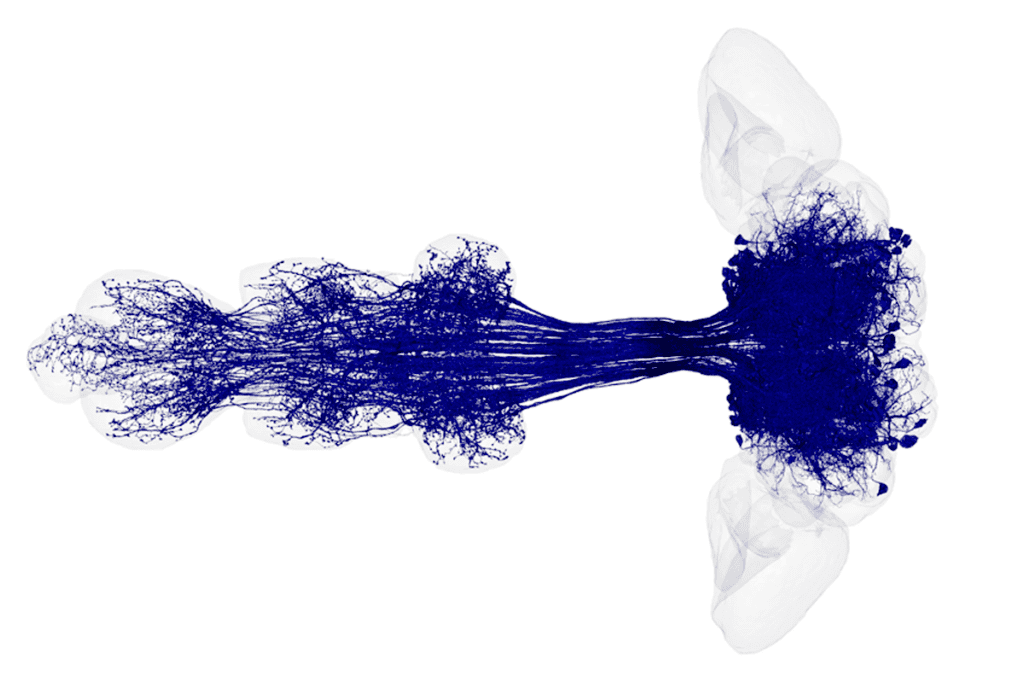
My colleague P. Robin Hiesinger notes that even the cake analogy may give genes too much credit; typical recipes specify ingredients, as well as the order and duration of steps, but in development, these can themselves be emergent, as seen in the assembly of the sorting plate that guides fly eye neurons into the brain. (For more on this, see Hiesinger’s companion essay, “When is self-organization a mechanism in brain development?”)
Where does this leave the field? We now know there are many more processes in the self-organization tool kit than Turing patterning. We need theorists who treat development as seriously as they treat learning, and who ask what other minimal rules could produce a given structure. We need experimentalists who are willing to think about, look for and measure the hypothesized knobs, such as gradient slopes and interaction widths. And we need transcriptomic and connectomic analysts who examine predictions from self-organization—smooth gradients versus steps and switches, as predicted by blueprints. Most of all, as Hiesinger argues in his companion essay, we need molecular and computational neuroscientists to spend more time in each other’s kitchens.