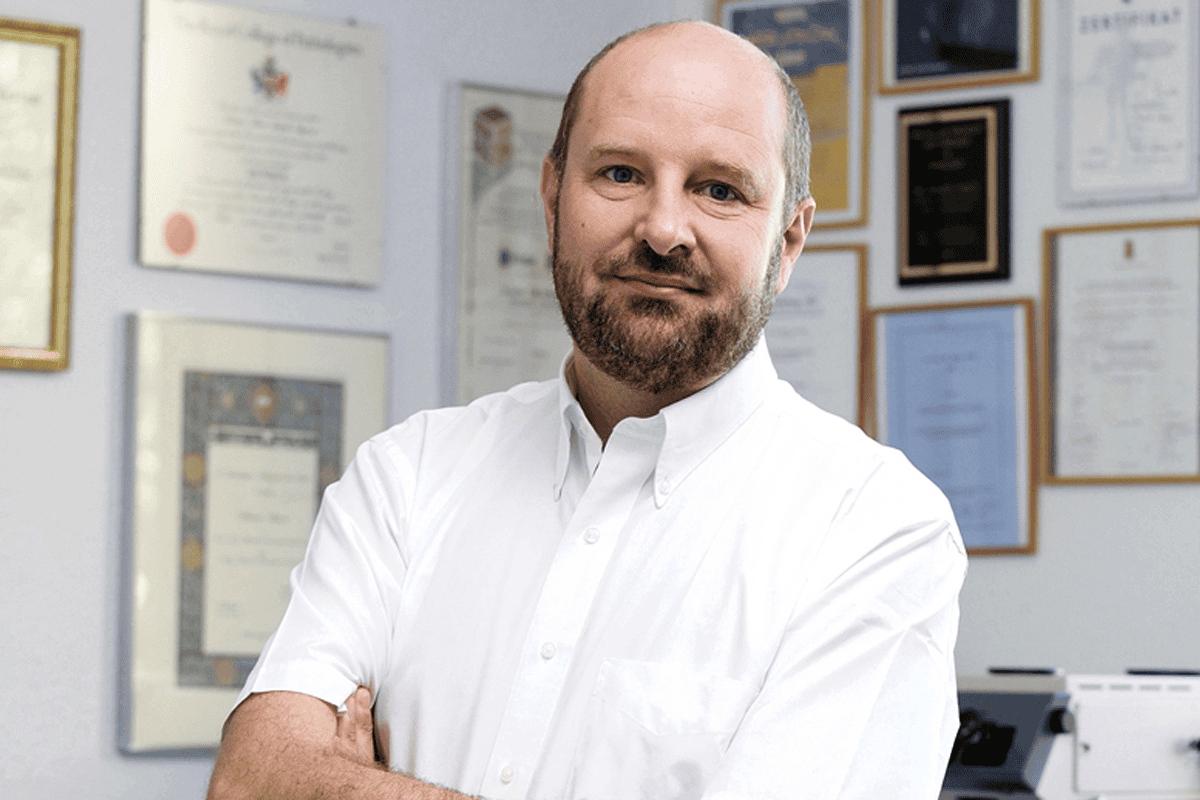
Neuropathologist Adriano Aguzzi has been cleared of research misconduct and negligence in a probe of 36 studies he co-authored over 28 years.
The University of Zurich, where Aguzzi was based until he retired earlier this year, conducted the investigation, which started in March 2024 and looked at studies he co-authored between 1996 and 2023.
On 2 July, the university released its report (in German) that resulted from its probe, alongside a statement from Aguzzi, which is in English.
The report, which The Transmitter had professionally translated, states that seven of Aguzzi’s papers contain “scientifically significant” errors.
The report states that it’s incumbent on Aguzzi to retract or correct these seven papers. If Aguzzi fails to retract or correct these studies, “this would constitute a separate violation of good scientific practice,” the report says.
Out of the 36 papers examined, 24 list Aguzzi as corresponding author, the report states. Aguzzi is responsible for errors in up to a dozen of these papers, the report found, but was not found guilty of research misconduct because neither intent nor negligence could be established.
“Although this whole thing was very painful, I welcome the opportunity to be able to correct whatever needs to be corrected and also to retract whatever is wrong,” Aguzzi told The Transmitter. “I want to be done with this.”
A
Many papers mentioned in the dossier had already been flagged on the post-publication peer-review site PubPeer, where Aguzzi had posted some replies and comments. “At some point, these discussions on PubPeer got so ugly that I simply withdrew,” he recalls.
Aguzzi—who cut his lab in half after 2019 to improve supervision—says that he had previously fired a postdoctoral researcher once it became clear that the researcher had fabricated data. Aguzzi had also discovered other lab members who may have been cutting corners before any papers listing them were published.
“Most of my people were rigorous and truthful,” Aguzzi says, referring to former students. “For some others, I have serious doubts, but I was never able to prove my suspicions.”
Aguzzi declined to name the people he accuses of fabricating data, citing legal concerns.
Still, Aguzzi says, he is disappointed that those he considers responsible for the errors faced no consequences. He claimed that the university decided to investigate only him because, of all the implicated people, he was the only person who still worked there. (Aguzzi retired in January but noted in his statement that he will continue to conduct not-for-profit research via a public-good foundation.)
E
Because Aguzzi is the corresponding author on many of the papers, “he is responsible for the integrity of those papers,” Bik says. “Even though he hasn’t perhaps done the manipulation himself, he was without doubt negligent.”
Bik is also unhappy with the University of Zurich for not investigating Aguzzi’s co-authors and not explicitly stating which papers should be retracted. “That’s the least they could do for the scientific community,” she says.
Wolfgang Ernst, a legal scholar at the University of Zurich and the University of Oxford who carried out the investigation, didn’t reply to requests for comment.
According to the Retraction Watch database, two papers co-authored by Aguzzi have been retracted—both within the past two years.
One of those was retracted by The Journal of Neuroscience last year over image-related problems following a probe at the University of Minnesota, which resulted in neuroscientist Sylvain Lesné, Aguzzi’s co-author, resigning from his tenured professorship at the institution in February 2025. That study has been cited 287 times, according to Clarivate’s Web of Science.
For this study, Aguzzi says he had a “minimal role,” contributing a transgenic mouse for the experiment. “I was offered an authorship, and I didn’t refuse it,” he recalls.
The other retracted paper—which the journal pulled in 2024 over image-related problems—was originally published in PLOS Pathogens in 2011 and lists Aguzzi as the last author. The study, which explored whether mice can be infected via aerosols, has 53 citations.
In a PubPeer thread about the PLOS Pathogens paper, Aguzzi noted in a reply in July 2013 that his policy has been to keep raw data for at least 10 years. “I have requested my coworkers (and former coworkers) to retrieve all primary data, and I promise that we will conduct a thorough internal audit,” Aguzzi wrote on PubPeer at the time.
A 2023 preprint paper co-authored by Aguzzi was withdrawn, citing “several irregularities.” Other papers by Aguzzi have also had corrections or errata issued for them.
According to Aguzzi’s statement, the University of Zurich has now recommended “clearer documentation, routine preservation of primary data, systematic screening of figures before submission, and independent verification of especially consequential results.”