Soon after Gerald “Gerry” Fischbach started his research career at the U.S. National Institutes of Health (NIH) in 1966, he made a fundamental neuroscience discovery.
He had been studying how exercise and immobilization affect the properties and synaptic function of skeletal muscle fibers. To try to see the nerve-muscle synapses forming in real time, he enlisted the help of a colleague just up the road at the Walter Reed National Military Medical Center, he wrote in an autobiography.
The pair plated chick muscle cells along with spinal cord neurons in petri dishes, and then Fischbach put them on the floor of his Ford station wagon and drove to his electrophysiological rig at the NIH. Without the controlled conditions of an incubator, the pH of the cell cultures changed dramatically—but Fischbach got to his lab just in time to change the media.
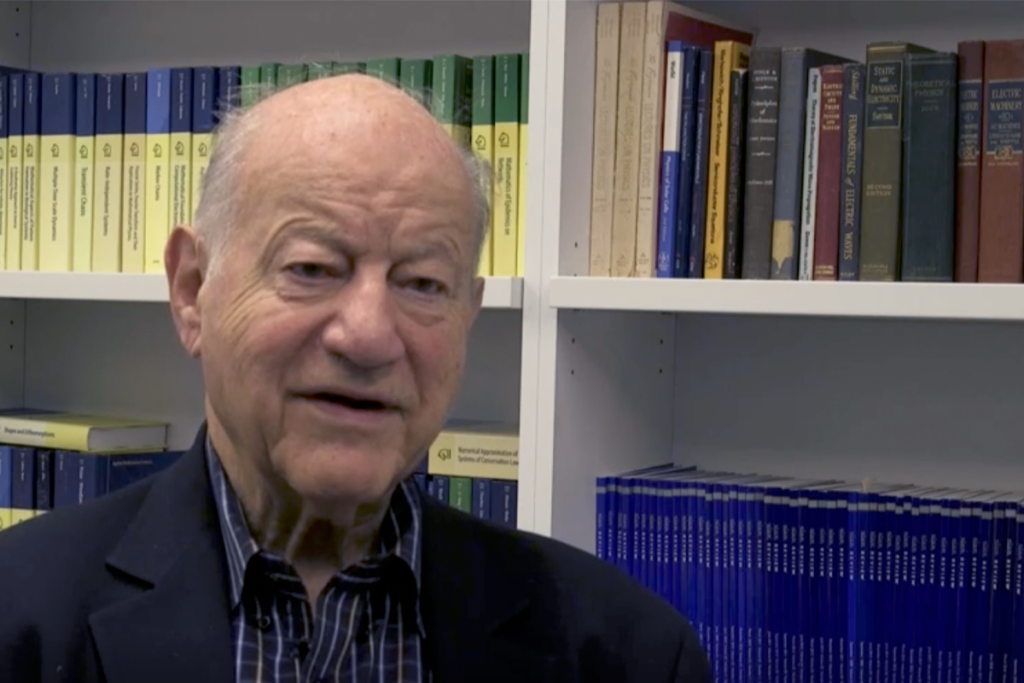
The risk paid off. “I could see not just the cells but the fine processes—the axons and dendrites and neurons—and could watch them over time as they reached out and touched muscle fibers,” he recalled in a series of video interviews for Web of Stories.
He probed these co-cultures for electrical activity, and one day he observed some blips in the microelectrode recordings. “I almost screamed,” he said in one of the interviews. “I ran out into the hall and said, ‘I formed synapses!’” One of his first papers, published in Science in 1970, confirmed that nerve-muscle synapses do indeed form in cell culture, he wrote in his autobiography. “This was revolutionary at the time.”
In the co-culture system Fischbach developed, “you could really watch synapses form [live in real time] in a way that you couldn’t for many, many years,” says Joshua Sanes, emeritus professor of molecular and cellular biology at Harvard University, who met Fischbach while he was a graduate student at Harvard and later served on many advisory boards with him.
Fischbach, who passed away on Sunday at the age of 87, went on to characterize the neuromuscular junction, showing how signals between nerve and muscle cells change and how acetylcholine receptors and enzymes mediate the specialization of this connection. And as he moved between the NIH, Harvard University, Washington University in St. Louis and Columbia University over the course of his four-decade-long research career, he worked his way up from the spinal cord to the midbrain, the basal ganglia, the neocortex and, finally, to the social brain, cognition and consciousness.
Beyond being a remarkable scientist, Fischbach had a great sense for identifying, training and bringing together promising young researchers with the right expertise, says Gabriel Corfas, professor of communication disorders at the University of Michigan Medical School, who did postdoctoral research with Fischbach. “He gave you a sense of empowerment and confidence and challenge in a very subtle way,” Corfas says.
In 2006, Fischbach took that know-how to the Simons Foundation, where he became the founding scientific director of the Simons Foundation Autism Research Initiative (SFARI). He spearheaded projects that brought together human geneticists and neuroscientists to broaden how autism was studied, says Kelsey Martin, executive vice president of the Autism and Neuroscience division at the Simons Foundation. (The Transmitter is funded by the Simons Foundation but is editorially independent.) “He was like an orchestra conductor who could put all these different ideas together and bring people together in a really important way.”
His success as a scientist and as an administrator also reflected his genuine support for the people he assembled, as well as his humility and curiosity, says Alyssa Picchini Schaffer, vice president and senior scientific officer of Neuroscience Collaborations at the Simons Foundation. “He was genuinely warm, and he cared about the people he worked with and supported as much as he cared about the science,” Picchini Schaffer says. “I think he really shaped a generation of scientists and an entire field. And that sort of legacy can’t be understated.”
F
Fischbach learned to record from the neuromuscular junction using microelectrodes to study acetylcholine’s action, he wrote in his autobiography. “I had to learn it from scratch, which I loved to do.” Riker suspected that acetylcholine primarily acted on the nerve terminal, but Fischbach discovered that instead acetylcholine primarily acts postsynaptically, though it also has a presynaptic effect.
“I had the bug, and I wanted to continue in neuroscience research,” Fischbach wrote. Still, he graduated from medical school and took up a medical internship at the University of Washington Medical Center in Seattle until he received a Vietnam draft request in 1965. This, he said in the video interviews, prompted him to get a job at the NIH that would substitute for military service.
Much of his work at the NIH involved establishing an in-vitro experimental setup to study the formation of muscle-nerve cell connections. But he soon realized he missed the university environment, and so in 1973 he took an associate professor of pharmacology position at Harvard University and became full professor in 1978.
Using his co-culture set up, Fischbach found that the nerve contact onto a muscle cell elicited the aggregation of neurotransmitter receptors, creating the hotspots, or clusters, of acetylcholine receptors that enable muscle contraction. The neuronal growth cone could even elicit increases in the acetylcholinesterase enzyme at developing junctions, a process that depends on synaptic transmission.
He spent almost 15 years, including a 9-year stint as chair of Washington University in St. Louis’ anatomy and neurobiology department, trying to identify the signal that induced these hotspots. His team would don boots to collect chick brains from a slaughterhouse in South Boston. Later, in the lab, they would homogenize the tissue and try to extract the protein, which they had named acetylcholine receptor-inducing activity, or ARIA. “I sound like I’m an expert in the area, but I’m still an electrophysiologist,” Fischbach recalled while talking about the experiments.
Fischbach and his team eventually purified and sequenced the protein, which later came to be known as part of the neuregulin family. This finding opened the door for a whole field of study, examining the role of neuregulins not only in the neuromuscular cholinergic synapses but also between neurons and glia and in GABAergic synapses, Corfas says. “It became an important factor in development and plasticity.”
I
He decided to join the Simons Foundation after its co-founder, Jim Simons, offered him a position over pastrami sandwiches at Artie’s Delicatessen on the Upper West Side in New York City. At the foundation, Fischbach established the Simons Simplex Collection, which collected genetic and phenotypic information from 2,600 autistic people and their parents and siblings.
“Gerry was a visionary leader who loved hearing about new ideas and approaching difficult questions from new angles. His leadership transformed our funding of scientific research,” says Marilyn Simons, co-founder and chair of the Simons Foundation.
Also at the foundation, Fischbach helped forge collaborations such as the Simons Collaboration on the Global Brain, Picchini Schaffer says. “Gerry really believed that convening people and having them wrestle with the science with each other, and having them have these deep, hard conversations, was as important as the funding and the facilitating of the science itself.”
He was always a big proponent of open science, pushing his students and postdocs to share unpublished data, Corfas says. “He said we should be open. We should share.” At the Simons Foundation, he played a part in building the SFARI database, which was made to be shared with qualified researchers, Martin points out. “That was really both prescient and amazing.”
Ultimately, being lovable, Sanes says, was what made Fischbach successful. “It really helped him bring people together.”
Despite Fischbach’s status, he always treated people with humility, says Apoorva Mandavilli, science and global health reporter at The New York Times, who worked with Fischbach when she was founding editor-in-chief of Spectrum. “He really made everybody feel comfortable. You would never know, talking to him, that he was one of the smartest neuroscientists of his generation,” Mandavilli says. “He was just an incredibly smart person, but without any of the airs that normally come with that kind of intelligence.”
Family was always front of mind for Fischbach, Corfas says, and he was constantly telling stories about his 4 children and 12 grandchildren. “He treated everybody with kindness and a little bit like a family.”