LISTEN TO THIS STORY:
0:00
/
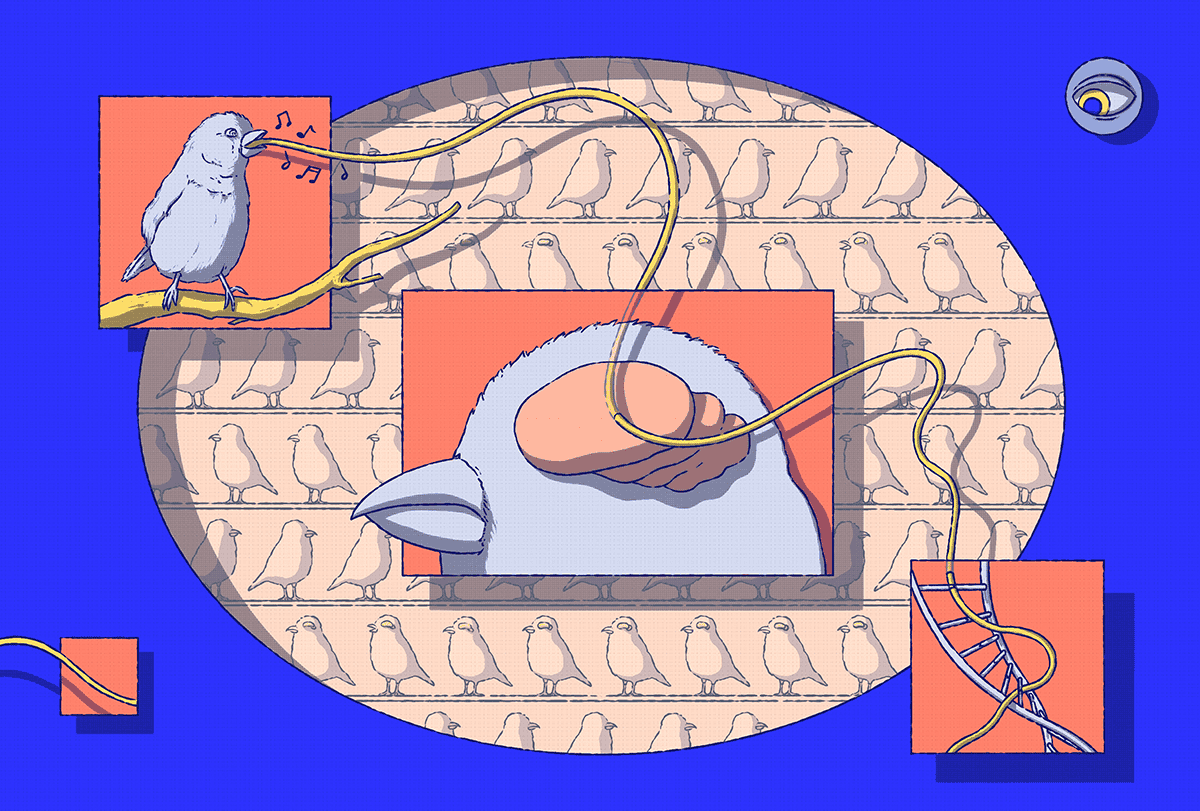
A 1992 PNAS paper showed how birdsong upregulates the expression of an immediate early gene in bird forebrains. The work revealed to Ribeiro the importance of studying molecular responses in naturalistic contexts.
Leia este artigo em português.
Answers have been edited for length and clarity.
What paper changed your life?
Song presentation induces gene expression in the songbird forebrain. Mello C.V., Vicario D.S. and Clayton D.F. Proceedings of the National Academy of Sciences (1992)
This paper by Claudio Mello, David Vicario and David Clayton showed that genes can respond dynamically to ethologically relevant experience.
The researchers played tape-recorded birdsongs to canaries and zebra finches and found that this rapidly induced expression of the immediate early gene ZENK in the songbird forebrain. They observed that ZENK expression was especially strong in auditory forebrain regions involved in processing songs from the same bird species, indicating that behaviorally meaningful sensory stimuli can trigger gene-expression programs in specific neural circuits. This was a landmark finding because it connected natural communication signals, neural activity and molecular plasticity in the brain.
Its impact extended beyond auditory research. The work helped establish immediate early genes as powerful markers of neural activation and plasticity. More broadly, the paper influenced neuroscience by showing how perception, behavior and molecular mechanisms can be studied together in freely behaving animals.
The paper stands not only as a classic in birdsong research but also as an early model for integrative, naturalistic neuroscience.
When did you first encounter this paper? What were you working on at the time?
I first encountered this paper in early 1993 when I was completing my undergraduate studies at the University of Brasília. At the time, I was deeply interested in the recently discovered activity-dependent immediate early genes, and I became fascinated by the application of this emerging field to behaviors animals actually display in their natural environments.
Claudio Mello, the study’s first author, was an alumnus of the University of Brasília, and my adviser at the time helped me reach out to him. Mello strongly encouraged me to apply to the doctoral program at Rockefeller University, where he was conducting research in Fernando Nottebohm’s laboratory. That is precisely what I did, and in the years that followed, I had the privilege of being supervised by both of them.
Why is this paper meaningful to you?
It helped define a way of thinking about the brain that integrates behavior, neural circuits and gene expression. It showed that molecular changes are not isolated cellular events but part of the brain’s response to meaningful experience. This was especially important to me because it suggested that other processes, such as memory, perception and sleep, could be studied through the dynamic regulation of plasticity-related genes.
The paper also has personal importance because it shaped my scientific trajectory during my work with Mello, inspiring experiments on immediate early genes in both songbirds and rats.
How did this research change how you think about neuroscience?
This research showed me that the brain can be studied across multiple levels at once: from natural behavior to gene expression to systems activity. It encouraged me to see genes such as ZENK not merely as molecular markers but as entry points into the mechanisms by which experience modifies neural circuits. This perspective influenced my later interest in how learning-related gene expression is regulated across sleep states, in collaboration with another former mentor at Rockefeller University, Constantine Pavlides. It helped shape my view that sleep is an active biological state in which waking experience can be reprocessed, stabilized and transformed at molecular and circuit levels.
Is there an underappreciated aspect of this paper that other neuroscientists should know about?
An underappreciated aspect of this paper is how strongly it anticipated modern systems neuroscience. Long before large-scale neural recording and transcriptomic approaches became common, the study successfully linked a natural sensory stimulus to region-specific molecular activation in the brain. It also showed the power of using ethologically meaningful stimuli, such as birdsong, rather than artificial laboratory stimuli.
This remains an important lesson: The brain’s molecular responses are often most revealing when studied in the context of behaviors that matter most to the animal.