LISTEN TO THIS STORY:
0:00
/
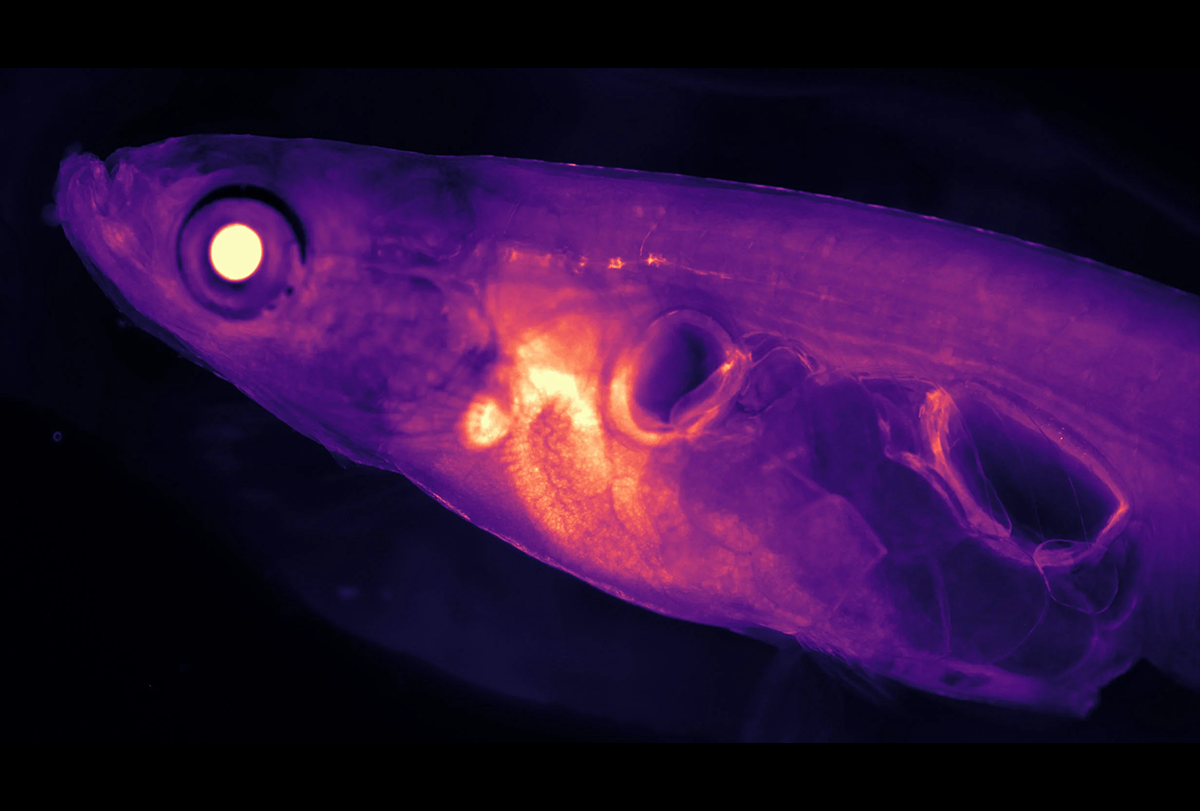
The Howard Hughes Medical Institute’s Janelia Research Campus is banking on whole-brain imaging in the Danionella fish to advance neuroscience, but some scientists forced to close their labs say that even with a three-year runway and transitional support, they feel betrayed by the pivot.
The Janelia Research Campus is launching two new projects: whole-brain imaging of a transparent fish called Danionella and an “AI-in-the-loop” tool to help parse all the imaging data, the facility announced last week.
As part of the change, Janelia is also shuttering two programs and plans to phase out projects that use rodent models, The Transmitter has learned. Janelia is funded by the Howard Hughes Medical Institute (HHMI), a private nonprofit biomedical research institution.
Investigators who run rodent labs have roughly three years to wrap up their projects and find new positions, and Janelia plans to provide each researcher with an additional $1 million in transition funding, says Gerald Rubin, head of biology and senior group leader at Janelia. The move does not affect external research funded by the HHMI, including the HHMI Investigators and Hanna H. Gray Fellows programs, Rubin adds.
Janelia is pivoting to Danionella because its translucence offers an opportunity to image the entire brain of a behaving adult animal, Rubin says. Neuroscientists use zebrafish models for similar reasons, but that species remains clear only in the larval stage.
The move “makes sense,” says Philippe Mourrain, professor of psychiatry and behavioral sciences at Stanford University, who works with Danionella. In neuroscience, there is already “such an overrepresentation of the mouse.”
The scientific community studying Danionella is small, so the announcement came as a surprise, says Matthew Lovett-Barron, assistant professor of neurobiology at University of California, San Diego. “As someone that has been working on Danionella for a while, I’m of course excited. They’re an amazing animal to study.”
The second project involves developing an AI-in-the-loop tool for hypothesis generation, experiment design and data interpretation. The goal is to explore if AI can “sharpen the thinking of human scientists,” says Nelson Spruston, vice president and executive director of Janelia Research Campus. Such an AI-in-the-loop system will be necessary to handle the massive datasets that whole-brain imaging generates, he adds.
Janelia plans to tap Drosophila and larval zebrafish research programs as “test beds for developing the technologies that we’ll need to apply to the Danionella system,” Spruston says. It’s too early to venture if those models, like the rodent models, will be phased out once the Danionella work is up and running, he adds.
“On the one hand, this is a really exciting program, but on the other hand, it’s also hard because we recognize that it creates difficulties for some of the people who will not be part of this program,” Spruston says. “We’re doing everything we can to give those people a long runway of several years and lots of transitional support funding to make sure that they land on their feet when they leave Janelia and move their labs to another institution.”
The field of neuroscience has learned how the brain processes certain inputs, but “we don’t know how the nervous system produces a behaving creature,” says Kenneth Miller, professor of neuroscience at Columbia University, who says he was unfamiliar with Danionella before Janelia’s announcement.
“From their description of it, it sounds like they’ve picked the right system for trying to crack that problem,” Miller adds. “It’s a bold move on their part. They’re going to be pioneering it all the way.”
T
he change marks a “major course correction” to ensure Janelia remains focused on high-risk, interdisciplinary projects, Rubin says. Janelia’s founding principles state that “our mission was to do good things for science that you couldn’t do in academia.”When it opened in 2006, Janelia focused on building better microscopes and studying circuit neuroscience, “because no one else was doing it at that time,” Rubin says. The facility added the Mechanistic Cognitive Neuroscience program in 2019 and the 4D Cellular Physiology program in 2022.
Janelia initially announced that it planned to fund each program for 15 years, but it now plans to close both to make way for the Danionella work. Both programs support “first-rate” investigators, Rubin says, but they didn’t pass the metric of “if they weren’t doing it at Janelia, it wouldn’t happen.”
In light of the “depressing and frustrating” funding environment, pouring resources into a “niche topic of uncertain value in neuroscience is like: ‘Oh my God, seriously?’” says Nick Steinmetz, associate professor of neurobiology and biophysics at the University of Washington.
Six to eight rodent labs must wind down their work; Janelia offered others the option to pivot their focus to align with the new projects, Spruston says.
Two scientists who must leave Janelia told The Transmitter they feel betrayed by the abrupt change. Both requested anonymity for fear of retaliation.
“All promises of long-term stability have been broken,” says a group leader in the sunsetted Mechanistic Cognitive Neuroscience program. At Janelia, group leaders run small labs focused on long-term, risky projects without the traditional academic demand of publishing frequent papers. They are also barred from external funding, cannot earn tenure and instead work on five-year renewable contracts.
“We’re being put on the street after four or five years, which is enough to set up these paradigms but explicitly not enough to turn it into legible papers,” the group leader adds, and says they are worried about competing for traditional jobs without external early-career funding or a plethora of papers on their CV.
“I cannot trust HHMI anymore. They can just change their mind at any moment,” says a scientist in the 4D Cellular Physiology program. “It just shows that the leadership might not really care about the people they claim that they care about.”
Leadership has a responsibility “to use our very large scientific resources to be doing stuff that is different than other people, that makes a unique contribution,” Rubin notes. “I think the decision that was made was absolutely the right one to make.”
With reporting by Claudia López Lloreda and Natalia Mesa.