LISTEN TO THIS STORY:
0:00
/
Five years after a groundbreaking paper, can a young field move beyond piecemeal studies?
From late 2013 to early 2016, a mass of ocean water up to 3 degrees Celsius warmer than average pulsed across the North Pacific Ocean. It was one of the largest, longest and most intense marine heat waves on record, extending up to 1 million square miles and showing up as a red, amoeba-like shape on maps of sea surface temperature. Scientists called it The Blob.
Then, in August 2016, volunteers monitoring the shores of an island near Seattle encountered exactly what they were looking for, and had long feared: a European green crab (Carcinus maenas), one of the most notorious invasive species of the global ocean. Though it had already spread from its native range in Europe and North Africa to the shores of six continents, it was the first time the crab had been found in Puget Sound, and ecologists think The Blob enabled its invasion there.
Wolfgang Stein and his colleagues have found that ganglia isolated from the digestive nervous system of the green crab maintain a regular, coordinated rhythm at higher temperatures than those of certain other crabs, suggesting that this nervous system robustness could be part of how the green crab outcompetes native crabs in the wild.
Many aspects of animal physiology contribute to temperature tolerance, and survival can’t be boiled down to any single one of them, says Stein, professor of neurophysiology at Illinois State University. Still, he says, “the nervous system is one of the major drivers of animal expansion.”
Stein is part of a small but growing group of neuroscientists investigating the effect of increasing environmental temperatures on crustaceans, birds, fish and other animal groups. Though this could help build a “critical mass” of information about different species, says Martín Tresguerres, professor of marine biology at the University of California, San Diego, it’s not possible to “study absolutely every species.” What the field needs in order to progress is “more guided” research, he says, with “more integration.”
T
he surging interest in studying heat and nervous systems was sparked by observations of another crab. Drawing on many years’ worth of data, researchers in the lab of Eve Marder at Brandeis University observed that the temperature at which neurons from the gut nervous system of wild-caught Jonah crabs (Cancer borealis) “crash,” or fall out of sync with one another, is correlated with the temperature of the waters they were collected from. The team was first alerted to the pattern after an unusually mild winter: “The crabs had just spent six months in water that was much warmer than they were used to,” Marder recalls.The resulting paper, published in 2021, is widely seen as a watershed publication in climate neuroscience. It alerted researchers to “a whole new form of data that we haven’t necessarily considered,” says Angie Michaiel, associate program officer in neuroscience in the Kavli Foundation’s Neurobiology and Changing Ecosystems initiative.
Higher water temperatures affect more than just crabs, of course, and more researchers are beginning to include the effects of environmental change in their work. Brady Weissbourd, assistant professor of biology at the Massachusetts Institute of Technology, studies the simple nerve net of a small jellyfish (Clytia hemispherica), which grows up to 1 centimeter in diameter and is native to the Mediterranean. He has captured high-resolution recordings of neural activity, identifying neurons that influence how the 300-micrometer-long larvae decide to settle and grow into polyps, and he’s also observing how changes in water temperature—and other climate-change-related effects on dissolved oxygen levels and pH—can alter their function.
Researchers are investigating other species as well. When zebrafish (Danio rerio) are exposed to excessive heat, they exhibit behaviors that look “like symptoms of brain malfunctioning,” says Florence Kermen, associate professor of neuroscience at University of Copenhagen. While observing experiments by colleagues at the Norwegian University of Science and Technology a few years ago, she says she noticed that “the fish would start losing equilibrium” as the water heated up, “become very confused in how they’re swimming, and then end up belly up.”
She collaborated with the team and found that just after the water reaches that critical belly-up temperature, a wave of “spreading depolarization” propagates across the brain of the zebrafish, and the membrane potential of neurons and glial cells falls to zero. The team reported the results in 2022.
Outside the oceans, Kimberly Rosvall, professor of biology at Indiana University Bloomington, has found that tree swallows (Tachycineta bicolor) in Indiana, where summers are hot and humid, have higher levels of heat-shock proteins in their brains than do those inhabiting cooler Alaskan climes. Yet Indiana nestlings exposed to experimental “heat waves” created by heat packs placed in nesting boxes do not show elevated levels of the proteins in their brains—only in their blood. Even more curiously, they are more likely to survive to adulthood than unexposed birds. Rosvall and her team wondered if the findings were a fluke. That wasn’t the case: “That experiment we have done now several times, and we keep finding the same outcome,” she says.
Y
et such studies don’t go far enough, Stein says. “Right now, much of the work—including our own—is mostly descriptive,” he says. “For this field to become a larger enterprise, I think we need to move toward more prediction.” That will help researchers understand which animals will be vulnerable to future conditions, which will be resilient, and why.To get there, Tresguerres says, will take generating a lot more data points—studying more species, but in a more coordinated way.
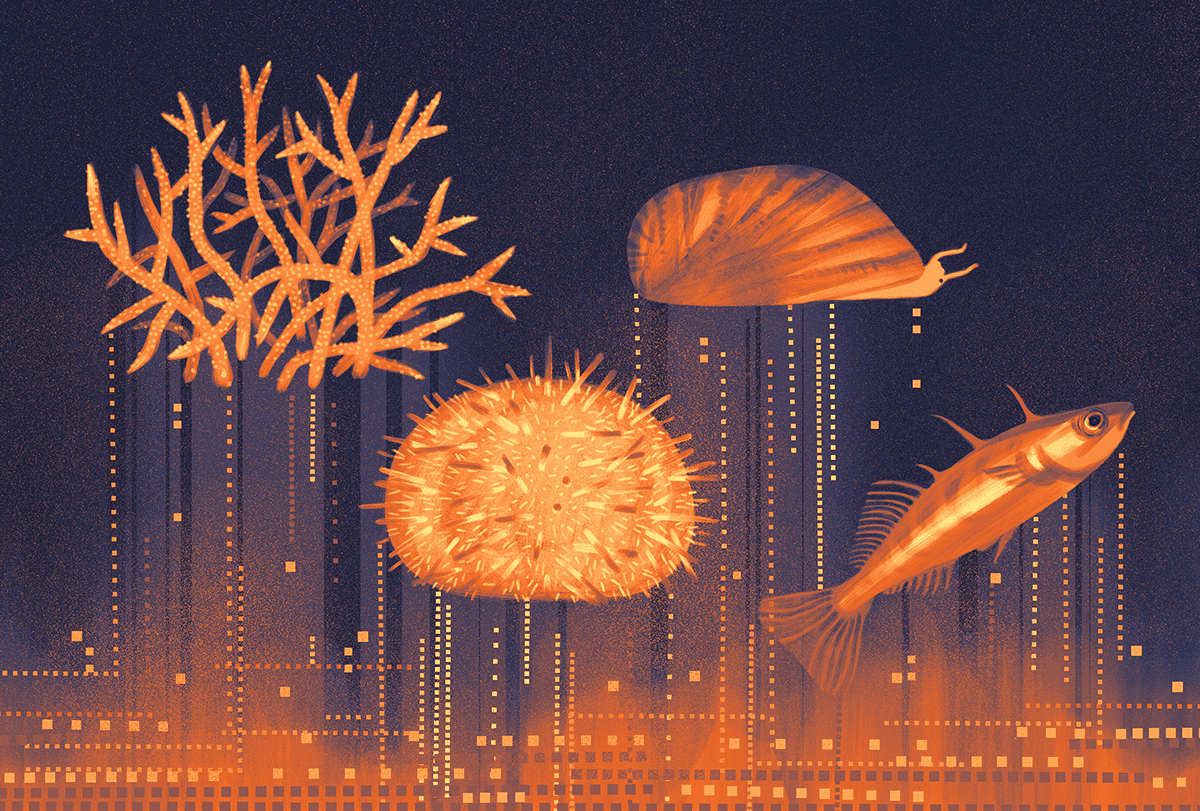
Tresguerres helms the Allen Discovery Center for Neurobiology in Changing Environments, which brings together more than 20 scientists to study the effects of temperature, pH and dissolved oxygen changes on the nervous systems of four species scattered widely across the evolutionary tree. The multidisciplinary team is investigating staghorn coral (Acropora cervicornis), slipper snails (Crepidula fornicata), painted urchins (Lytechinus pictus) and three-spined stickleback fish (Gasterosteus aculeatus) “from genes to cells to behavior to population genomics,” Tresguerres says.
“The four we picked are strategic,” he adds. Each is an ecologically significant species, yet they represent nervous systems of varying complexity. Perhaps most importantly, the application of neuroscience tools and techniques to the four species was already underway. The vision is to lay the foundation of tools and methods that other researchers can easily adapt to expand the scope of climate neuroscience.
Tresguerres anticipates that insights from one species (the slipper snail) could help narrow down hypotheses about how related species (clams and mussels) that are not part of the initiative deal with environmental change. Comparing animals with more ability (fish) and less (sea urchins) to regulate their internal environment may also yield insights, he says. So could comparisons among stickleback fish populations, which range from California to Alaska and are expected to be genetically adapted to different climate regimes.
That work thematically aligns with Rosvall’s new research. She and a group of collaborators are embarking on nesting box heat-wave experiments with about 10 species of songbirds, some thriving in a warming world and others in decline. The team thinks surveying gene expression in different cell types across the brains of multiple related species will enable them to understand how evolution builds a brain that can cope with heat. “Are their brains just unflappable?” Rosvall says of the tree swallows. Or simply better than declining species at bouncing back?
More comprehensive studies would need to be bolstered by “a shared framework,” allowing labs to compare results across species and environments, Stein says—a big effort, but it could line up genetic findings with behavior and survival, he says, which would move the field “from a set of interesting observations” to “something that is more predictive.”
Then broader revelations should come. “If we are able to say which systems will be resilient, which will fail under specific environmental conditions or behave differently,” Stein says, it becomes relevant not only for neuroscience, but also ecology and conservation.
“And that’s not something a single lab can do,” he says.